MicroMouth
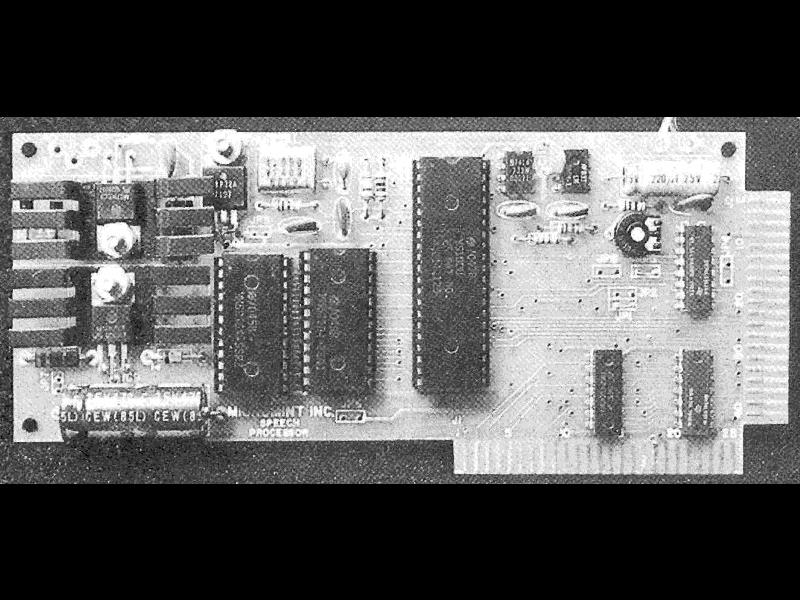
Image gallery
From the Circuit Cellar to a computer slot
Steve Ciarcia presented the MicroMouth in his June 1981 BYTE Circuit Cellar project, “Build a Low-Cost Speech-Synthesizer Interface.” Micromint offered an Apple II board as a $120 kit or a $150 assembled unit. A TRS-80 Model I package included a power supply, cable, and enclosure; a Model III version was also listed. These were contemporary prices, rather than present-day collector values.
The design extended beyond those two computers. Micromint’s sales information described parallel-port use and connections to S-100, Digital Group, and Heath H8 systems. The same basic speech hardware could therefore serve a slot-based home computer or an independently wired project.
A vocabulary in two ROMs
At its heart was National Semiconductor’s DT1050 chipset: an MM54104 speech processor with SSR1 and SSR2 vocabulary ROMs. The standard kit provided 144 selectable expressions, including words, tones, and silences. The count describes addressable entries rather than 144 unrelated dictionary words.
Digitalker decoded compressed speech data from external ROMs. Its output preserved characteristics of a recorded voice, while host software selected entries and combined them into messages. Numbers and measurement words made the vocabulary useful for status announcements and instrument readouts.
This was not a general text-to-speech system. Supplying written text did not automatically produce speech, and a word absent from the ROM vocabulary could not be requested simply by spelling it. New vocabulary required appropriately encoded speech data. The separate processor and ROM arrangement allowed different vocabulary sets to use the same speech engine.
Simple commands, careful timing
The owner’s manual shows how a BASIC OUT command, or an Apple II POKE, selected an expression by number. With the board in Apple II slot 1, POKE -16001,20 spoke “twenty.” The equivalent example for port 127 was OUT 127,20. Addresses and jumpers depended on the host connection.
The next command had to wait for the current utterance to finish. Sending it early interrupted the speech. The board supplied a busy indication for software to check; the manual explains why programs should examine the appropriate status bit rather than assume every computer returns the same complete byte.
The board included the clock, power regulation, filtering, and audio amplification needed around the speech chipset. The PDF includes assembly instructions, schematics, vocabulary codes, jumper settings, and example programs.
A portable speech demonstrator
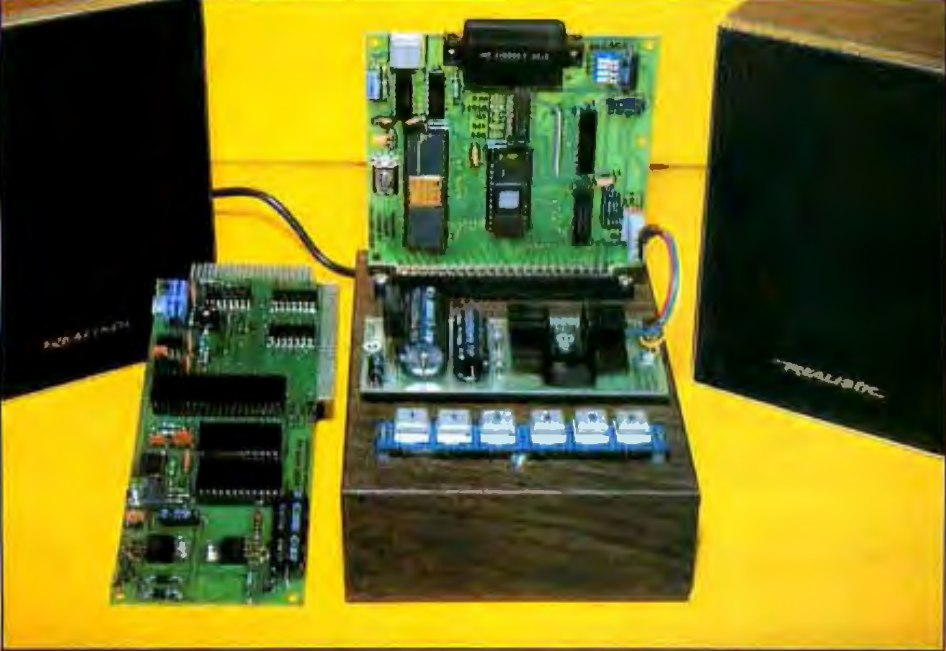
In August 1981, Ciarcia showed a Z8-based demonstrator that controlled a MicroMouth through parallel I/O. Six pushbuttons selected demonstration sequences, avoiding the need to carry a complete desktop computer to demonstrate speech.
The color photograph shows a finished MicroMouth board at the left and the Z8 controller above the demonstration enclosure. A prototype speech board was housed inside the box. The controller sent vocabulary codes and monitored the busy signal to pace its messages. This illustrates the MicroMouth’s role as a reusable speech interface rather than a self-contained talking appliance.
Beyond hobby computers
A 1984 Iowa State University research project used a MicroMouth in the “Communicaider,” a prototype communication aid combining speech output, an LCD, and a Z8-based controller. The researcher selected the board partly because it already included its clock, power circuitry, amplifier, and speech ROMs. That project also implemented switching between vocabulary sets; this was part of the research system, not a feature to assume on every stock board.
An audio-enhanced videotex patent, granted in 1986, identified the MicroMouth as a suitable speech interface for prompts and information such as log-on time. The proposal controlled it through an eight-bit parallel connection. It is an example of a documented application concept, not evidence that every described videotex terminal was manufactured with a MicroMouth.
Hear the Voice Messenger
Digitalker — numbers and alphabet
Digitalker chipset demonstration.
Specifications
- Manufacturer
- Micromint
- Designer
- Steve Ciarcia
- Documented introduction
- June 1981 BYTE Circuit Cellar project
- Speech chipset
- National Semiconductor DT1050 / MM54104
- Standard vocabulary ROMs
- SSR1 and SSR2
- Vocabulary
- 144 addressable expressions, including tones and silences
- Interfaces
- Apple II slot, TRS-80 connection, and configured parallel I/O
Documentation and downloads
- MicroMouth owner’s manual and assembly instructions (PDF)
Micromint’s 1981 manual: schematics, assembly, connections, jumpers, vocabulary, and BASIC examples.
Sources and further reading
- Micromint MicroMouth owner’s manual, 1981
- Steve Ciarcia: Build a Low-Cost Speech-Synthesizer Interface, BYTE June 1981, page 46
- Steve Ciarcia: Z8-based controller and MicroMouth demonstrator, BYTE August 1981
- National Semiconductor DT1050 datasheet
- Communication aids using voice synthesis, Iowa State University, 1984
- Audio-enhanced videotex system patent US4581484