PHILIPS DIGITAL FORMANT SPEECH SYNTHESIZER
Philips PCF8200
The Philips PCF8200 turns a stream of compact digital speech parameters into sound using a programmable formant model.
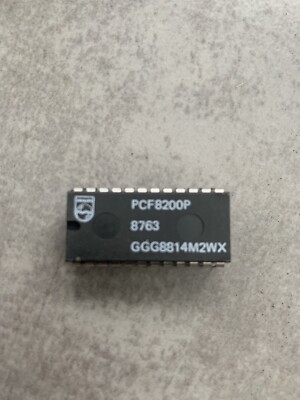
Overview
The Philips PCF8200 creates speech from a stream of compact digital parameters. The values describe how the voice should change over time: its pitch and loudness, along with the resonant frequencies and bandwidths that shape the sound. Inside the chip, an excitation signal passes through digital formant filters, which shape it into a speech waveform. The PCF8200 synthesizes from these controls instead of playing back recorded words.
The chip needs a stream of speech parameters
The PCF8200 does not receive a written sentence or a simple phoneme code and work out the speech on its own. A host system must prepare and supply the changing control values that describe the utterance as a time-ordered stream of short parameter frames. Those values can be derived by analyzing recorded speech, or generated by software rules for text-to-speech. In either case, the chip turns the incoming parameter stream into sound.
A digital model of the vocal tract
The synthesizer combines an excitation signal with a series of digital resonators. The excitation represents the sound source; the resonators model vocal-tract formants. Each formant is controlled by its frequency and bandwidth, while pitch and amplitude describe other parts of the sound. Philips specifies five formants for male speech and four for female speech, supported by selectable male and female parameter tables.
Smooth changes come from changing values
Speech parameters are updated in short frames. The PCF8200 interpolates between successive values so the sound changes smoothly instead of jumping abruptly at every update. The host still has to provide the right sequence and timing of values: the chip synthesizes the stream, while the speech software decides what sequence to send.
A compact engine for speech systems
Philips designed the PCF8200 for microprocessor-controlled equipment, with speech code held in separate memory. Its low data rate made long announcements practical with relatively little storage. Philips also offered development hardware and software for analyzing speech and preparing PCF8200 code. Later research demonstrated the chip in multilingual text-to-speech systems, where software converted written language into acoustic building units and assembled them into speech.
PCF8200 at a glance
| Feature | Specification |
|---|---|
| Synthesis method | Digital vocal-tract / formant synthesis |
| Input | Host-supplied parameter frames via I²C or parallel interface |
| Voice model | Five formants for male speech; four for female speech |
| Speech-code bit rate | 455 to 4,545 bits per second |
| Speech bandwidth | 5 kHz |
| Voice options | Male and female speech with selectable parameter tables |
| Interfaces | I²C and parallel interfaces |
| Output | Internal low-pass filter and 11-bit digital-to-analog converter |
Machines using this chip
Continue exploring
Further references
- Philips, “Voice synthesizer PCF8200,” Radio, Audio and Associated Systems handbook (development data, July 1986)
- Menno ten Have, “Speech synthesis—the complete approach with the PCF8200,” Electronic Components and Applications, vol. 7, no. 4 (1986), pp. 229–238
- Olászy, Gordos, and Németh, “Phonetic aspects of the MULTIVOX text-to-speech system” (1990)
- R. W. King, “Tools and processes for developing low-cost and high-quality text-to-speech synthesis for communication aids” (Eurospeech 1991)