AtariVox / AtariVox+
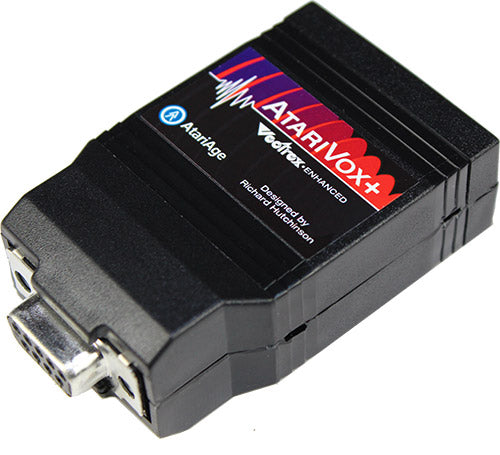
Image gallery
Find an AtariVox
Check the version and console compatibility before buying. AtariAge’s product link is also included below.
Search eBay for AtariVoxA new voice for classic consoles
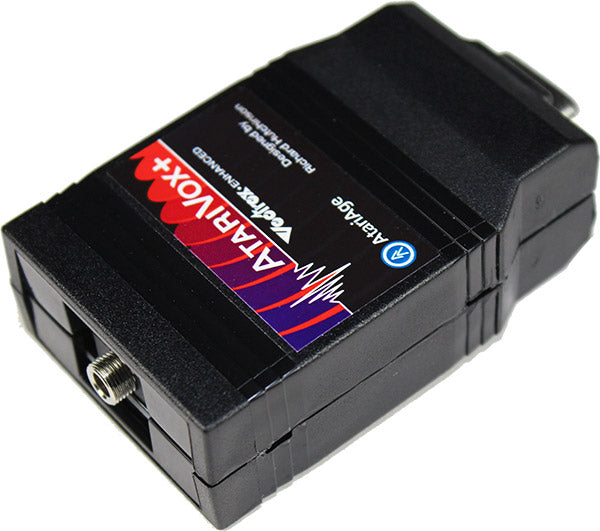
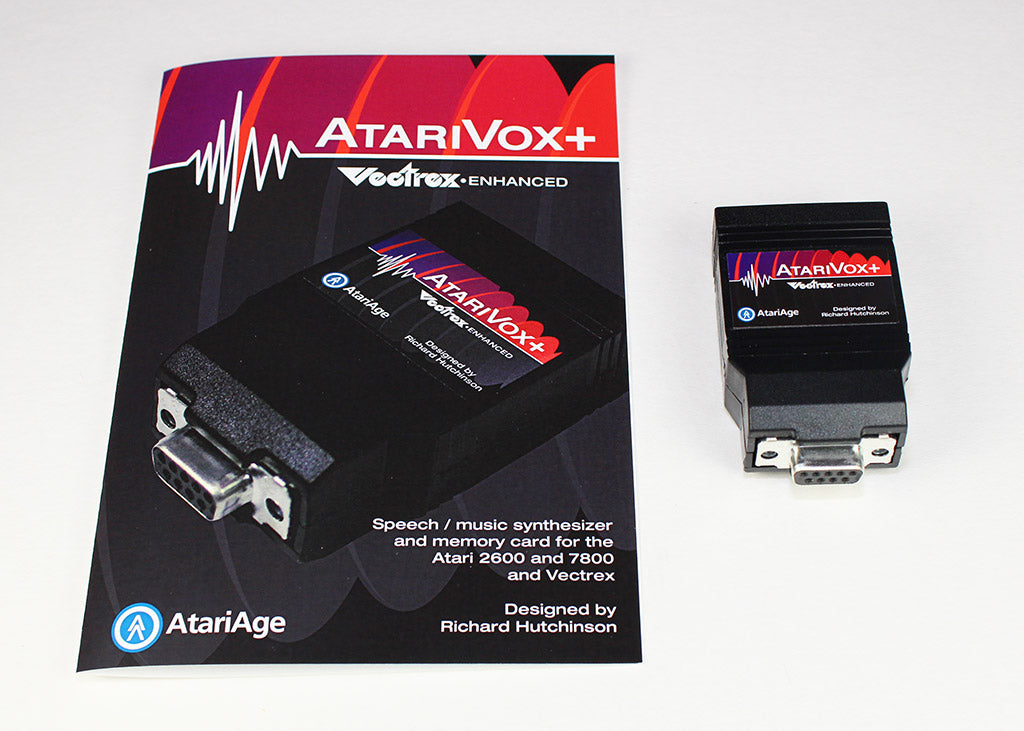
Designed by Richard Hutchinson, AtariVox combines speech, musical sound, and persistent game-save storage in a controller-port accessory. Its original manual describes a unit primarily for the Atari 2600 and 7800, with audio delivered through a separate speaker connection and an adjustable onboard amplifier.
The AtariVox+ version pictured here adds selectable AtariVox, VecVox, and VecVoice compatibility modes for supported Atari and Vectrex software. Its SpeakJet chip gives old consoles a programmable electronic voice.
SpeakJet brings the voice to life
SpeakJet generates speech and complex sounds using its five-channel synthesizer and Mathematical Sound Architecture. The manufacturer’s manual lists 72 speech elements, 43 sound effects, and 12 telephone touch tones, with controls for pitch, rate, bend, and volume. Sound is synthesized as it plays rather than assembled from recordings of complete spoken phrases.
Games send allophone and control codes to construct their dialogue. The chip’s 64-byte input buffer allows incoming commands to wait while earlier sounds play. The vocabulary is therefore chosen by the game’s programmed sound sequences; AtariVox does not automatically read arbitrary game text aloud.
Speech through the joystick port
The developer documentation describes a 19,200-baud serial speech connection through the second joystick port. Two signal lines carry speech data and readiness information, letting the game check whether more data can be accepted.
The same connector supplies power and two additional lines for the save-memory interface. This lets speech and persistent storage share a port originally intended for a controller. Software must explicitly support the accessory; attaching it does not add speech or saving to every cartridge.
A memory card as well as a synthesizer
AtariVox’s separate EEPROM provides 32 KB of nonvolatile storage, retaining saved data when the console is switched off. The programming guide identifies a Microchip 24LC256 or compatible device and describes its I²C interface. This storage is separate from the SpeakJet’s internal phrase memory.
A community allocation registry reserves save-memory space for individual games. Following those allocations helps games share one accessory without overwriting each other’s high scores, progress, or settings.
Choose the mode for the game
AtariVox+ switches select AtariVox mode for the original Atari 2600 and 7800, VecVox mode for Vectrex software, or VecVoice mode for earlier Vectrex speech compatibility. Supported titles include Juno First and Wizard of Wor Arcade on the 2600, Dungeon Stalker on the 7800, and Verzerk in VecVoice mode. Support can involve speech, saving, or both, depending on the game.
AtariAge specifies that AtariVox+ does not work with the newer Atari 2600+ or 7800+ consoles. Its enclosure also requires a suitably fitting controller extension cable for the original 7800 and Vectrex. Consult the product page and game instructions for the required mode and connection.
Specifications
- Designer
- Richard Hutchinson
- Speech chip
- SpeakJet
- Save memory
- 32 KB nonvolatile EEPROM
- Connection
- Controller port; separate audio output
- AtariVox+ modes
- AtariVox, VecVox, VecVoice
Documentation and downloads
- Original AtariVox user manual
Richard Hutchinson’s original AtariVox documentation. It predates the additional AtariVox+ Vectrex modes.
- SpeakJet user manual
Magnevation’s September 2004 chip manual, including allophones, sound effects, and control codes.
- AtariAge product page and purchasing information
AtariVox+ operating modes, current availability, supported games, and console compatibility.
- AtariVox programming guide for the Atari 7800
Serial speech interface, EEPROM access, pinout, and assembly-language examples.
- SaveKey and AtariVox memory allocation registry
Community registry used to reserve save-memory pages for individual games.
- SpeakJet user manual — Revision 1.0 (July 2004)