SPEECH CHIP COLLECTION
SpeakJet
A new source of classic robotic voices: SpeakJet brought programmable speech and sound synthesis back to builders, retro consoles, and musical experiments.
Overview
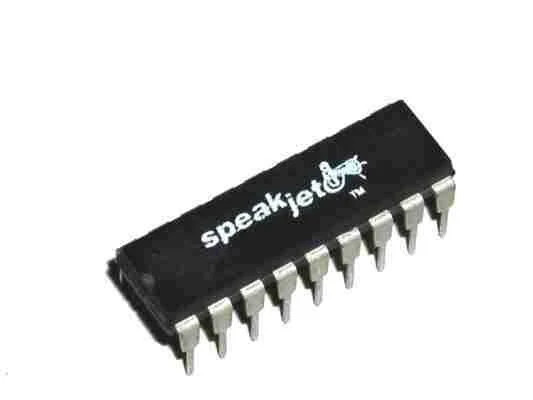
SpeakJet was produced to fill a gap left by the disappearance of classic speech-synthesis chips. Computers had become capable of generating speech in software, but that did not give a small electronics project—or a vintage game console—a convenient new speech chip. SpeakJet supplied that missing ingredient: a dedicated source of the distinctive electronic voices that builders still wanted to hear.
Image gallery
Find SpeakJet hardware for your collection
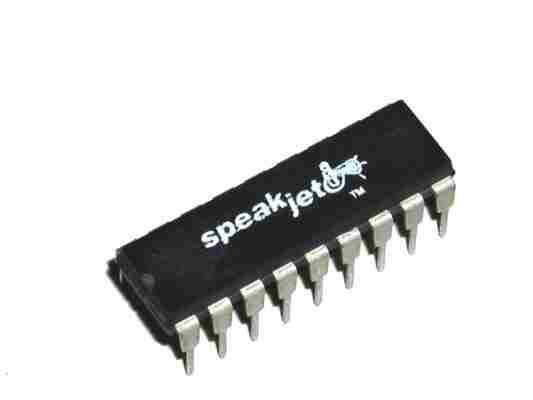
Search for SpeakJet chips, development hardware, and related documentation. Check whether a listing is for a chip, a board, or a complete device.
Search eBay for SpeakJetWhy SpeakJet was made
Scott Savage, who produced SpeakJet and continues to produce it today, describes the chip’s purpose as providing a new source of speech hardware after the classic parts had gone out of production. As desktop computers took over speech generation in software, the familiar standalone chips became increasingly difficult to obtain. Enthusiasts could still build around surviving components, but new designs needed a dependable alternative. SpeakJet was intended to fill that void. Its story connects the speech chips of the early personal-computer era with people building new hardware decades later.
Synthesized speech, calculated as it plays
Magnevation’s Mathematical Sound Architecture (MSA) calculates allophone sounds and transitions through a five-channel synthesizer. It uses no recorded speech samples. Pitch, rate, bend, and volume shape the result; SCP also exposes oscillator registers directly. Five sound oscillators are accompanied by a sixth oscillator for envelopes. The manual credits Savage Innovations with developing SCP.
A vocabulary beyond human speech
SpeakJet’s sound vocabulary extends beyond the allophones used to form human words. Its expanded set includes robot vocal sounds, biological creature sounds, electronic beeps, and alarms. These sounds can be sequenced with speech and shaped with the chip’s pitch, rate, bend, and volume controls, giving a designer building blocks for a robot’s personality, a creature’s call, or a science-fiction warning. The recordings below demonstrate its beeps, biological sounds, and red-alert alarm.
Working with phrases in Phrase-A-Lator
Magnevation’s Phrase-A-Lator software made the sound-building process visible. Its phrase editor lets users audition speech elements, assemble a sequence, alter delivery controls, and inspect the actual codes sent to the chip. That last feature is particularly useful when transferring a tested phrase into a microcontroller program. The software’s dictionary can supply phonetic spellings for matching words; it can also be edited. This is a dictionary in the development software, not evidence that the bare chip reads arbitrary English text. Crafting a phrase therefore remains a listening exercise: choose sounds, hear the result, adjust, and listen again.
Speech without a host computer
The Phrase-A-Lator guide shows an EEPROM editor with 16 phrase cells and a separate event-configuration screen. A builder can assign stored sequences to changes on the input lines, rather than keeping a computer attached to supply every sound. The guide also demonstrates using a wait state and an event to coordinate multiple chips. In practical terms, the same voice hardware can serve a computer-driven experiment or a device that responds to a button, switch, or other event.
The serial and audio connections
The serial input accepts non-inverted logic-level data, not RS-232 voltages. The default is 9600 baud, 8N1. A 64-byte buffer queues sound commands; SCP commands act immediately. VOut carries 32 kHz PWM audio, requiring low-pass filtering before amplification. Consult the manual’s connection diagram and pin definitions when building an interface.
AtariVox: new voices for classic consoles
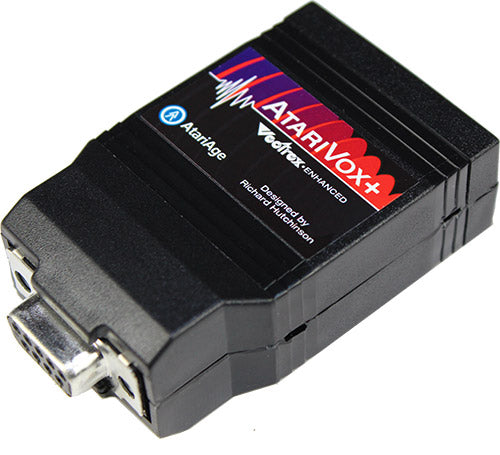
AtariVox took advantage of this newly available source of robotic speech. AtariAge describes SpeakJet as the heart of AtariVox+, controlled by the console through a software-generated serial interface. The voice’s retro character makes it a fitting addition to games for the Atari 2600 and 7800, with Vectrex support through the appropriate modes. AtariVox+ also contains separate save memory; that memory belongs to the accessory, not to SpeakJet itself. A compatible game must supply the speech commands. The accessory is not a universal converter that makes every original cartridge talk.
A musical life beyond spoken words
SpeakJet also became a musical sound source. The MIDIbox community built a controllable synthesizer around it, with demonstrations combining speech elements and direct oscillator control. Thorsten Klose’s IIC interface module used a PIC16F88 to bridge the MIDIbox hardware and SpeakJet’s serial connection. This distinction matters: IIC was a feature of the interface module, not the chip’s native speech input. The project illustrates how a voice chip can become an instrument when another controller maps musical gestures to its sound engine.
Two chips inside the FLAME MIDI TALKING SYNTH
FLAME’s MIDI TALKING SYNTH used two independently controlled SpeakJet chips for richer combinations and a stereo arrangement. Its manual emphasizes robot voices, beeps, alarms, noise, and retro science-fiction sounds as musical material. Joystick movements could be recorded and replayed, and the instrument added MIDI-synchronized tremolo to shape the audio. This was an application designed around the chip’s particular behavior, rather than treating it as a conventional synthesizer with ordinary note-on and note-off handling.
Its place in the speech-chip collection
SpeakJet continues the idea that speech can be an electronic component a builder programs and hears. It belongs alongside SC-01 / SC-01A, SC-02 / SSI-263 / 78A263, and SP0256-AL2 as another way to give a machine a voice. Filling the supply gap did not make it a socket-compatible substitute for those parts. Its own interface and sound engine gave designers a fresh starting point—and gave vintage machines a path to new robotic speech.
SpeakJet at a glance — manual Revision 1.1
| Feature | Specification |
|---|---|
| Supply | 2.0–5.5 V |
| Speech elements | 72 allophones |
| Other sounds | 43 effects; 12 DTMF tones |
| Phrase storage | 256-byte EEPROM, shared with configuration |
| Inputs / outputs | 8 event inputs; 3 programmable outputs |
| Direct sound control | SCP register access |
SpeakJet — Blast off
SpeakJet demonstration.
Electronic beeps
A demonstration of SpeakJet’s electronic beeps.
Biological creature sounds
A demonstration of SpeakJet’s biological creature sounds.
Red alert
An alarm demonstration using SpeakJet’s sound effects.
Documentation and downloads
Machines using this chip
AtariVox uses SpeakJet for speech and sound; its separate save-memory hardware is described on the device page.
AtariAge
AtariVox / AtariVox+
Richard Hutchinson’s SpeakJet-based accessory adds programmable speech and persistent game saves to supported classic-console games.
Explore AtariVox / AtariVox+Continue exploring
Further references
- Scott Savage: firsthand account of SpeakJet’s purpose and continuing production
- Magnevation: SpeakJet user manual, Revision 1.1
- Magnevation: Phrase-A-Lator user guide, Version 1.4
- AtariAge: AtariVox+ description and operating modes
- MIDIbox: SpeakJet project history and musical applications
- Thorsten Klose: MBHP IIC SpeakJet module and interface firmware
- FLAME: MIDI TALKING SYNTH user manual