ECHO GP
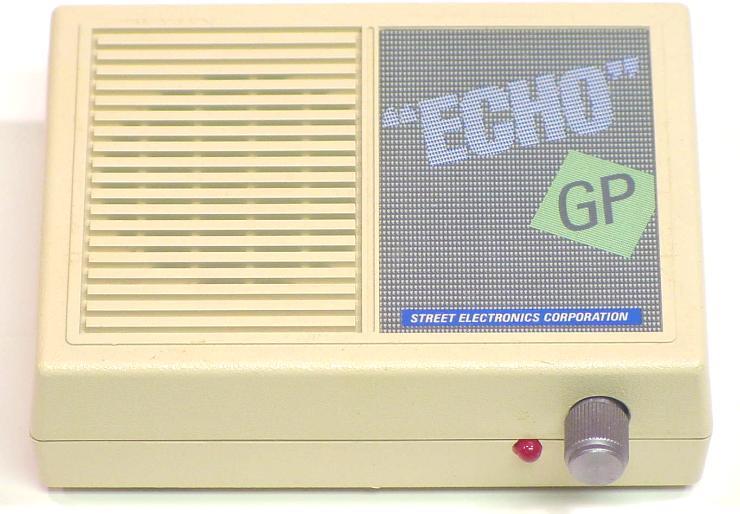
Image gallery

Find an ECHO GP for your collection
Search for the external synthesizer and its documentation. Check the power supply, serial cable, and operating condition before buying.
Search eBay for ECHO GPA voice that could move between computers
Street Electronics’ ECHO GP—the General Purpose model—was a compact external speech synthesizer connected through a serial port. It turned ordinary written English into an electronic voice, allowing programs to speak new messages without selecting them from a fixed word list.
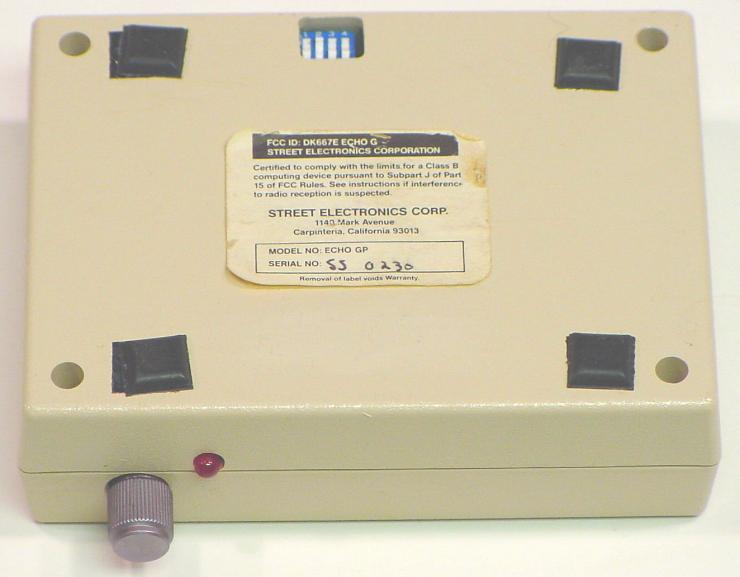
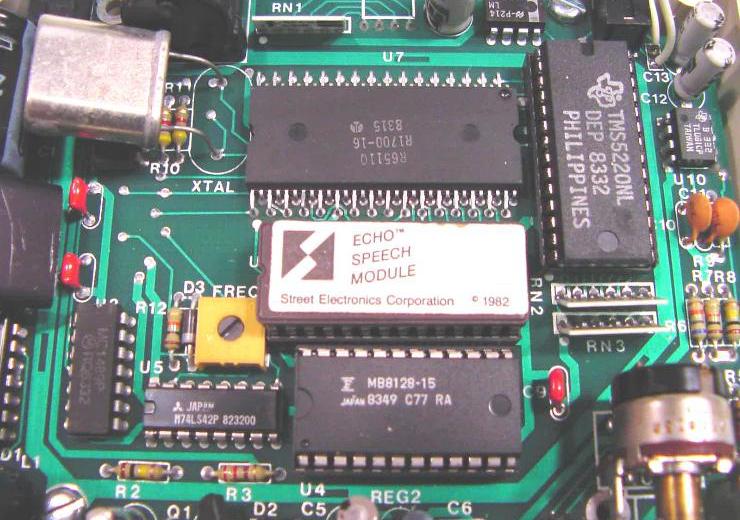
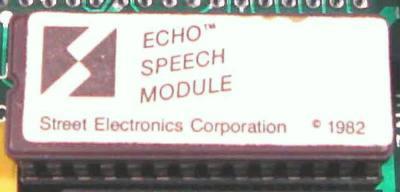
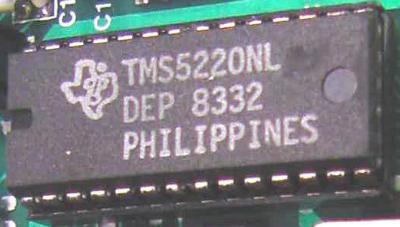
Its built-in loudspeaker and front volume control made it a desktop companion to the computer. Inside the photographed unit, a Texas Instruments TMS5220NL speech processor works alongside a Rockwell R6511Q microprocessor and a firmware device labeled ECHO Speech Module, copyright 1982.
From English spelling to LPC speech
Street’s product portfolio describes a conversion system with more than 400 pronunciation rules. Text becomes phonemes, then the LPC parameters required by the speech chip. The TMS5220 models the vocal tract digitally; it does not itself understand English spelling.
The GP carried its text-to-speech firmware onboard, leaving the host free to do other work. Street specified a buffer of more than 1,700 characters to absorb incoming text. Owners could also specify phonemes directly, giving troublesome names and unusual words their own pronunciation.
Giving the voice expression
Software commands adjusted speaking rate, pitch, loudness, and punctuation handling. Street advertised 63 pitch settings and 15 software volume levels. Letter-by-letter spelling provided another way to understand a word that sounded unclear.
Ken Harms’ contemporary Atari review describes automatic inflection: a question mark raised the final syllable’s pitch, while a period lowered it. He also noted modes that spoke progressively more punctuation, extending to spaces and carriage returns. These controls made the unit useful for reading computer output as well as entertaining listeners.
Speaking through a serial port
For Atari 400 and 800 owners, Harms demonstrated the ECHO GP through an Atari 850 interface. His example selected 300 baud, initialized serial port 1 or 2 with BASIC OPEN and XIO commands, and sent speech using PRINT # statements.
His own application displayed a four-color chart and explained it aloud, keeping explanatory text off the screen. He suggested spelling exercises, talking games, and communication aids. During an informal listening comparison at a Lawrence Livermore Laboratory science fair, visitors generally preferred the ECHO’s clarity, especially words starting with hard consonants. This was a reviewer’s listening experiment rather than a standardized speech test.
Apple II Plus and IIe users could connect through a Super Serial Card. Raised Dot Computing also documented Apple IIc operation with the appropriate cable. The external serial connection made the GP useful beyond a single computer’s expansion-card architecture.
A place in accessible computing
The ECHO GP was a speech output device; it did not independently inspect a computer’s screen. Screen review required host software to select text and send it to the synthesizer. In 1988, Raised Dot Computing listed the external GP among the synthesizers supported by Flipper, MS-DOS screen-access software developed by Omnichron.
This distinction matters: a program could easily send a message to be spoken, while navigating an existing application required screen-access software. Flipper provided tools to examine screen text, supporting practical daily computer use rather than only demonstrations.
Keeping an affordable voice available
In October 1984, Raised Dot Computing reported that Street Electronics had stopped retail sales of the GP because sales had disappointed. Raised Dot Computing and Associated Services for the Blind arranged a joint purchase to keep the units available, and the first shipment had arrived. Raised Dot offered them for $225 each.
That report records a change in distribution, rather than proving a final manufacturing date. It also captures an important part of the ECHO GP’s story: accessibility organizations helped sustain useful hardware when the general retail market had not supported it.
Specifications
- Manufacturer
- Street Electronics Corporation
- Model
- ECHO GP (General Purpose)
- Connection
- Serial interface; host-specific cable required
- Speech processor
- TMS5220NL (photographed unit)
- Control processor
- Rockwell R6511Q (photographed unit)
- Speech method
- LPC with onboard text-to-speech conversion
- Buffer
- More than 1,700 characters, per manufacturer portfolio
- Voice controls
- Regular/fast speech; pitch, volume, and punctuation modes
- Audio
- Built-in speaker and volume control
- Historical price
- Raised Dot Computing: $225 in October 1984