LINEAR PREDICTIVE CODING · TEXAS INSTRUMENTS
Texas Instruments TMS5220 Family
Compare TI’s classic LPC voices—from the Speak & Spell generation to the TMS5220 and TMS5220C used in talking computers and arcade machines.
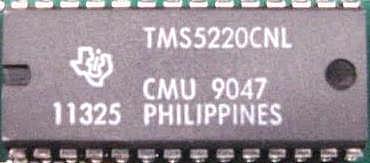
Overview
From the Speak & Spell to talking computers and arcade adventures, Texas Instruments turned compact speech data into some of the most recognizable electronic voices of the era. This family exhibit takes the TMS5220 as its centerpiece and compares the earlier TMS5100, TMS5110, and TMS5200 with the later TMS5220C. The TMS6100 is their companion speech memory, not another synthesizer.
Image gallery
Find a TI speech processor
Explore current listings for the TMS5220 and its later revisions.
Search eBayAn electronic model of the voice
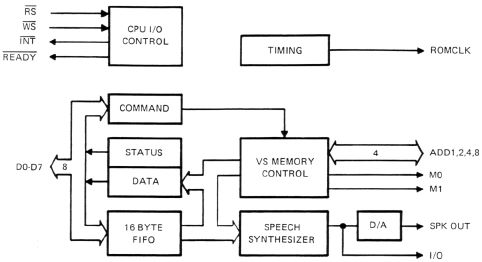
Linear Predictive Coding (LPC) represents speech through changing vocal-tract parameters instead of storing every waveform sample. Energy, pitch, and filter coefficients describe successive speech frames. A pulse-like excitation produces voiced sounds; noise produces unvoiced sounds. A tenth-order lattice filter shapes that excitation into speech, and interpolation smooths the changes between frames. An output converter supplies the reconstructed audio. The economical data format made longer messages practical in expensive early memories.
Two ways to feed the TMS5220
A SPEAK command reads encoded speech through the dedicated serial speech-memory interface. SPEAK EXTERNAL instead accepts bytes from the host through an eight-bit bus and a 16-byte FIFO buffer. Software must keep that buffer supplied, using status and interrupt signals. Consequently, a TMS5220 system can use speech stored in host ROM, RAM, or files; a dedicated TMS6100 is an option rather than a requirement.
Where the words live
The TMS5220 has no built-in dictionary or text-to-speech parser. Its memory supplies LPC speech data, typically analyzed from a speaker’s recorded voice. Custom vocabulary belongs to that data, not to the processor’s part number. TI also offered application vocabularies for industrial, weather, military, aviation, and clock uses. A TMS6100 contains mask-programmed speech data and uses a specialized serial interface; an ordinary parallel EPROM cannot simply replace it on those pins.
From TMS5100 to TMS5220C
The early TMS5100 helped give the Speak & Spell its voice. TMS5110 and TMS5110A continue the serial-control branch. The TMS5200 introduces the parallel host interface and is associated with the TI-99 speech module and Bally Squawk & Talk boards. TMS5220 revises the synthesis tables; TMS5220C, also marked TSP5220C, adds programmable frame-rate features. These are related processors, but shared ancestry does not make their control interfaces, speech encodings, or electrical requirements interchangeable.
A voice that followed you into the arcade
TMS5220 appears in Atari’s Star Wars, Firefox, and Return of the Jedi. The later TMS5220C powers voices in Gauntlet, Gauntlet II, Paperboy, and 720°. Computer speech boards also crossed generations, making the chip marking and board revision important when identifying an ECHO system. The related machine cards below connect this family to exhibits in the museum.
The same bytes can sound different
LPC parameters are stored as compact codes that index tables inside the synthesizer. Different revisions can interpret those codes differently, affecting pitch, energy, or filter response. Speech data should therefore be matched to the target chip. A common package or similar command set is not a guarantee that an older vocabulary will sound correct on a newer processor.
Compare the family
| Part | Interface and role | What distinguishes it |
|---|---|---|
| TMS5100 | Four-bit control interface; serial speech data | Early Speak & Spell generation |
| TMS5110 / TMS5110A | Serial-control speech processor | Revised early LPC branch; check the suffix and tables |
| TMS5200 | Eight-bit host bus, FIFO, and speech-memory interface | TI-99 module and Bally Squawk & Talk generation |
| TMS5220 | Eight-bit host bus, FIFO, and speech-memory interface | Centerpiece of this exhibit; updated synthesis tables |
| TMS5220C / TSP5220C | Later TMS5220-style interface | Programmable frame rates and revised control behavior |
| TMS6100 | Dedicated serial speech memory | Stores vocabulary; does not generate audio |
Hear Parsec — TI-99 speech module
A TMS5200-family application: the speech module supplies the voice in TI’s Parsec.
More Parsec speech
Another sample from the TI-99 speech module.
Individual processors and companion chips
TMS5100 · TMS5110 / TMS5110A · TMS5200 · TMS5220 · TMS5220C · TMS6100
Documentation and downloads
Machines using the TI LPC family
The family spans several generations. Open each machine to see its processor and board details.
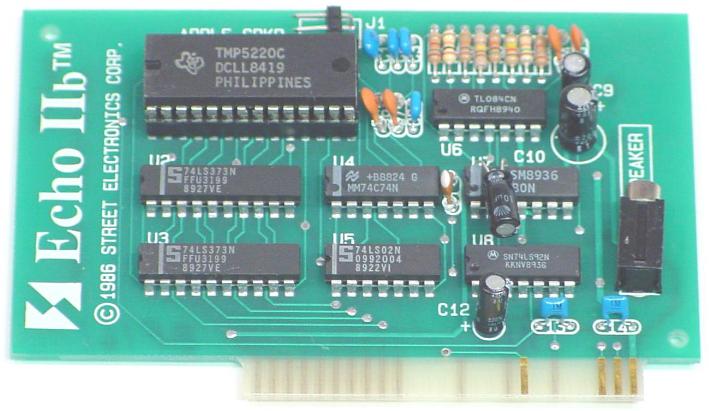
Street Electronics
ECHO IIb
Street Electronics’ Apple II speech card paired LPC synthesis with TEXTALKER and screen review for accessible computing.
Explore ECHO IIb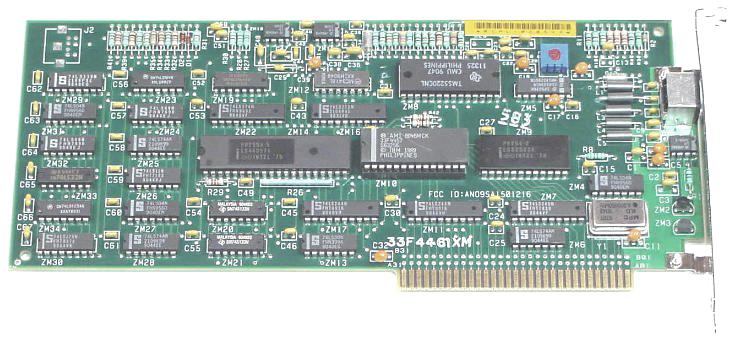
IBM PS/2 Speech Adapter
IBM’s ISA speech adapter combined TMS5220C LPC synthesis with CVSD voice recording and playback.
Explore IBM PS/2 Speech Adapter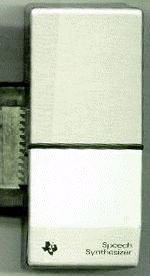
Texas Instruments
TI Solid State Speech Synthesizer
TI’s PHP1500 sidecar added LPC speech to the TI-99/4 and TI-99/4A, with resident vocabulary and cartridge-driven speech programming.
Explore TI Solid State Speech Synthesizer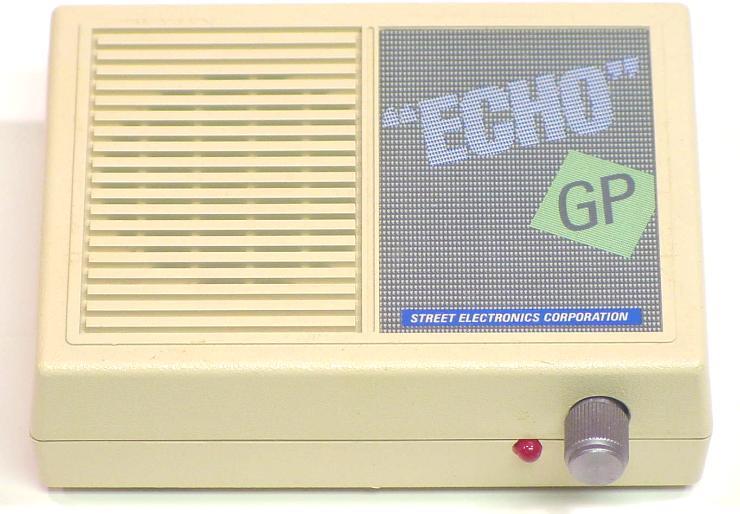
Street Electronics
ECHO GP
Street Electronics’ serial text-to-speech box paired a TMS5220 with onboard firmware, expressive voice controls, and a role in accessible computing.
Explore ECHO GP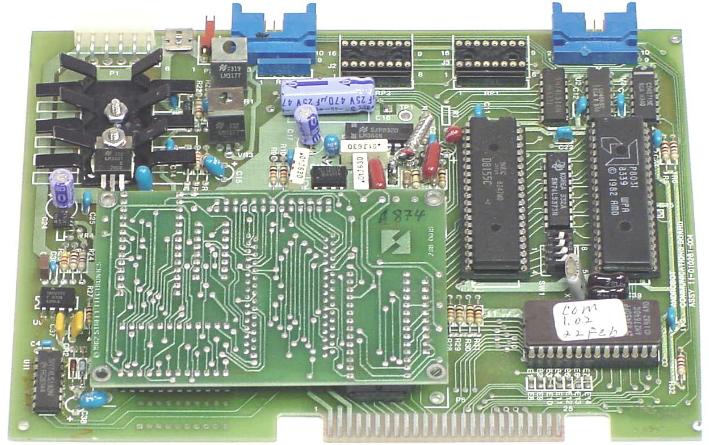
Androbot
Topo Communications Card
An ECHO speech module and TMS5220 gave Androbot’s infrared-controlled TOPO a programmable electronic voice.
Explore Topo Communications Card