ECHO IIb
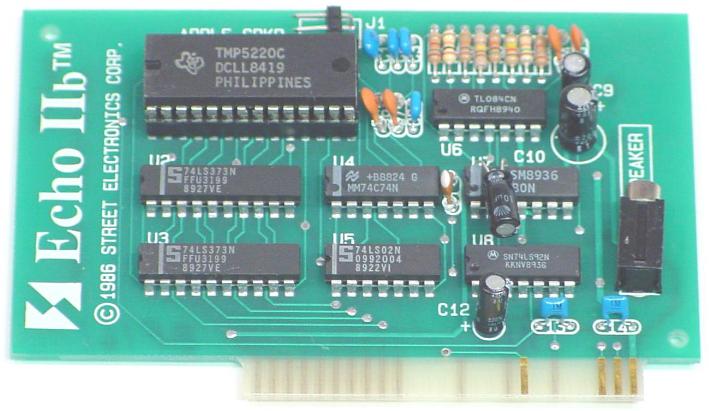
Image gallery
Find an ECHO IIb for your collection
Look for ECHO IIb cards and related software on eBay. Check the model and board photographs when comparing listings for other ECHO products.
Search eBay for ECHO IIbAn Apple II voice built for everyday use
Street Electronics’ ECHO IIb was an internal speech-synthesizer card for the Apple II family. It belonged to a line of products that made an Apple useful through spoken output, from educational applications to reading and editing text without relying on the screen.
The board photographed here carries a ©1986 Street Electronics marking. A December 1986 Raised Dot Computing newsletter already mentioned IIb-compatible software, and its February 1987 issue reported the card shipping at a list price of $130. Those contemporary references establish its period without assigning an unsupported exact launch date.
The speech circuit on the board
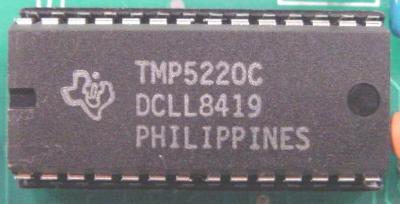
The close-up shows a Texas Instruments chip marked TMP5220C, catalogued here with the TMS5220C family. The photographs preserve the actual package marking as well as the identity of the complete card.
The TMS5220 family uses linear predictive coding, or LPC. Instead of storing an entire sound waveform, speech data describes changing pitch, energy, and filter characteristics. The synthesizer reconstructs the sound from those compact parameters. Its host interface can accept encoded speech data from the computer, so a speech application need not be restricted to a vocabulary permanently installed in a dedicated speech ROM.
That distinction helps explain how an LPC card could also offer text-to-speech. Pronunciation software ran on the Apple; the dedicated speech circuit turned the resulting speech data into sound. The chip itself did not read English spelling.
TEXTALKER turned ordinary output into speech
TEXTALKER intercepted normal text output under DOS 3.3 or ProDOS. After it was loaded, a BASIC PRINT statement could speak as well as display text. Users could choose speech, screen output, or both, and adjust pronunciation through software phoneme codes.
The manufacturer’s manual distinguished unrestricted text-to-speech with a robotic male voice from supplied higher-quality female speech with a limited vocabulary. Memory requirements differed between the two.
An audio cursor for the screen
The software’s accessibility features were central to its usefulness. Line review let a listener revisit text already on the screen, rather than hearing only whatever the program happened to print next.
Marshall Pierce’s December 1986 account described a significant improvement: pressing a key could interrupt speech and pass the same key to the application. A familiar menu could therefore be used immediately, without waiting for every option to finish speaking.
The updated review mode spoke the selected line directly, supported up-and-down navigation, and could examine up to nine defined screen columns. Column review was particularly useful for information such as a disk catalog. The newsletter credited Larry Skutchan of the American Printing House for the Blind with the TEXTALKER changes and identified version 3.1.2 as compatible with the IIb and Apple IIgs.
These features made the voice an interface for reading, navigation, and editing. The important advance was not merely that a computer could speak, but that its user could decide what to hear and move on quickly.
A speaker designed around the listener
The February 1987 review described a tilted external speaker with volume control and a headphone jack. An included jumper could route the Apple’s other sounds through it too.
The reviewed package included a talking text-file reader and a spoken-sentence builder. Its manual was available as ProDOS text files as well as print. Software and documentation were part of the product’s accessibility, alongside the card itself.
Where the IIb fits in the ECHO family
The IIb followed the ECHO II and ECHO+ in Street Electronics’ Apple line. It omitted the dedicated music and sound-effects capabilities of the ECHO+ and Cricket, concentrating on speech.
The ECHO IIc was a separate external product for the slotless Apple IIc family. The IIb shown here fitted an internal expansion slot. A shared ECHO manual covers multiple models, so its music chapters and IIc installation instructions should not be read as IIb features.
Hardware, software, and a suitable slot
The IIb needed a free compatible expansion slot and its speech software. The shared manual excludes slot 3 on the IIe and IIgs. Surviving cards should be identified by their board and chip markings, and paired with software appropriate to the computer and operating system.
For collectors, the two gallery photographs document both the complete IIb board and its speech processor. For the people who used it, the surrounding software could make a much larger difference: an Apple that could read its own output offered another route into computing.
Specifications
- Manufacturer
- Street Electronics Corporation
- Model
- ECHO IIb
- Period
- Documented in late 1986 and early 1987
- Hardware
- Internal Apple II expansion card
- Speech technology
- Linear predictive coding (LPC)
- Software
- TEXTALKER; DOS 3.3 and ProDOS
- Basic compatibility
- Apple II Plus with 64 KB, Apple IIe, Apple IIgs
- Female speech requirements
- 128 KB Apple IIe or Apple IIgs
- Output
- External speaker; headphone jack described in 1987 review
- Historical list price
- $130, reported February 1987