FLAME MIDI TALKING SYNTH
Watch it in action
FLAME MIDI TALKING SYNTH demonstration
Watch the FLAME MIDI TALKING SYNTH demonstration, starting at 0:22.
Watch on YouTube ↗Find a FLAME MIDI TALKING SYNTH
Search for the FLAME MIDI TALKING SYNTH and check each listing for the complete instrument, included accessories, and operating condition.
Search eBay for FLAME MIDI TALKING SYNTHShopping through this link helps preserve and grow the SpeechChips Museum. If you make a purchase, we may earn a commission that supports the collection.Two SpeakJets, two audio channels
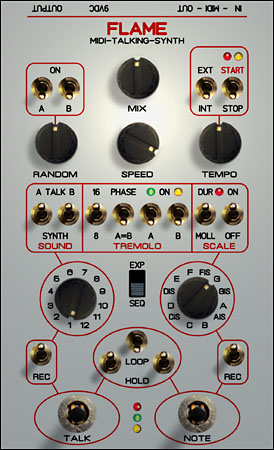
The FLAME MIDI TALKING SYNTH contains two independently controlled SpeakJet chips. Each chip supplies a mono 32 kHz PWM audio signal: chip A goes to the right channel and chip B to the left channel of the stereo output. The MIX control adjusts their relative levels, and a stereo insert cable can split the channels for separate placement in an external mixer.
FLAME designed the instrument around the SpeakJet’s own speech and sound engine. Its allophones can be tuned and used tonally, alongside sound effects, beeps, alarms, noise, and robot-like voices. The result is a playable palette of speech-derived and retro electronic sounds rather than a conventional sample-based synthesizer.
Joysticks, sound banks, and sequences
In sequencer mode, the TALK joystick triggers sounds. Its vertical movement changes pitch across a range of three octaves, while horizontal movement changes the sound’s formants. The HOLD switch freezes a joystick position, and REC captures and repeats joystick movement over two measures, synchronized to the internal or external MIDI tempo.
The manual describes 64 playable sounds arranged in lists, with 12 sound banks for selecting different collections. Sounds can be triggered individually or arranged into short repeating sequences. A MIDI clock controls the sequencer and its tremolo timing.
MIDI control and the Note Off workaround
The instrument has two operating modes. SEQUENCER mode is centered on joystick performance and recorded movements. In EXPANDER mode, external MIDI notes trigger preset words and sounds, making the unit usable from a keyboard or sequencer.
A SpeakJet sound cannot be stopped directly by a MIDI Note Off message once it has started. FLAME’s manual explains that the instrument uses MIDI-controlled audio tremolo to interrupt the output and fit the sound into a MIDI performance. This is an external shaping feature of the instrument, not a change to the SpeakJet chip itself.
Specifications
- Speech and sound chips
- Two independently controlled Magnevation SpeakJet chips
- Audio outputs
- Dual mono 32 kHz PWM audio on left and right channels of a 6.3 mm stereo socket
- Performance controls
- Two joysticks, HOLD and REC switches, sound selection, pitch, formant, MIX, and tremolo controls
- Modes
- SEQUENCER and EXPANDER
- MIDI functions
- MIDI note triggering in EXPANDER mode; internal or external MIDI clock for the sequencer
Sources and further reading
Speech hardware
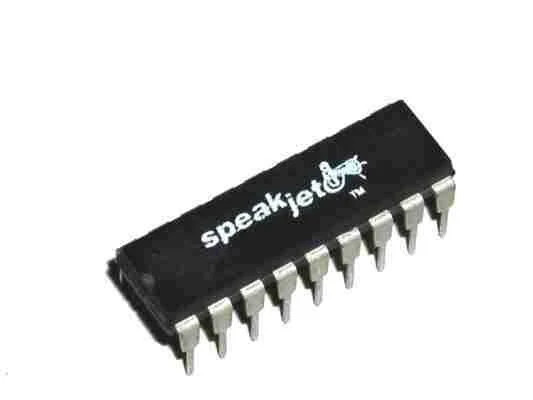
SpeakJet
A new source of classic robotic voices: SpeakJet brought programmable speech and sound synthesis back to builders, retro consoles, and musical experiments.
Hear the SpeakJet →