Intellivoice
Explore the SP0256 family, gallery, and samples →
Image gallery
Find an Intellivoice for your collection
Explore eBay listings for Mattel Intellivoice modules and related material.
Search eBay for IntellivoiceGiving Intellivision a voice
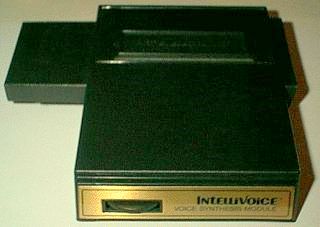
Released in 1982, Mattel’s Intellivoice Voice Synthesis Module brought spoken dialogue to the Intellivision. It sits between the console’s cartridge connector and a game cartridge. Compatible software uses speech for warnings, instructions, and character voices, while ordinary cartridges gain no speech merely by passing through it.
SP0256-012: a custom internal vocabulary
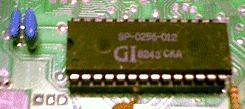
The speech processor is the General Instrument SP0256-012. Like the SP0256-AL2, it contains both a speech engine and a factory-programmed internal ROM, but the ROM contents differ. The 012 pattern is Mattel’s resident vocabulary, often called RESROM, rather than the AL2 set of isolated allophones. Its number words and common game phrases provide reusable building blocks. The familiar “Mattel Electronics Presents” announcement is one example. Its 16-kilobit capacity is 2 KB; it is not a 16 KB recording store.
This is a custom speech program, not a separate synthesis technology. The suffix identifies the built-in contents. Substituting an AL2 chip would supply different sounds for selections that the games expect to be Mattel phrases. The internal mask ROM is fixed at manufacture, and the module does not translate arbitrary written text into speech.
How the chip reconstructs speech
The SP0256 models the changing acoustics of a vocal tract. Compact speech instructions describe excitation, pitch, amplitude, timing, and digital-filter settings instead of storing every waveform sample. Voiced sounds begin with repeating excitation pulses; unvoiced sounds use noise. A 12-pole filter shapes that source into recognizable speech, and the sequencer changes the parameters as an utterance progresses.
This LPC-based approach makes speech economical enough for small ROMs, but the quality depends on the encoded data. A recorded actor supplies the source performance; analysis and editing turn it into a program that the chip can reconstruct. The processor is therefore synthesizing a voice from acoustic parameters, rather than playing an ordinary PCM sound file.
Two paths into the same speech engine
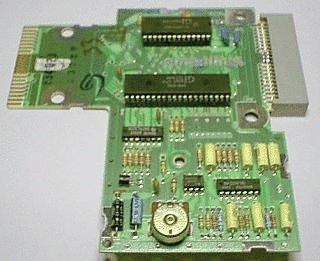
Intellivoice has two speech-data paths. A game can select an utterance in the SP0256-012’s internal ROM, or send its own encoded speech through the SPB640 buffer/interface chip. That buffer connects the console cartridge bus to the speech processor and contains a 640-bit FIFO—80 bytes of temporary storage—which delivers cartridge data serially.
The FIFO is a queue, not a vocabulary ROM. It lets the console supply additional speech as the synthesizer consumes it. Thus a cartridge can introduce voices and phrases absent from RESROM without carrying a dedicated SPR serial speech ROM. The resident vocabulary and cartridge speech share one synthesis engine; they are not independent voices that can speak over one another.
From digital pulses to television sound
The SP0256 output is a pulse-width-modulated signal, not a conventional analog audio waveform. Intellivoice filters and amplifies it before feeding it into the console’s television audio path. Its volume control adjusts speech independently of the normal game sounds. The module includes LM324 and LM358 operational-amplifier circuitry for this analog stage.
Speech therefore emerges from the television alongside the game’s existing audio. There is no loudspeaker hidden in the module. Its cartridge pass-through connection and voice-volume control make it a self-contained console accessory rather than a general-purpose computer speech interface.
Making the voices fit
Patrick Jost, responsible for much of the speech analysis and editing, described a process that began with scripts, phonetic transcriptions, and auditions. Sibilant voices and popping consonants could be troublesome. Recordings were processed on an HP 1000 minicomputer using ILS and custom software.
Automatic analysis could produce poor results or consume too much memory. Jost edited waveform segments manually and repeated the analysis to improve intelligibility and reduce storage. He worked extensively on Space Spartans and B-17 Bomber and trained editors for Bomb Squad. An actor’s performance was only the start: the final voice required careful engineering and listening.
Space Spartans: a talking battle computer
Space Spartans made speech part of monitoring a spacecraft under attack. Keri Tombazian supplied its female computer voice. The development team had to cut dialogue to fit the cartridge and accepted more mechanical male voices while preserving greater clarity for the computer. Its synthetic sound suited the science-fiction setting, even though memory pressure helped shape that sound.
Bomb Squad: voices that matter to play
Bomb Squad uses spoken guidance during a timed bomb-disposal puzzle. Phil Proctor voiced Frank, while Peter Bergman voiced Boris; both were members of The Firesign Theatre. The speech communicates information the player needs, so losing the spoken instructions seriously compromises the experience. Here the voice module does more than announce a title—it becomes part of the game’s interface.
B-17 Bomber: a crew in the cockpit
B-17 Bomber combines a bombing mission with crew voices and radio-style warnings. Phil Proctor played the pilot and Phil Austin the bombardier. Their contrasting performances help give the crew character despite the constrained speech hardware. The project grew out of an earlier air-traffic-control concept and became a combat flight game as its designers developed the scenario.
TRON Solar Sailer and the wider library
TRON Solar Sailer, released in 1983, uses several character voices and spoken information in a game based on Disney’s film. Its credits include Cory Burton as Tron and Brian Cummings as the Master Control Program. The development team had to optimize the game to fit its ROM budget.
These four cartridges form the dedicated Mattel Intellivoice series. World Series Major League Baseball also supports speech, but belongs to the Entertainment Computer System library and requires the ECS hardware. It is worth distinguishing this additional use from a fifth cartridge in the original dedicated voice series.
An ambitious accessory with a short commercial life
Ron Carlson led the hardware work, Ron Surratt the software, and Patrick Jost the voice-data effort. Early speech sessions took place at General Instrument’s New York voice laboratory; Mattel later established its own facility in Hawthorne.
Mattel also explored multilingual resident vocabularies and a restyled module for Intellivision II. Neither reached production. The voice project ended during Mattel’s retrenchment in 1983, leaving a small commercial library and a memorable demonstration of speech used as gameplay. A connector concealed beneath the top nameplate was intended for further peripherals, including proposed wireless controllers.
Listen to the resident vocabulary
The samples below demonstrate Intellivoice announcements and number-word combinations. They help distinguish the custom 012 program from the AL2 allophone set. Additional character dialogue belongs to the game’s speech data; it should not all be attributed to the SP0256-012’s internal ROM.
Hear Intellivoice
Mattel Electronics Presents — SP0256-012
Intellivoice’s custom introductory phrase.
999,999 — Intellivoice SP0256-012
Intellivoice number vocabulary combined into a large number.
Hello commander — Intellivoice SP0256-012
Intellivoice: “Hello commander. Computer reporting.”
Specifications
- Manufacturer
- Mattel Electronics
- Model
- 3330
- Introduced
- 1982
- Platform
- Intellivision
- Speech processor
- SP0256-012
- Interface
- SPB640
- Internal speech ROM
- 16 kilobits / 2 KB, factory-programmed RESROM
- Streaming buffer
- 640 bits / 80 bytes, FIFO
- Audio output
- Console / television; separate speech volume control
Where the speech comes from
| Source | What it contains | How it reaches the voice engine |
|---|---|---|
| SP0256-012 internal ROM | Common words, numbers, and announcements | Resident utterance selection |
| Game cartridge ROM | Game-specific encoded voices and phrases | Console transfers data through SPB640 FIFO |
| SPB640 FIFO | A temporary queue of speech data | Serial stream to the SP0256; not permanent storage |
Documentation and downloads
- SP0256B PDF Datasheet
Technical reference for the indicated processor.
Sources and further reading
- Mattel Intellivoice history and engineering specification
- Mattel Model 3330 service manual
- Patrick Jost interview and Intellivoice software overview
- Space Spartans development and voice credits
- Bomb Squad development and voice credits
- B-17 Bomber development and voice credits
- TRON Solar Sailer development and voice credits
- MAME Intellivoice hardware emulation and resident-ROM identification