The Voice
Explore the SP0256 family, gallery, and samples →
Image gallery
Find The Voice for your collection
Search for the Odyssey² module and related cartridges. Check that the listing includes the module, suitable power equipment, and the games you need.
Search eBay for The VoiceA console with something to say
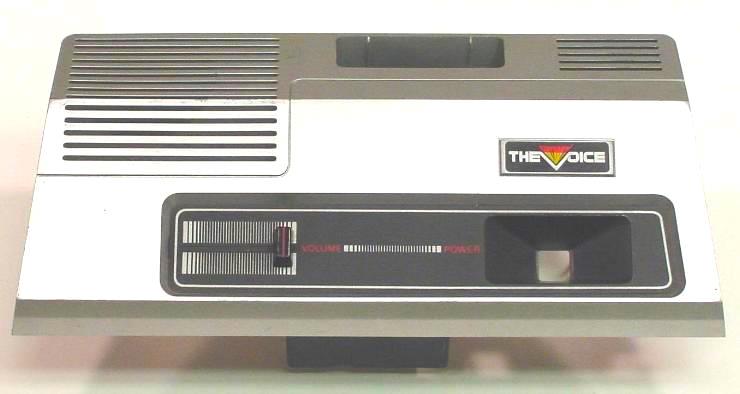
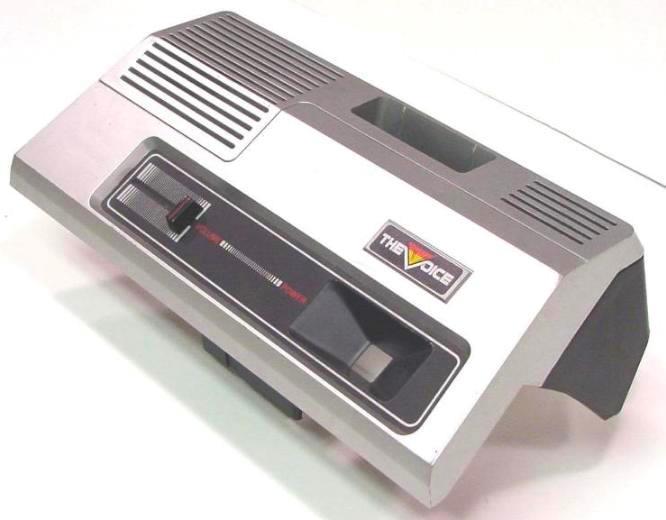
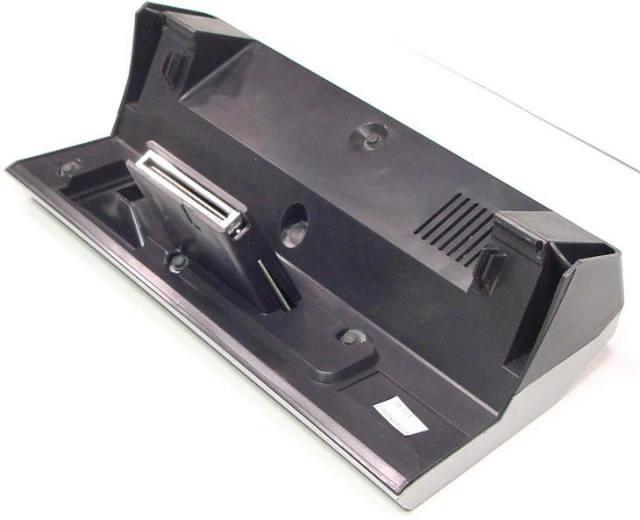
The Voice brought speech and additional sound effects to the Magnavox Odyssey². Its sculpted enclosure fitted over the console and connected through the cartridge port, with a second slot accepting the game cartridge. A built-in speaker and sliding volume control gave speech its own audio path, while the keyboard and console power switch remained accessible.
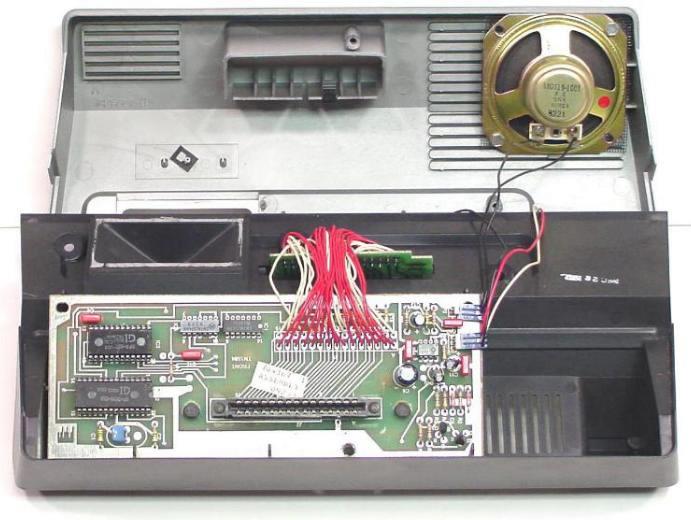
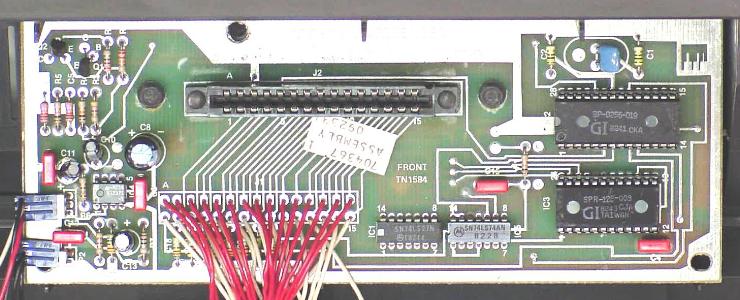
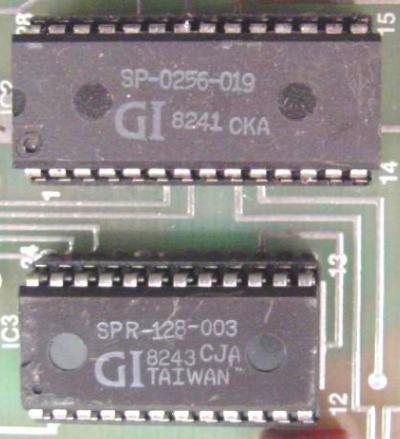
The photographed board carries two General Instrument devices: the custom SP0256-019 speech processor and an SPR-128-003 serial speech ROM. They supplied a vocabulary of game phrases, speech sounds, and effects that software could call upon.
The custom SP0256-019 sound set
The SP0256-019 belongs to the same LPC speech family as the SP0256-AL2, but its ROM configuration was tailored to The Voice. The AL2 sound set was intended for constructing words from allophones; the Odyssey system combined access to those speech sounds with ready-made phrases and an expanded external speech library.
The SP0256-019 is not a chip that accepts English text directly. It takes sound-selection commands and reconstructs audio from encoded speech parameters. The companion SPR-128-003 supplies additional data through a serial connection. Cartridge software determines what is spoken and when.
Dan Boris’ technical reference lists a bank containing the allophone selection range and phrases such as “Enemy,” “All clear,” “Open fire,” and “You blew it.” Three further built-in banks contain more words and effects, including explosions, a bee sound, and musical tones. Additional banks can be supplied by cartridges. Bank and command addresses in that reference are console I/O addresses, not a universal standalone-chip wiring recipe.
Games that talked—and games that listened to spelling
K.C.’s Krazy Chase! used speech for tips and celebrations. Nimble Numbers Ned combined spoken mathematics drills with an action game. Smithereens! was marked voice-enhanced, and its manual explicitly allowed the cartridge to be inserted directly into the console or through The Voice.
Sid the Spellbinder gave speech a more central role. Children alternated between shooting a segmented snake and spelling words spoken by the machine. A correct answer replenished ammunition; after two unsuccessful attempts, the program spelled the word aloud. Its 1982 manual credits cooperation with the University of Tennessee Knoxville College of Education.
Support varied by cartridge. A pass-through slot did not make an ordinary game talk, and some educational programs depended on spoken prompts. The Fall 1983 review of Sid specifically lists The Voice as required hardware.
Type & Tell: making the keyboard speak
Type & Tell let owners type a name or message on the Odyssey² keyboard and press ENTER to hear it. Its manual treats the six on-screen lines as one continuous message and provides simple cursor movement, correction, insertion, and deletion controls.
The manual also suggested playful uses: arranging letter names into sound-alike sentences, repeating characters to create machine-like noises, and recording the synthesizer as a robot character in a homemade science-fiction production. Speech became something to experiment with, as well as something a game delivered.
The conversion was performed by cartridge software. Owen Linzmayer’s Spring 1983 hands-on review noted that deliberate phonetic respelling could improve pronunciation. The unit could build unfamiliar words from speech sounds, but it did not understand every English spelling perfectly.
Speech hardware beyond the plastic shell
MAME’s implementation documents a 2 KB internal speech-chip ROM and 16 KB of external speech data. It also supports hardware revisions using daughterboards of smaller ROMs and the cartridge connection for extra speech data. Its modeled speech clock is 3.12 MHz.
The console checked the chip’s load-request signal before issuing another sound command. A free input buffer meant another command could be accepted; it did not necessarily mean the current sound had finished. That distinction allowed software to queue the next utterance without interrupting one already playing.
A preserved speech-development console illustrates how new sounds were prepared. General Instrument’s Speech Field Development Board let an SP0256 use erasable parallel EPROMs in place of production serial ROMs. Dan Boris’ firsthand teardown and repair account describes dumping those development EPROMs and finding that their contents matched the production Voice data.
Hear the SP0256 family
The audio players below retain the recordings from the shared SP0256 reference: three Currah SP0256-AL2 demonstrations and three Intellivoice SP0256-012 examples. These are comparisons within the speech-chip family, not recordings of the Odyssey’s SP0256-019. They demonstrate how different sound sets and host software gave related chips different voices.
SP0256 family audio comparisons
Alphabet — Currah SP0256-AL2
Currah Voice Messenger alphabet; the final letter is pronounced “zed.”
Digits — Currah SP0256-AL2
Currah Voice Messenger: digits one through nine, then zero.
By your command — Currah SP0256-AL2
Currah Voice Messenger demonstration using a lower clock rate.
Mattel Electronics Presents — SP0256-012
Intellivoice’s custom introductory phrase.
999,999 — Intellivoice SP0256-012
Intellivoice number vocabulary combined into a large number.
Hello commander — Intellivoice SP0256-012
Intellivoice: “Hello commander. Computer reporting.”
Specifications
- System
- Magnavox Odyssey²
- Interface
- Console cartridge port with pass-through game slot
- Speech processor
- SP0256-019
- Speech ROM
- SPR-128-003 (photographed unit)
- Speech technology
- LPC synthesis; selectable allophones, phrases, and effects
- Audio
- Built-in speaker and sliding volume control
- ROM configuration
- 2 KB internal and 16 KB external, as documented by MAME
- Software
- Voice-enabled cartridges; Type & Tell supplies text conversion
Examples from the console speech map
| Bank selector | Sound command | Result |
|---|---|---|
| $E4 | $C0 | Enemy |
| $E4 | $C4 | Open fire |
| $E4 | $C8 | You blew it |
| $E8 | $80 | Amazing |
| $E9 | $93 | Bee sound |
| $EA | $89 | Large explosion |
Addresses are Odyssey² console I/O values from Dan Boris’ reference. They select banks and trigger sounds; they are not direct standalone chip pin codes.
Sources and further reading
- North American Philips: Type & Tell manual, 1982
- North American Philips: Sid the Spellbinder manual, 1982
- North American Philips: Smithereens! manual, 1982
- Owen Linzmayer: The Voice of Odyssey, Spring1983 hands-on review
- Owen Linzmayer: Spellbinder, Fall1983 hands-on review
- Dan Boris: Odyssey² technical reference, voice banks and commands
- MAME source: The Voice hardware and implementation
- Dan Boris: firsthand speech-development-board teardown and repair