TI Solid State Speech Synthesizer
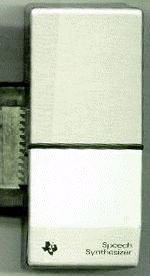
Image gallery
Find a TI speech synthesizer for your collection
Search for the speech sidecar and related material. Check the computer interface, condition, and included software.
Search eBay for TI speech synthesizersGiving the TI home computer a voice
Texas Instruments’ Solid State Speech Synthesizer, model PHP1500, added spoken output to the TI-99/4 and TI-99/4A home computers. The side-mounted accessory was designed for educational directions, feedback, games, and programs written by owners. TI’s 1980 manual presented speech as another way to communicate, especially with people who could not yet read.
Attaching the hardware was only part of the arrangement. A speech-aware cartridge supplied the software that used it. Speech Editor offered an interactive way to assemble utterances, while TI Extended BASIC brought speech commands into programs.
The synthesizer and its speech memories
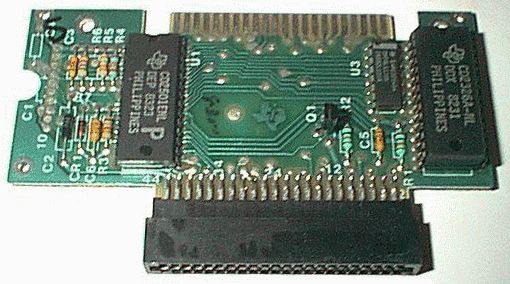
The unit combines an LPC speech processor with two serial speech ROMs. The photographed processor bears the CD2501E designation, part of the TMS5200 family. This is the chip family associated with the TI speech module; it should not be confused with the later TMS5220 simply because the devices are closely related.
The TMS6100-family speech memories store compact encoded speech and vocabulary information. Audio returns through the computer’s side connector into the console’s sound path, so the voice is heard through the computer’s normal audio output. The accessory does not need its own external speaker.
Linear predictive coding stores parameters describing the changing speech signal rather than a complete sampled waveform. The synthesizer uses those parameters to recreate the voice. Its input is encoded speech data, not a written sentence or a simple phoneme number.
A resident vocabulary to experiment with
TI described the built-in collection as nearly 400 words and phrases. The Extended BASIC manual specifies 373 entries including letters, numbers, words, and phrases. This gave a beginning programmer a useful vocabulary without first having to design speech data.
CALL SAY selected spoken material from that collection. CALL SPGET retrieved a word’s speech pattern into a string variable, allowing the data to be reused and modified. The manuals described building additional words from combinations and adding endings such as S, ED, and ING.
Speech Editor’s manual also explained that speaking patterns retrieved into variables could change the timing of a phrase. The result was a system owners could explore at several levels: selecting a word, arranging a sentence, or working with its underlying speech data.
Beyond the built-in words
Terminal Emulator II supplied another approach: software text-to-speech and allophone speech. In her August 1984 COMPUTE! column, C. Regena demonstrated opening the SPEECH output device and sending text to it with PRINT. Spellings could be adjusted to improve pronunciation.
The same article explored pitch, pitch slope, stress, and pauses, even using the computer to sing an alphabet song. These capabilities came from the cartridge software directing the LPC hardware. A text-to-speech interface therefore did not change the physical chip into a phoneme synthesizer.
The little door and a different route to expansion
The early manual described plug-in speech modules that would supplement the resident vocabulary. This explains the lift-up compartment on some units: it reflected a planned way to add specialized spoken material.
By 1984, Regena reported that Terminal Emulator II’s flexible speech software had made those vocabulary inserts unnecessary. The platform’s speech capabilities grew through software and supplied speech data rather than relying solely on extra vocabulary modules.
Speech was part of the application
TI’s system-software design specification placed responsibility for speech access in the application cartridge. The peripheral provided the voice, while the software decided what to say and when to say it. This division let an educational program speak instructions or a game use speech as part of its atmosphere.
It also explains why the presence of the sidecar alone did not make every program talk. A program needed speech support or an appropriate programming environment.
Preserving the data as well as the hardware
Modern tispeech-tools can decode and encode TI LPC data for several chip generations, including the TMS5200. The project treats the chip profiles separately, preserving the differences that affect the sound of encoded material.
For a complete exhibit, the synthesizer, resident ROM data, compatible cartridges, and programming manuals belong together. They preserve both TI’s recognizable electronic voice and the experiments owners made with it.
Specifications
- Manufacturer
- Texas Instruments
- Model
- PHP1500
- Host computers
- TI-99/4 and TI-99/4A
- Format
- Side-mounted expansion peripheral
- Speech memory
- Two TMS6100-family serial ROMs
- Synthesis method
- Linear predictive coding (LPC)
- Resident vocabulary
- 373 entries in the Extended BASIC manual; marketed as nearly 400
- Audio output
- Through the console’s audio path
- Programming support
- Speech Editor, TI Extended BASIC, Terminal Emulator II
Sources and further reading
- Texas Instruments: PHP1500 user manual (1980)
- Texas Instruments: Speech Editor manual
- Texas Instruments: Extended BASIC manual
- Texas Instruments: home computer system-software design specification
- C. Regena: The Singing Computer, COMPUTE!, August 1984
- Thierry Nouspikel: speech module circuitry and audio routing
- Joel Reyes Noche: module photographs and TMS5200 identification
- tispeech-tools: LPC encoding and decoding profiles