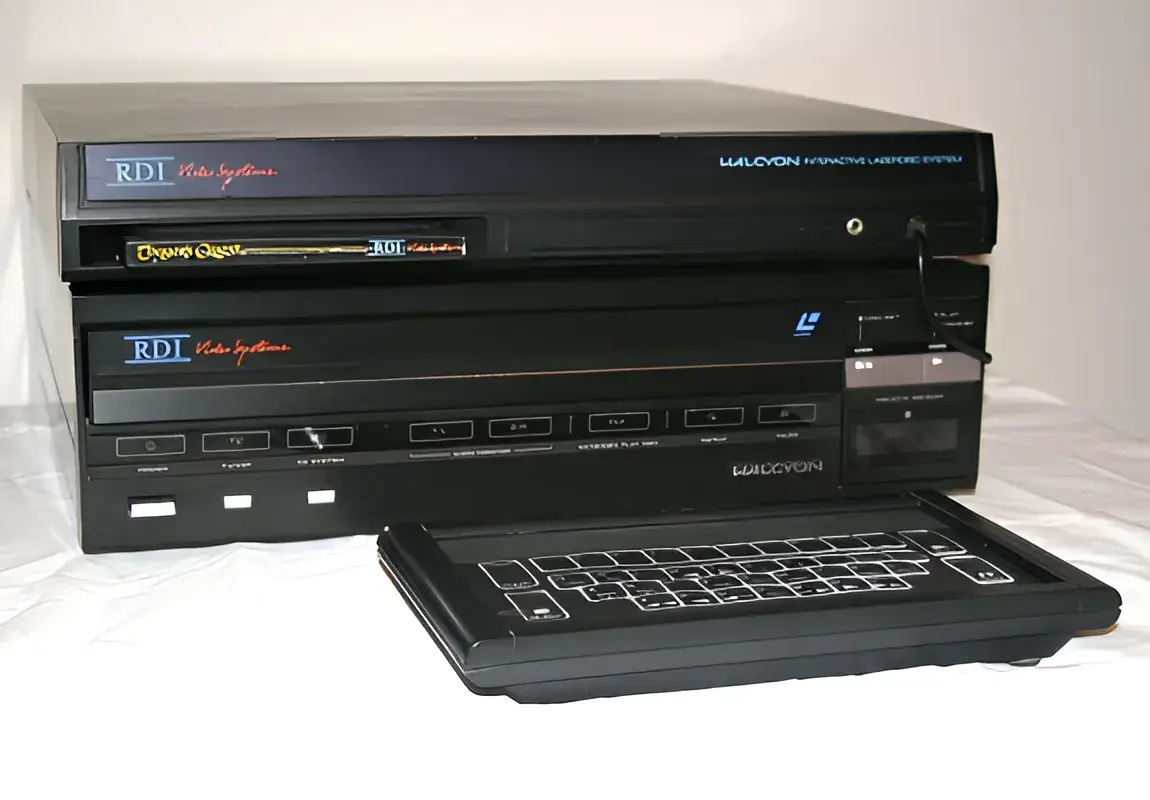
RDI Halcyon
Watch it in action
RDI Halcyon demonstration
A demonstration of the RDI Halcyon and its voice-controlled laserdisc system.
Watch on YouTube ↗A console that spoke—and listened
The Halcyon was conceived as more than a laserdisc player attached to a game. A computer coordinated the player’s choices with animated scenes on disc, while a headset microphone let the user answer aloud. The system could also speak prompts, names, and responses, making voice part of the play itself.
Two separate speech systems
The Halcyon’s Votrax SC-02 produced its synthesized voice. RDI used a separate speech-recognition subsystem to listen for spoken input; the SC-02 did not recognize words. Separating those jobs matters: one system turns phonetic instructions into sound, while another analyzes the player’s voice and reports recognized commands to the game.
A story carried by laserdisc
In Thayer’s Quest, the player watched animated story passages and made choices at decision points. The Halcyon combined those recorded scenes and audio with computer-controlled game state, jumping through the disc as the story branched. The home version’s double-sided disc held material beyond the later single-sided arcade conversion, giving the original design room for more of its fantasy world.
Voiceprints, prompts, and a bounded vocabulary
The voice interface was designed around a trained user and a game-specific set of expected responses, rather than unrestricted conversation. In the 1985 Computer Chronicles demonstration, the machine greeted host Stewart Cheifet by name and then struggled to recognize a spoken choice during play. That moment shows both the promise and the practical limits of early speech recognition: a compelling hands-free idea whose reliability depended on the speaker, microphone, and vocabulary.
A vision ahead of its market
RDI first planned the Halcyon around RCA’s CED videodisc format, then shifted to LaserDisc as the CED option disappeared. The change raised the system’s cost. Contemporary and retrospective accounts describe a planned 1985 launch at roughly $2,500 for a voice-controlled system—an extraordinary price for a home game machine. The Halcyon remained a rare, short-lived system rather than becoming a widely sold console.
Games and afterlife
Thayer’s Quest and NFL Football were the two completed Halcyon games commonly documented. Thayer’s Quest later survived in a cut-down arcade conversion, while footage from the richer Halcyon version preserves a glimpse of the system’s original ambition. The Halcyon is remembered as an early attempt to combine speech recognition, synthesized speech, and branching full-motion video in a home entertainment system.
Specifications
- System type
- Voice-controlled home laserdisc entertainment system
- Speech synthesizer
- Votrax SC-02 (confirmed by the museum owner)
- Speech recognition
- Separate headset-based speech-recognition subsystem
- Game input
- Spoken responses; keyboard also shown in prototype material
- Completed games
- Thayer’s Quest and NFL Football
Sources and further reading
- The Videodisc Monitor, July 1984: RDI Halcyon coverage
- Computer Chronicles: “Lasers and Computers” (January 14, 1985)
- Computer Chronicles Revisited: Halcyon demonstration transcript and context
- International Arcade Museum: Thayer’s Quest and the Halcyon laserdisc
- Atari Compendium: Thayer’s Quest history and Halcyon version
Speech hardware
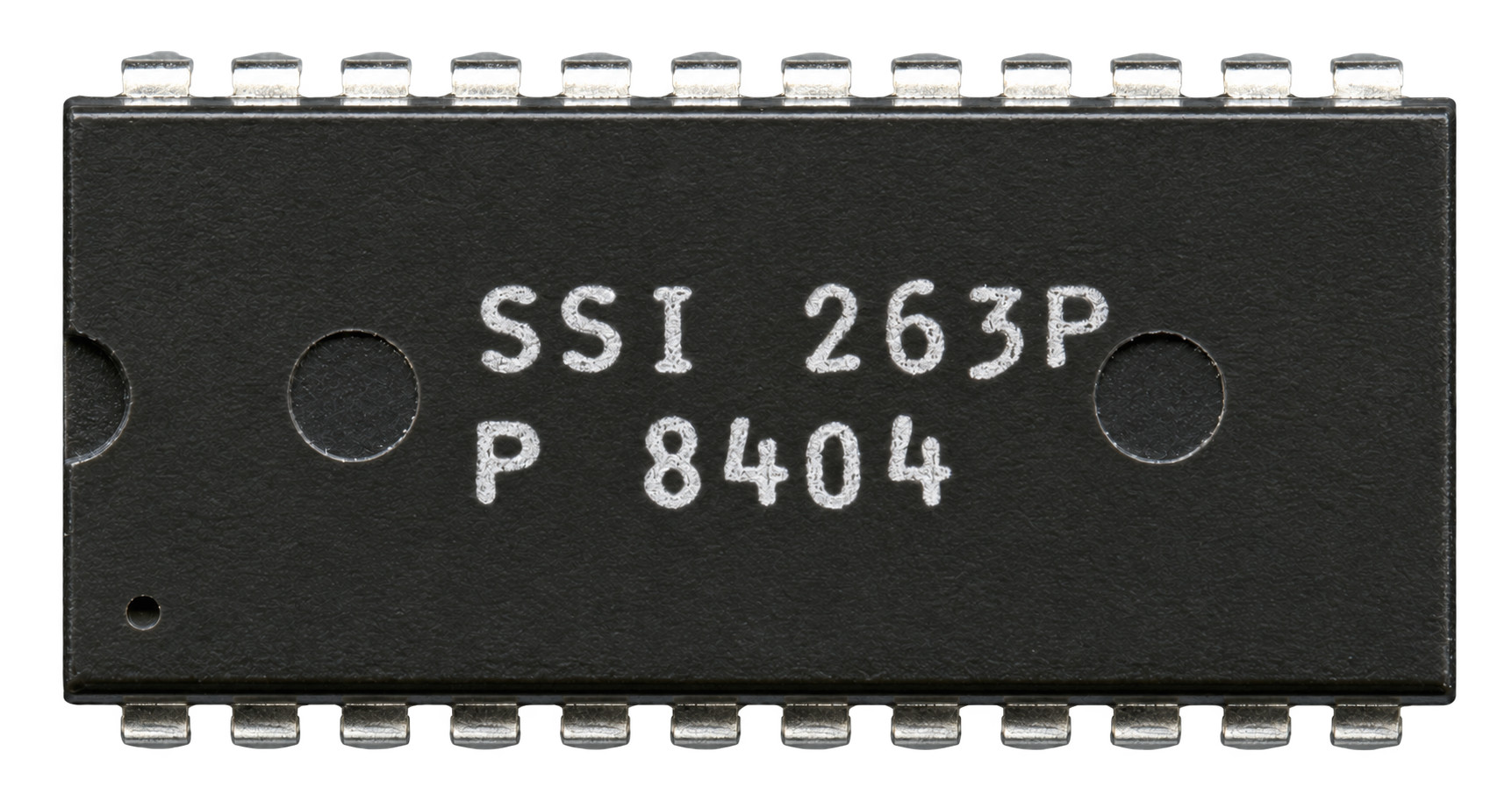
SC-02 / SSI-263 / 78A263
A programmable vocal tract in a chip: the Votrax SC-02 / Silicon Systems SSI-263 brought expressive control to vintage electronic speech.
Hear the SC-02 / SSI-263 / 78A263 →