Synthetic Sound Labs Scat-Talker
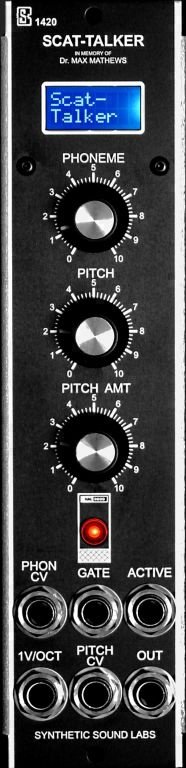
Image gallery
Watch it talk
SSL Scat-Talker Exploration #1 — John L Rice
Phoneme selection, sequencing, pitch control and musical patches. Some passages use external effects.
Watch on YouTube ↗Find a Scat-Talker for your collection
Look for Synthetic Sound Labs Scat-Talker modules and related listings.
Search eBay for Scat-TalkerA vintage voice in a modern synthesizer
Synthetic Sound Labs’ Scat-Talker, Model 1420, gives a modular synthesizer the distinctive voice of a Votrax SC-01. Documented in December 2015 as a limited-edition module, it brings vintage speech hardware into a setting where its peculiar accent becomes a musical instrument.
The SC-01 synthesizes speech from phoneme codes using a model of the vocal tract. It is not playing recordings of a speaker. The Scat-Talker puts selection and pitch under panel and voltage control, inviting musicians to play the sounds themselves.
Patch a mouthful of sound
A control voltage chooses a speech sound; a gate or the illuminated panel button requests the selected phoneme. The display identifies the selection and gives an example word. Turning the selector alone does not immediately replace the sounding phoneme.
The module offers 63 sound-selection positions, including silence, plus a factory demonstration position. These are the module’s selections; the SC-01 itself uses a six-bit phoneme code. There is no text-entry interface or built-in spelling-to-speech converter. Words must be assembled by sequencing their constituent sounds.
Give the voice a melody
Pitch has its own panel control and two voltage inputs: a nominal 1V/octave input and a second input with adjustable modulation amount. The manufacturer describes the response as roughly exponential and cautions against expecting precise tuning or perfect stability.
That looseness is part of the instrument’s appeal. A gentle LFO can suggest vibrato; more extreme changes push the voice toward growls and cartoon chatter. A MIDI-to-CV converter can connect a computer-based sequencer to these inputs; MIDI is not a native connection on the module.
The timing that makes it musical
Most phonemes can sustain, while certain short, percussive sounds behave differently. The ACTIVE output indicates the chip’s built-in phoneme interval rather than simply copying the incoming gate. Audio can continue after that interval, and repeatedly requesting an unchanged selection does not produce the same new-phoneme activity.
In John L Rice’s demonstration, ACTIVE triggers an external envelope controlling a filter. A sequencer supplies phonemes while a keyboard supplies pitch, separating what the voice says from the notes it sings. Delay, reverb and phase processing heard in that demonstration come from external equipment.
From words to vocal percussion
Sound designer Ethan Persoff demonstrated another approach in 2025: a Rucci 16 Step CV Sequencer drives a Scat-Talker, while envelopes and a voltage-controlled amplifier trim speech sounds into musical events. Phonemes become percussion, bright lead sounds and slow drones.
Recognizable speech is only one destination. Repeating a small group of sounds, changing their pitch or shifting the sequence can create phrases that resemble a language without saying anything at all. The listener hears the shape of a voice, with rhythm and melody taking over the work of words.
A new life for the SC-01
The Scat-Talker belongs alongside the museum’s talking machines because it demonstrates a different use for their technology. The same kind of vocal-tract synthesis that gave early electronic voices their character can be explored as a playable sound source.
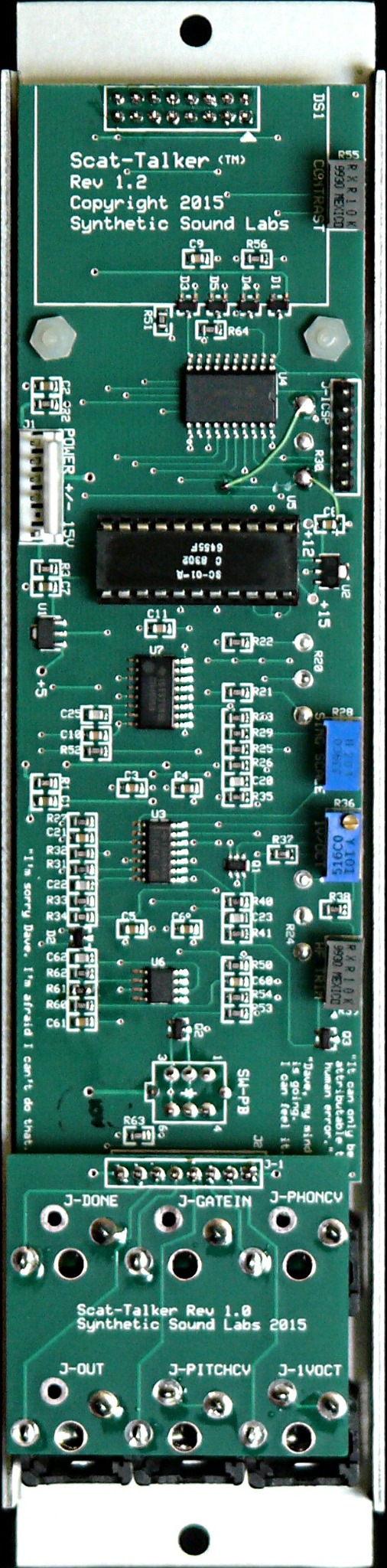
Its MU format is a single module unit wide and 5U tall. It is designed for a powered modular system, not as a self-contained speech accessory. A suitable power supply and other modules provide the surrounding instrument.
Specifications
- Speech hardware
- Votrax SC-01
- Format
- Single MU width; 5U tall
- Phoneme selection CV
- 0 to +5 V
- Gate input
- Approximately 1.2 V logic threshold
- Pitch CV
- Nominal 1 V/octave; approximately 0 to +5 V; imperfect tracking
- Modulation
- Second pitch input with adjustable attenuation
- Activity output
- Logic high for the chip’s phoneme interval
- Power connection
- Synthesizers.com / DOTCOM six-pin Molex
- Supply and current
- +15 V at 73 mA; −15 V at 16 mA
Sources and further reading
- Synthetic Sound Labs — Model 1420 manufacturer page
- ModularGrid — manufacturer description and module specifications
- John L Rice — SSL Scat-Talker Exploration #1, December 2015
- Synthtopia — contemporary announcement and annotated demonstration, December 14, 2015
- Ethan Persoff — phoneme sequencing and musical sound design, April 8, 2025