Speak & Music
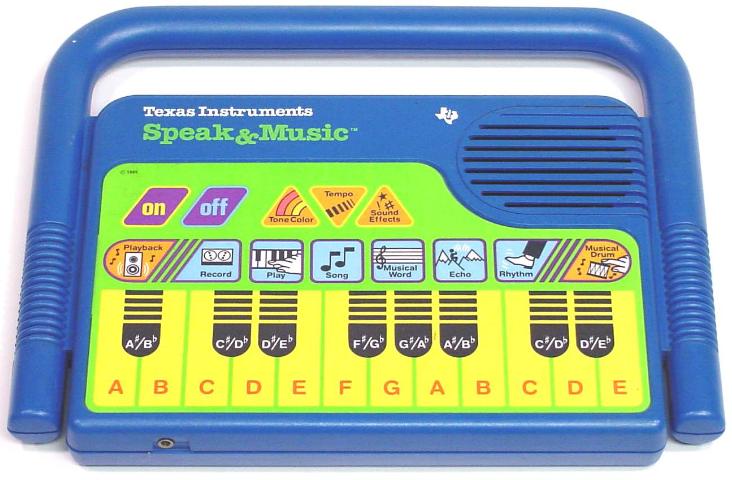
Image gallery
Find Speak & Music for your collection
Explore current eBay listings for Texas Instruments Speak & Music and related musical learning aids.
Search eBay for Speak & MusicA talking introduction to music
TI’s 1986 parent’s guide presents Speak & Music as a musical learning aid for grades 1–5. Its twenty-key chromatic keyboard spans A below middle C to E above high C. Spoken instructions let children choose activities without having to read a screen.
Listening, remembering, and playing
Twelve stored songs accompany free playing. Musical Word asks the child to reproduce note sequences; Echo builds melodies progressively; Rhythm asks for matching patterns using the Musical Drum key. Difficulty levels extend the challenge as listening skills improve.
What Record actually records
Record stores approximately sixty notes, including rests, for playback. This is a musical sequence recorder, rather than a microphone recording a performance. TI says the saved piece remains until another recording begins or the batteries run down.
Changing the sound
Four tone colors and four tempos vary the musical result. Twelve sound effects can be used in Play and Record. The guide describes four AA batteries and includes troubleshooting advice for weak or erratic operation.
The electronics in this collection
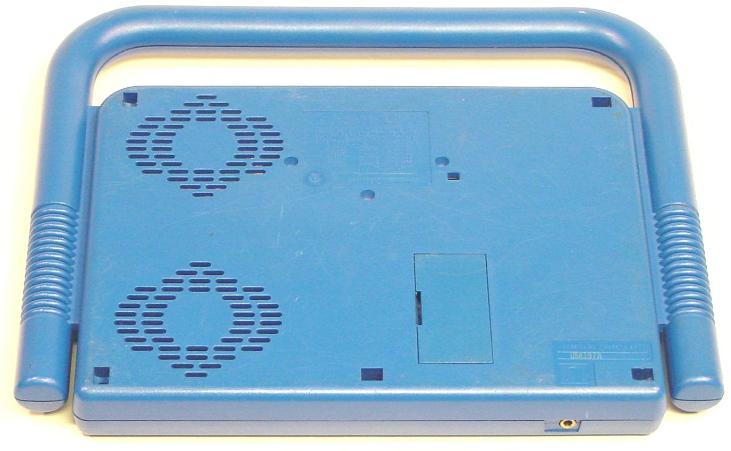
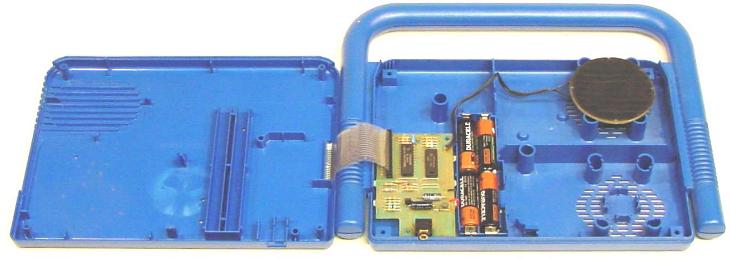
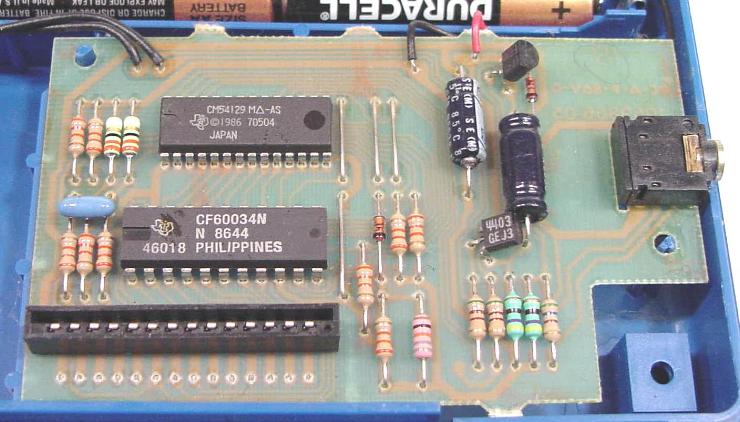
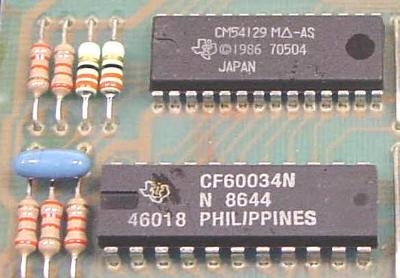
The close-up photograph clearly shows two Texas Instruments devices: CM54129 ML-AS, marked ©1986, and CF60034N. The wider views show the compact circuit board, membrane-keyboard connection, battery compartment, and speaker. These photographs document the actual hardware rather than relying solely on the product’s familiar name.
The CM54129 speech processor
Joerg Woerner’s teardown of a June 1987 example identifies CM54129 with the TI 50C40 speech-controller design, combining a voice processor, an eight-bit controller, and mask-programmed storage. That integration helps explain why this musical learning aid has far fewer major components than some earlier talking products. The CM54129 marking identifies the consumer application; it should not be confused with a TMS5220 simply because both belong to TI’s speech history.
How a compact chip produces a voice
TI’s later TSP50C4X design manual explains the integrated controller-and-synthesizer approach: a processor retrieves encoded speech information and drives a digital model of the vocal tract. LPC represents changing excitation, loudness, and filter characteristics instead of retaining every sample of the original waveform. This is architectural context for the family, not proof that every later C4X specification applies to CM54129.
The companion chip
CF60034N is readable in the photograph. Woerner proposes that CF60034 expands the speech controller’s keyboard input capability, but explicitly treats that role as uncertain. Without a verified schematic or data sheet, its precise function remains unconfirmed.
A voice built into the activity
The speech is part of a purpose-built musical program. Buttons select its activities and responses; they do not provide an ordinary English text-entry interface. The synthesis technique describes how sound is generated, while the programmed content determines what this particular product says.
Related musical learning aids
Woerner documents Little Maestro alongside Speak & Music, followed by the German Music-Star, French La Musique Magique, and Italian Fonillo Suonaparla. These relatives show how TI adapted the musical-learning concept across audiences and languages. Their chip markings and appearances should be checked individually rather than assumed identical.
Specifications
- Manufacturer
- Texas Instruments
- Period
- Mid-1980s; TI parent’s guide copyright 1986
- Keyboard
- 20-note chromatic keyboard
- Main IC shown
- CM54129 ML-AS
- Companion IC shown
- CF60034N; exact role unconfirmed