Super Speak & Read

Image gallery
Find Super Speak & Read for your collection
Explore eBay listings for the folding reading aid, matching books, and expansion packs.
Search eBay for Super Speak & ReadA book that answers back
Super Speak & Read opens like a small carrying case. A printed activity booklet lies over its input panels, and a child presses a pictured answer through the page. The speech system supplies questions and feedback. The printed artwork provides the visible interface, while electronics connect each selected position to the activity.
Learning through sight and sound
Texas Instruments’ 1991 learning-products leaflet places Super Speak & Read in its preschool range for ages 3–7. TI emphasizes phonics and sight-reading as ways to develop basic reading skills. Spoken guidance, printed words, and pictures let children practice through several kinds of cues instead of relying on a conventional computer screen.
A later generation of Speak & Read
The earlier Speak & Read appeared in 1980 with an alphabet keyboard and fluorescent display. Datamath dates Super Speak & Read to 1988 and documents the new book-over-touch-panel format. The yellow folding unit photographed here is the later Super model, visibly identified on its case. The earlier machine’s keyboard, vocabulary, and game specifications should not be assigned to it.
The photographed circuit board
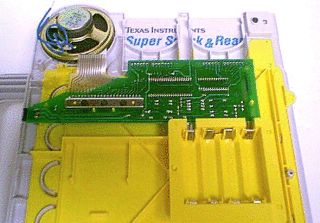
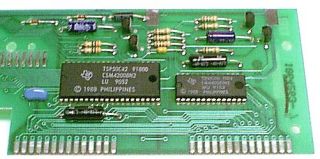
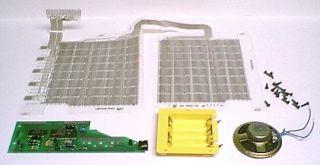
The four photographs show the closed case, installed electronics, a board close-up, and the separated components. The main IC’s TSP50C42 marking is visible. A second IC sits beside it. Ribbon connections lead toward the large membrane assemblies; the dismantled view also shows the speaker and battery holder. The photographs make the connection between the book-shaped surface and its underlying electrical inputs visible.
An integrated speech controller
The TSP50C42 combines an eight-bit processor, LPC synthesis, 8 KB of internal ROM, and external speech-memory support. Integrating control and voice generation reduces the number of separate processing components.
How the voice is reconstructed
The TI manual specifies a ten-pole LPC lattice filter. Encoded speech data supplies parameters governing the excitation, energy, and filter response. The digital filter models the acoustic effect of the vocal tract, reconstructing speech from a compact description rather than a full uncompressed waveform. The processor retrieves and decodes the data for the synthesizer; the resulting output drives the speaker circuit.
Speech memory and interchangeable content
Datamath’s teardown of a 1991 example identifies a TSP60C80 speech ROM beside the TSP50C42 and describes plug-in speech-ROM modules matched to booklets. That example’s mask codes are not automatically the codes on every production revision. A book supplies pictures and words; the associated electronics supply the utterances and activity behavior.
Three libraries of activities
Datamath documents a blue basic set with four books, an orange Reading Fun 1 pack covering books 5–11, and a purple Reading Fun 2 pack covering books 12–18. The expansion concept adds new printed activities and corresponding electronic content. It does not turn the machine into a scanner that recognizes arbitrary printed text.
What the touch surface detects
The membrane panels detect selected positions underneath a page. Understanding the words or pictures belongs to the child; interpreting the switch position belongs to the programmed activity. No optical character recognition is needed for that interaction. This design links ordinary paper publishing to a repeatable electronic lesson.
Related reading systems
Regional versions adapted the book-based reading format to different languages. Matching booklets, ROM content, and hardware revisions matter when comparing these systems.
Specifications
- Manufacturer
- Texas Instruments
- Model shown
- Super Speak & Read; folding book-based model
- Period
- Introduced 1988; included in TI’s 1991 leaflet
- TI recommended ages
- 3–7 (1991 leaflet)
- Speech controller shown
- TSP50C42
- User input
- Position-sensitive membrane panels under printed booklets