Speech+ Calculator
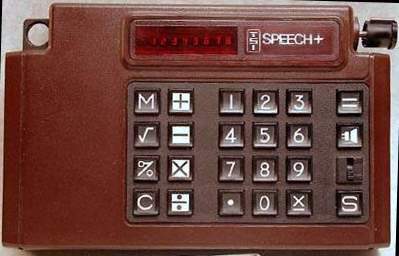
Image gallery
Find a Speech+ for your collection
Look for Telesensory Speech+ calculators and related material on eBay. Check the photographs and model when comparing the original calculator with the later Student Speech+.
Search eBay for Speech+A calculator you could hear
The Speech+ from Telesensory Systems Inc. brought spoken arithmetic into a handheld calculator in the mid-1970s. Designed for people who were blind, it announced key presses and results through its built-in speaker. An ordinary calculation no longer depended on being able to read the display.
Made in the United States by Telesensory Systems of Palo Alto, California, it was a pioneering consumer application of electronic speech. Its instructions came on an audio cassette, extending the same accessibility principle to learning how to use it.
Familiar arithmetic, spoken aloud
The calculator provided addition, subtraction, multiplication, and division, along with percentages, square roots, and memory. An eight-digit red LED display gave a visual readout, while a key marked with a loudspeaker symbol made the calculator speak the number on the display.
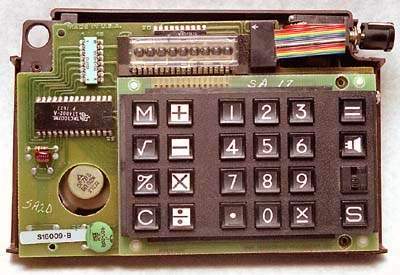
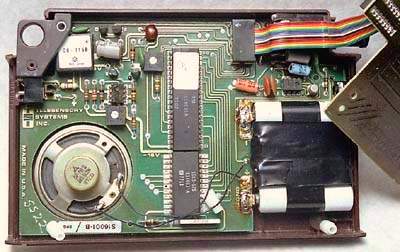
The knob at the upper right served two purposes: pulling it out switched the calculator on, and turning it adjusted the volume. The photographs show the finished calculator and two views of its internal boards, including the display, keypad, speaker, and integrated circuits.
From an algorithm to working silicon
The speech circuit was developed by Silicon Systems Inc. for Telesensory Systems. These were two separate companies with similar initials: SSi designed the semiconductor, while TSI made the accessible calculator.
In a development account published by Vintage Calculators, design engineer Ed Bernard recalled that Telesensory approached SSi in March 1975 to implement Dr. Forrest S. Mozer’s speech-synthesis algorithm. Design began that spring, layout was finished in July, and the first silicon arrived in September. The circuit worked on its first fabrication run; production parts followed in late 1975 or early 1976.
Lead mask designer Grant Still Shatto II also contributed his recollections, describing the excitement of hearing the new chip produce its first word. The project gave a small integrated circuit an immediately recognizable purpose: helping someone carry out everyday calculations.
A small vocabulary with a useful job
The S14001A speech processor worked with a separate speech-data ROM, identified as the General Instrument S14007 in the photographed calculator. The processor and ROM performed different jobs: one generated the speech output, while the other held the data used to produce it.
Sean Riddle’s hardware analysis found a 2 KB speech ROM and 24 vocabulary entries in use. Five control signals selected a word, and a sixth started speech. The available word selections were sufficient for digits, calculator operations, and messages such as overflow.
This was a purpose-built speaking calculator, rather than a general text-to-speech machine. Combining a limited set of spoken elements let it announce many numerical results without storing every possible number as a complete recording.
Development in 1975, availability in 1976
Dates attached to surviving Speech+ calculators can refer to different stages of the project. The Computer History Museum dates its example to approximately 1975; the chip-development account places production parts around the turn of 1976 and describes the calculator’s launch in 1976. Both dates belong in its history, without treating a development date as an exact retail launch date.
The later Student Speech+
The American Printing House for the Blind subsequently worked with Telesensory on a Student Speech+ calculator. APH’s collection record describes its introduction in 1978, with Telesensory responsible for design and APH carrying out partial assembly and distribution.
The student model used blue plastic and prominent key markings for students with low vision. It retained a 24-word electronic vocabulary and offered memory, sign change, and a floating decimal point. APH records an original price of $455 and discontinuation by 1982. Those details describe the student adaptation, rather than the brown calculator photographed here.
Speech as an everyday tool
The Speech+ illustrates why the history of synthetic speech extends beyond talking toys and computer demonstrations. Spoken feedback made a familiar electronic tool accessible to more people. Its voice had a small vocabulary, but a practical role: confirming an entry, reading a result, and making arithmetic easier to perform independently.
Specifications
- Manufacturer
- Telesensory Systems Inc., Palo Alto, California
- Model
- Speech+ handheld talking calculator
- Period
- Developed in 1975; launch described as 1976
- Display
- Eight-digit red LED
- Functions
- Addition, subtraction, multiplication, division, percentages, square root, and memory
- Speech output
- Spoken key presses and numerical results; built-in speaker
- Speech processor
- S14001A, developed by Silicon Systems Inc.
- Speech-data ROM
- General Instrument S14007; 2 KB speech-data storage
- Vocabulary
- 24 words in use
- Controls
- Pull-out power switch and rotary volume knob; speak-display key
- Instructions
- Supplied on audio cassette
- Country of manufacture
- United States