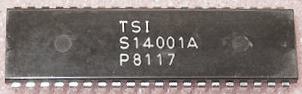
TELESENSORY SYSTEMS · SILICON SYSTEMS · MOZER SPEECH
S14001A
TSI’s ROM-based speech processor, designed by Silicon Systems for the Speech+ calculator and later heard in Berzerk’s robotic taunts.
Overview
The TSI S14001A reconstructs compressed speech from an external ROM using Forrest S. Mozer’s waveform-compression technology. Designed in 1975, it connects the early history of accessible talking calculators with some of the most memorable voices in arcade games.
Image gallery
Find an S14001A for your collection
Look for TSI S14001A chips, speech boards, and documentation. Check the part marking, condition, and included speech ROMs.
Search eBay for S14001ATSI on the package, Silicon Systems behind the design
TSI stands for Telesensory Systems, Inc., the company that commissioned the speech processor for its Speech+ talking calculator. Silicon Systems, Inc. (SSi) designed and supplied the integrated circuit. Ed Bernard was the design engineer, and Grant Still Shatto II led the mask layout. The TSI marking and the Silicon Systems engineering credit describe different roles in the same project.
A voice designed for accessibility
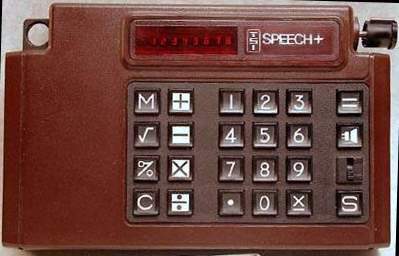
Development began in 1975 to bring Forrest S. Mozer’s speech algorithm into a practical calculator for blind users. Speech+ reached the market in 1976, allowing a user to hear numbers and operations. Sean Riddle’s examination of a surviving calculator found 24 used vocabulary entries in a 2 KB mask ROM, with five selection lines and a start signal. That is one application’s vocabulary, not the processor’s universal word list.
How the voice is reconstructed
The S14001A works from encoded waveform information. Compact two-bit delta values describe changes in the reconstructed signal, rather than storing every sound sample at full precision. An accumulator builds a four-bit waveform, which the on-chip digital-to-analog converter turns into an audio signal. This is a different approach from the LPC filter used by the SP0256 family or the formant synthesis of the SC-01.
Making a little memory go a long way
Mozer’s techniques exploit repetition within voiced speech and the ear’s tolerance of changes to waveform phase. A short waveform segment can be stored, mirrored, and repeated to reconstruct a longer sound; silent portions can be generated without storing a long sequence of samples. Unvoiced sounds need different treatment because they lack the same regular pitch pattern. The patent describes a broader family of compression methods; the chip implements a specific hardware format. This economy let recognisable speech fit into the small ROMs available in the 1970s.
The ROM gives the chip its vocabulary
There is no built-in dictionary or fixed allophone library. An external parallel ROM holds entry pointers, control information, and compressed sound data. The processor’s twelve address lines provide a 4 KB address space, and its six selection inputs allow up to 64 entry codes. An entry can represent a word, phrase, or reusable sound segment. Creating a new vocabulary requires encoding audio in this particular format and preparing a compatible ROM image; ordinary text or a WAV file cannot be sent directly to the chip.
Selecting and playing a sound
The host places an entry number on the six selection inputs and pulses START low–high–low. The processor reads the entry’s pointer, follows its control data, and reconstructs the sound until an ending condition. The BUSY signal reports activity. Historical schematics use different names and sometimes different bit ordering for the selection lines, so a wiring diagram and its ROM organisation must be considered together.
From calculators to arcade robots
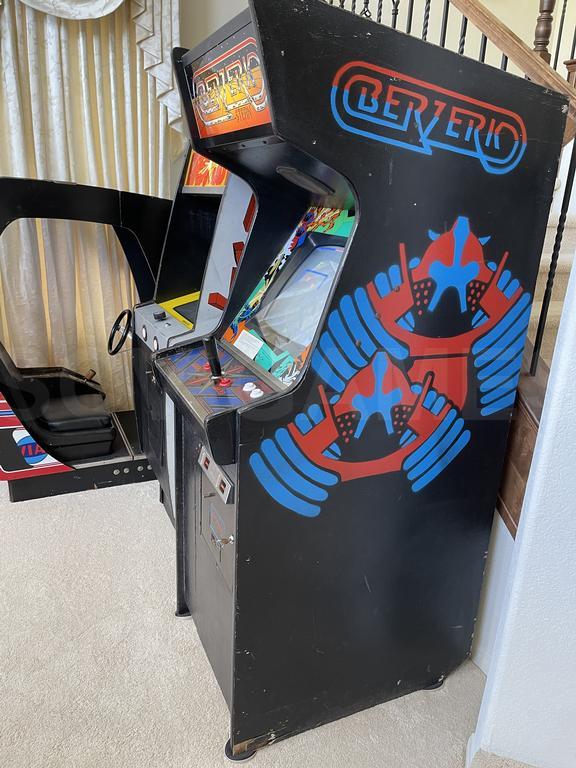
Berzerk and Frenzy use the S14001A on Stern’s VSU-1000 speech hardware. Their external speech ROMs supply the vocabulary that gives the robots their threatening personality. Other documented applications include the Fidelity Talking Chess Challenger, Canon Canola SP1260, Atari’s unreleased Wolf Pack prototype, and Stern’s VSU-100 pinball speech board. That board appeared in Flight 2000, Catacomb, Freefall, Lightning, Orbitor-1, and Split Second. The unreleased Moon War prototype also used this speech system; the released game used different hardware.
A relative of Digitalker, with its own format
Mozer’s speech-compression work also underlies National Semiconductor’s MM54104 Digitalker. The shared lineage does not make their ROMs or interfaces interchangeable. The S14001A’s vocabulary is determined by its own encoded data, whereas the SC-01 and SC-02 provide phoneme-based interfaces for building speech. None of these chips accepts written English without additional conversion software.
Preserving and experimenting with the hardware
The S14001A is a 40-pin device with unusual electrical requirements: +5 V and −10 V supplies. Technical investigations report negative-going levels on the BUSY and audio outputs, so modern microcontroller connections require appropriate interfacing. Jonathan Gevaryahu and Kevin Horton reconstructed its operation, and original designer Ed Bernard later rewrote MAME’s implementation in 2016. Their work preserves both the voice and the circuitry that produced it. The downloadable guide is a reverse-engineered technical reference; some early uncertainties are clarified by the later implementation.
Berzerk — Got the humanoid / Got the intruder
The S14001A’s distinctive robotic voice in Berzerk.
Documentation and downloads
Machines using this chip
Telesensory Systems
Speech+ Calculator
A pioneering handheld talking calculator from Telesensory Systems, using the S14001A to announce key presses and results.
Explore Speech+ Calculator