SynPhonix 200
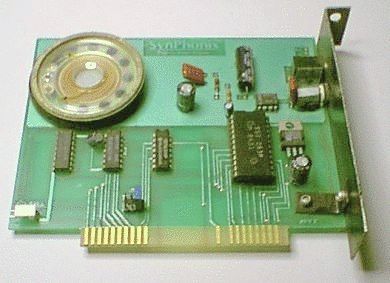
Image gallery
Find a SynPhonix for your collection
Look for SynPhonix cards and related software. Check the model and computer interface before buying.
Search eBay for SynPhonixA voice for the IBM PC
Artic Technologies’ SynPhonix 200 was an internal speech-synthesis card for the IBM PC and compatible computers. Its SSI 263 synthesizer assembled speech from phonemes, giving programs a flexible voice instead of limiting them to a ROM full of complete words. Software shaped those sounds into recognizable English.
The SynPhonix family was advertised for IBM and Apple computers in 1984. Artic promoted educational activities, business applications, entertainment, and access for people with disabilities. The PC Model 200 later became an important companion to screen-reading software.
A small speaker and an expressive synthesizer
The board carried its own speaker, with an external-speaker connection and a volume control at the rear of the computer. A contemporary hands-on review also described using that output to record spoken material onto cassette, including audio versions of software documentation.
The SSI 263 accepts speech-sound codes and control settings rather than written sentences. Its programmable parameters include phoneme duration, inflection, articulation, amplitude, rate, and filter frequency. Changing these settings can alter the rhythm, pitch movement, and character of the resulting voice. Text-to-speech therefore depends on software as well as the chip.
Artic advertised the family for singing and sound effects alongside speech. Those capabilities came from manipulating the synthesizer’s sounds and parameters; they did not turn it into a recording of a human singer.
SONIX and the route from text to speech
Artic’s SONIX speech software provided control over sounds and speech parameters. The Model 200 package included text-to-speech software, a demonstration, and tools for creating fixed-vocabulary files. These files supplied convenient prepared utterances without making the hardware a fixed-vocabulary synthesizer.
Optional vocabulary tools supported more elaborate applications. PortTalk let software send output to the speech system as though it were sending it to a printer. That offered another route for making existing programs speak. A 1987 accessibility resource book listed the Model 200 at $225; prices and bundled software changed over time.
Turning a screen into spoken information
Artic Vision paired the SynPhonix 200 with screen-review and navigation tools for blind users. Reviewers Jim Turri and Curtis Chong described five separately configurable voice settings for video output, review, keyboard input, console output, and printer output. Different pitches, rates, volumes, and tones helped distinguish the source of spoken information. These were software voice profiles, rather than five simultaneous hardware voices.
The program could convey uppercase text through changes in tone and pitch. Its review tools moved through characters, words, lines, sentences, or paragraphs and searched for text. Users could define screen regions to read. In this setting, the card’s adjustable voice was a practical interface: it helped a listener understand and navigate a computer.
Related models, different computers
The SynPhonix name covered several products. The 100 served the Apple II, while the jr version fitted the PCjr’s internal modem slot. Those boards should not be assumed to fit a standard PC just because their speech capabilities were related.
The 1988 resource-book update described the 210 as a successor to the 200. It added a treble adjustment and an Artic switch interface for programmers developing switch-operated applications. The 220 targeted Toshiba 1100, 1200, and 3100 portable computers. These later models extended the family into new forms of computer access.
Preserving the complete speaking system
A working exhibit needs more than the circuit board. The matching speech software turns text into sound instructions, and screen-reading software supplies the navigation that made speech useful in daily computing. Keeping those programs and their documentation together with the hardware preserves both the electronic voice and the ways people used it.
Specifications
- Manufacturer
- Artic Technologies
- Model
- SynPhonix 200
- Platform
- IBM PC and compatible computers
- Format
- Internal expansion card
- Speech synthesizer
- SSI 263
- Synthesis method
- Phoneme-based
- Audio output
- Onboard speaker or external speaker
- Controls
- Rear volume control; software voice settings
- Software
- SONIX text-to-speech; optional PortTalk and Artic Vision
- Period price
- $225 in the 1987 Resource Book
Sources and further reading
- Artic Technologies advertisement: PC Magazine, October 16, 1984
- Trace Center: 1987 Resource Book 3, printed page 123
- Jim Turri and Curtis Chong: hands-on Artic Vision review, printed pages 17–23
- Trace Center: 1988 Resource Book 4, printed page 128
- Silicon Systems: 1985 data book, SSI 263 programming reference