Topo Communications Card
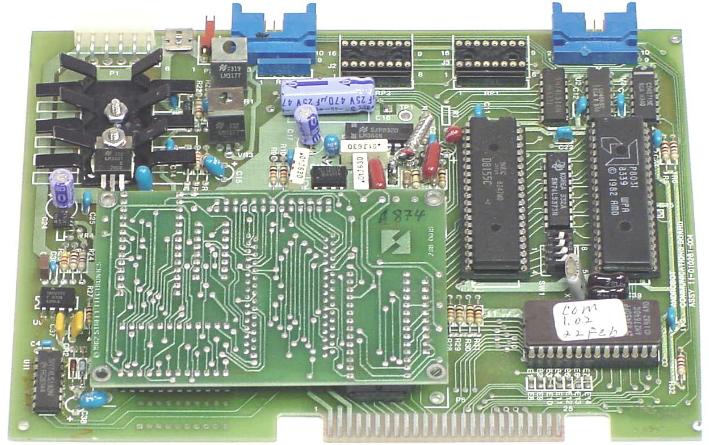
Image gallery
Find TOPO hardware for your collection
Explore current eBay listings for Androbot TOPO robots, speech modules, and related hardware.
Search eBay for TOPO hardwareA computer peripheral with a voice
Androbot’s later TOPO system combined a mobile robot, a remote base communicator, and a host computer. The communications and speech card belonged inside the robot, connecting its electronic voice to the control system. A talking demonstration could make the machine feel like a companion while showing how software, communications, and speech hardware worked together.
Not every TOPO was the same
The November 1983 COMPUTE! review describes an earlier radio-controlled TOPO supplied with an Apple interface card and TopoBASIC. That review treated voice as a future accessory. The subsequent Digital TOPO specification dated December 1, 1983 describes onboard speech and a two-way infrared link. These are different configurations, so the speech and communications specifications should not be applied to every robot bearing the TOPO name.
The ECHO module inside
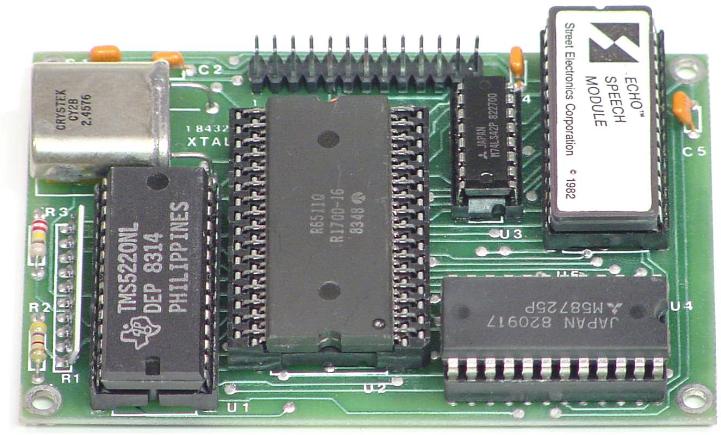
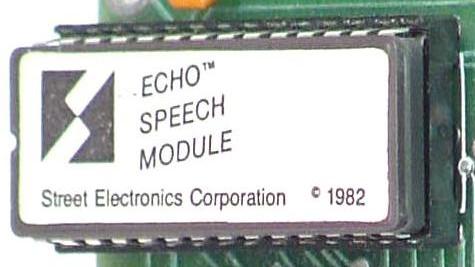
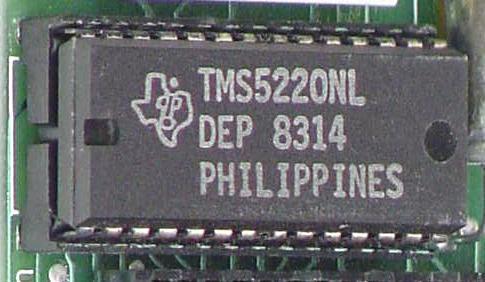
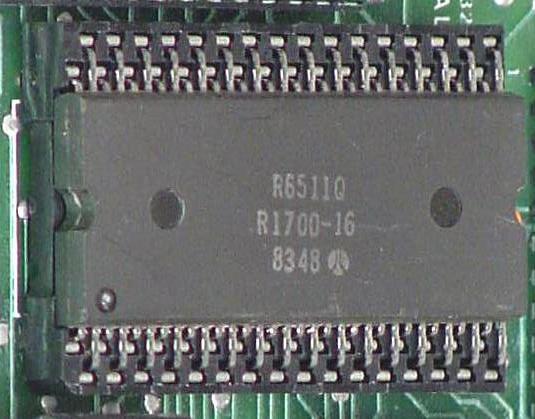
The close-up photographs show a Texas Instruments TMS5220NL, an R6504 processor, an M58725P memory device, and a ROM labeled ECHO Speech Module, Street Electronics Corporation, ©1982. This is a small speech subsystem within the larger robot electronics. The ECHO GP connection is visible in the module’s layout and labeling; the shared ECHO identity does not by itself establish that every ROM revision or interface is interchangeable.
Androbot’s owner’s manual explicitly credits Street Electronics’ ECHO II technology as the foundation of TOPO’s speech module. The photographs and that acknowledgment connect this robot voice with the same ECHO family used for computer speech.
From spelling to speech
Street Electronics describes its ECHO system as a sequence of transformations: text is interpreted using pronunciation rules, converted to phonemes, then translated into linear predictive coding parameters for the TI speech processor. The text-to-speech intelligence belongs to the surrounding software and firmware; the TMS5220 does not read English spelling by itself.
The chip generates an excitation signal and shapes it with a digital filter modeling the vocal tract. Changing the LPC parameters changes the resulting sound. Its output is converted to an analog signal, amplified, and reproduced by the speaker. A compact acoustic description can therefore produce an utterance without storing its complete audio waveform.
A wireless conversation between machines
The Digital TOPO specification gives the infrared link a nominal range of 30 feet and describes acknowledgments and error checking. The base communicator connects to the host over RS-232, with a 9,600-baud host interface and a 1,200-baud robot link. Keeping those two rates separate helps explain the base’s role between computer and robot.
The same specification lists three Intel 8031 controllers across the system: two in the robot and one in the base. Its eight-slot card cage initially uses two slots, for motion and communications/speech. The R6504 visible on the ECHO module is a separate speech-processing component, not one of those 8031 controllers.
Programming the electronic accent
The Apple II+/IIe owner’s manual uses FORTH-based TopoSoft. SAY" accepts text; PHON" accepts phonetic instructions. SET-PITCH offers values 1–63, defaulting to 24, while SET-VOLUME uses 0–15, defaulting to 12. TALK-FAST and TALK-SLOW select speech rates; TALK-LEVEL and TALK-WAVY change intonation.
The Digital TOPO specification lists 48 phonetic symbols and control over pitch, duration, emphasis, and volume. Working with these sounds lets a programmer shape pronunciation more directly than ordinary spelling. A phonetic interface and an LPC synthesizer describe different layers of the same system: the user selects sounds, while the chip produces them from acoustic parameters.
Speech coordinated with movement
TILL-SILENT waits for speech to finish before later commands proceed. SAY-LATER" queues text, and SAY-IT starts the queued speech. These controls let a programmer decide whether an announcement accompanies motion or comes before it. The manual also discusses respelling difficult words and refining sounds in phonetic mode.
What the voice did—and what it meant
The talking TOPO remains a useful example of a speech synthesizer integrated into a larger control system. A host program supplies the actions and utterances; communications hardware delivers them; the ECHO module creates the voice. Speech output alone does not establish speech recognition or independent understanding. The Digital TOPO notice lists voice input among future capabilities under evaluation, rather than a standard built-in feature.
Specifications
- Application
- Onboard communications and speech for later Androbot TOPO systems
- Speech processor shown
- Texas Instruments TMS5220NL
- Speech module
- Street Electronics ECHO; ROM label ©1982
- Module processor shown
- R6504
- Synthesis
- LPC, with ECHO text-to-speech and phonetic control
- Robot link
- Two-way infrared; specified range up to 30 feet
- Link rates
- 9,600 baud host to base; 1,200 baud base to robot