VS-100
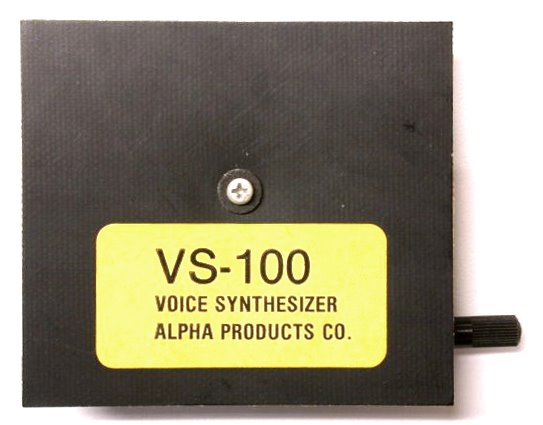
Image gallery
Find a VS-100 for your collection
Search for the synthesizer and supporting material. Check that the interface and software match your TRS-80 model.
Search eBay for VS-100A talking companion for the TRS-80
Alpha Products’ VS-100 brought phoneme speech to the TRS-80. The compact external unit connected to the computer’s expansion bus, while software supplied the pronunciation rules that turned written English into speech. It belonged to the early-1980s wave of accessories that made a home computer’s voice something an owner could program.
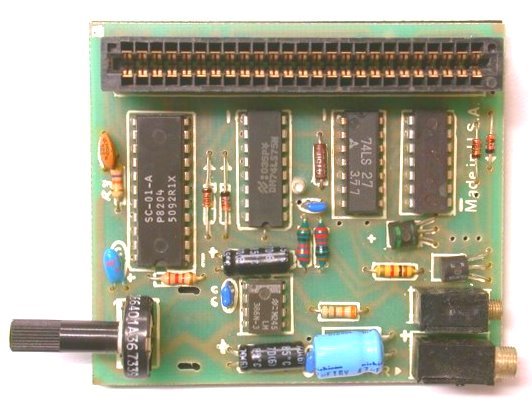
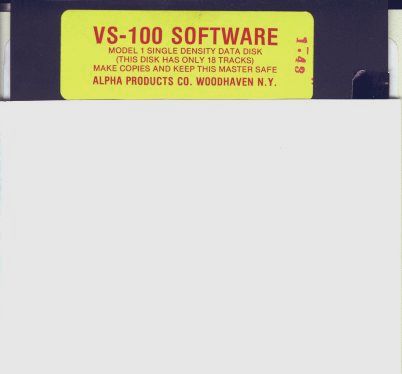
The photographed circuit board is marked Model III and carries a Votrax SC-01-A. The gallery also includes a Model I software disk. These represent different parts of the VS-100 family: the computer interface and software version matter when assembling a working system.
Speech sounds instead of stored sentences
The SC-01 family synthesizes a sequence of phonemes rather than playing recordings of complete words. Its codes select from 64 speech sounds and control four inflection levels. The computer must supply the sequence and timing. Ordinary text therefore needs a pronunciation program before the hardware can say it.
The VS-100 and Radio Shack’s TRS Voice Synthesizer used the same basic chip family, but their computer interfaces and input conventions differed. Software written for one should not automatically be expected to work with the other.
From BASIC to individual phonemes
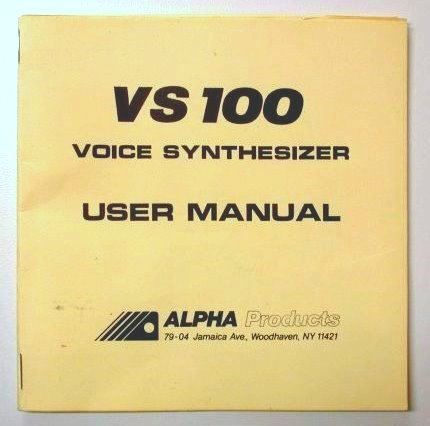
Alpha’s manual describes direct speech output with BASIC’s OUT command at port 11. Its example builds “daddy” from successive sound codes. This gave programmers a way to construct an utterance themselves, bypassing automatic spelling rules.
The Model III requires an additional step: the program enables the I/O bus and checks a busy signal before submitting the next sound. The manual shows a short INP-based polling routine. This handshake keeps the computer from delivering a phoneme while the synthesizer is still occupied.
For text-to-speech, the manual provides VS32 and VS48 drivers for 32K and 48K systems. Loading the appropriate software let the owner work with text instead of manually spelling every word as speech sounds.
How Talker borrowed a BASIC command
Kevin Tschudi, who wrote Alpha’s Talker software, recalled starting with Naval Research Laboratory pronunciation work described in BYTE. The rules considered a letter together with its neighbors to decide which sound to produce—or whether to leave it silent.
Tschudi used a hook in Microsoft BASIC’s PRINT handling. When the command was followed by a star, the software spoke the text BASIC had already parsed; otherwise, it passed control along. That turned PRINT* into a convenient speech command without requiring programmers to abandon familiar BASIC.
The software had a little personality of its own. Tschudi remembered adding a rule to pronounce his surname correctly. Two selected swear words became “bleep,” although creative misspelling defeated the joke. These small touches show the people behind a voice that otherwise sounds distinctly mechanical.
Still speaking after the market moved on
In a 1990 report, Donald W. Ady described buying the Model 3/4/4P version from Alpha. He noted the 50-pin connection used by those machines, the different 40-pin Model I version, and the extension cable needed to reach the Model 4P’s recessed connector.
Tschudi later recalled that Alpha still sold remaining TRS-80 inventory in response to inquiries around 1990, even as most of its business had shifted to IBM PC users. The accessory’s useful life extended beyond the period when its host computer was a mainstream purchase.
Keeping the voice and its software together
The modern Talker/80 project includes a VS-100 compatibility mode that accepts the original phoneme codes and can run software such as VS32 and VS48. It maps the sounds to DECtalk equivalents, so the result differs from an actual SC-01. Its documented compatibility mode also omits the original pitch control.
Compatible replacements help preserve the programs; surviving VS-100 hardware preserves the original electronic accent. The unit, matching interface, power supply, speaker, software, and manual together tell the most complete story.
Specifications
- Manufacturer
- Alpha Products
- Product
- VS-100 Voice Synthesizer
- Photographed hardware
- TRS-80 Model III version
- Other documented versions
- Model I and Model 3/4/4P interfaces
- Format
- External expansion-bus peripheral
- Speech chip
- Votrax SC-01-A on photographed board
- Speech method
- 64 phoneme codes; four inflection levels
- Programming
- Port 11 phoneme output; Model III busy-signal polling
- Text-to-speech drivers
- VS32 and VS48
- Talker command
- PRINT* for spoken text