VTech Learning-Window Voice Cartridge
Explore the SP0256 family, gallery, and samples →
Image gallery
Find Learning-Window speech hardware
Explore eBay listings for VTech Learning-Window and related Spiel-Master hardware.
Search eBay for Learning-WindowSpeech for a teaching machine
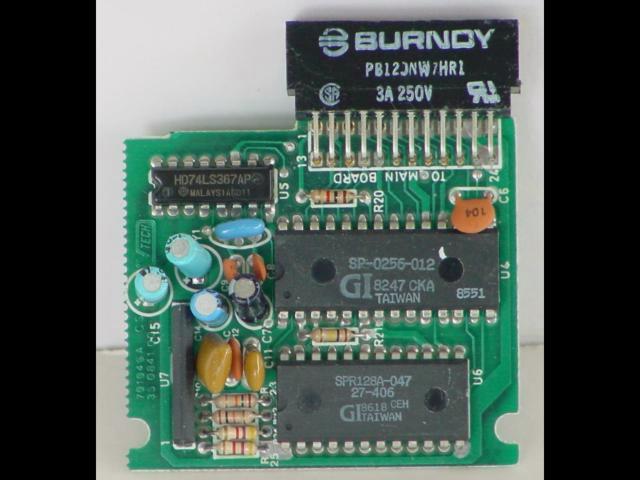
The VTech Learning-Window was a mid-1980s educational machine with cartridge-based expansion. Its Voice Cartridge supplied hardware for spoken output. The SPR128A-047 marking on the board shown here matches the first US speech-cartridge ROM documented in MAME’s Learning-Window hardware notes.
Inside the cartridge
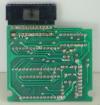
The component-side photograph shows a General Instrument SP0256-012 processor, an SPR128A-047 serial ROM, and an HD74LS367AP logic device. A Burndy connector joins the board to the main unit. The reverse photograph shows how the copper tracks connect the components and host connector.
A processor and a separate speech memory
The SP0256 performs the sound synthesis. The SPR128A-047 supplies encoded speech storage, with 128 kilobits of capacity—16 KB. It is a mask ROM with serial addressing and data-transfer logic, rather than a second voice processor. Its program data must pass to the speech engine before it becomes sound.
How it makes a voice
The SP0256 reconstructs speech from compact acoustic parameters. Periodic pulses or noise excite a programmable 12-pole digital filter that models the vocal tract. Stored instructions change the filter coefficients, pitch, amplitude, and timing. The resulting pulse-width-modulated output requires analog filtering before amplification. This is synthesized speech rather than playback of an ordinary digital waveform recording.
Why the external ROM matters
A general-purpose speech engine can serve different products when the product’s vocabulary comes from external memory. In this design, the serial ROM holds much more data than the SP0256’s 2 KB internal ROM. Its suffix identifies a particular programmed image, so an SPR128 device from another product is not automatically a compatible vocabulary replacement.
Documented revisions and languages
MAME’s preservation notes distinguish the US speech-cartridge ROMs SPR128A-047, SPR128A-089, and SPR128A-099. A firsthand teardown of the German Yeno Spiel-Master documents a related speech cartridge with SPR128A-081 and an SP0256 whose internal ROM was bypassed. That supports the importance of external data in this product family, while also showing why one revision’s speech chip and ROM should not be assumed to describe every version.
The chip marking on this example
The board in this gallery is visibly marked SP0256-012. Other preserved Learning-Window examples are documented with SP0256-AL2 processors. These names identify different internal ROM contents within the same speech-engine family. The external program and circuit determine which data the engine actually uses. The 012 marking alone does not establish that this VTech cartridge speaks the Mattel resident vocabulary, and the bypass arrangement reported for the German board has not been verified for this particular specimen.
What the photographs establish
The images identify the main components, ROM pattern, and board connections. A verified vocabulary listing, circuit trace, and recording from this exact cartridge would be needed to describe all its spoken material and control details. Voice samples from an Intellivoice or AL2 demonstration are therefore not substituted for this cartridge’s own output.
Specifications
- Product family
- VTech Learning-Window
- Function
- Speech expansion cartridge
- Visible processor marking
- SP0256-012
- External ROM
- SPR128A-047, 128 kilobits / 16 KB
- Logic device
- HD74LS367AP
- Period
- Mid-1980s
Documentation and downloads
- SP0256B PDF Datasheet
Technical reference for the indicated processor.
- SPR128 serial speech ROM datasheet