Atari 1400XL & 1450XLD
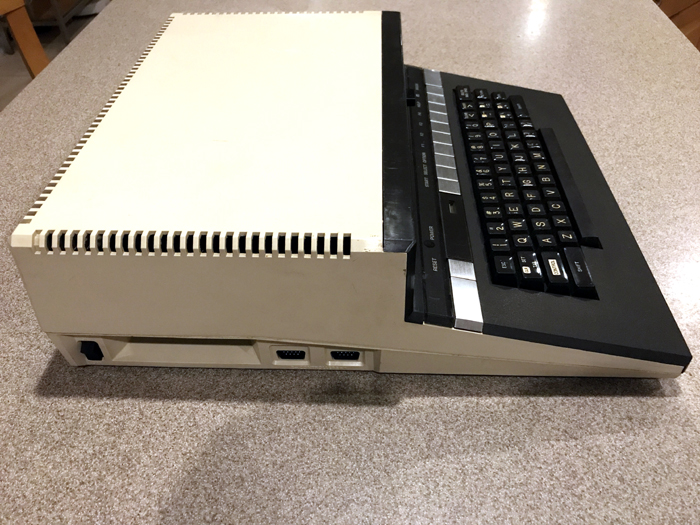
Image gallery
Find an Atari 1400XL or 1450XLD for your collection
These unreleased machines are exceptionally scarce. Search for prototypes, documentation, and related collector material; check carefully whether a listing is original hardware or a reproduction.
Search eBay for Atari 1400XL & 1450XLDShopping through this link helps preserve and grow the SpeechChips Museum. If you make a purchase, we may earn a commission that supports the collection.A voice built into the computer
The Atari 1400XL and 1450XLD were among the rare home computers designed to include a dedicated speech chip as standard equipment, alongside a built-in 300-baud modem. Speech was part of the computer itself, rather than an optional cartridge or external box. Neither model reached a commercial release, but surviving prototypes preserve an unusually ambitious vision of the talking home computer.
They were not the only computers with this idea. Exelvision’s EXL 100 also incorporated a Texas Instruments TMS5220-family speech synthesizer. What makes the Atari designs especially interesting is the combination of onboard Votrax speech and an operating-system interface intended to make speaking another ordinary computer function.
Two machines, one ambitious XL family
Atari showed the 1400XL and 1450XLD alongside the 600XL and 800XL at the June 1983 Summer Consumer Electronics Show in Chicago. Both proposed machines offered 64KB of RAM and built-in modem and speech facilities. The 1400XL retained the low-profile keyboard-computer form; the larger 1450XLD added integrated floppy-disk storage, with room for a second drive.
The disk subsystem evolved during development. Early reporting described a double-sided drive storing approximately 254KB per disk. The later 1450XLD design specified a 360KB drive and a parallel controller. Those figures describe different stages of the project, rather than interchangeable specifications for every prototype.
The first voice: Votrax SC-01
Atari’s 1983 speech-handler specification names the Votrax SC-01 for both computers. It generated phonemes electronically instead of playing recorded words. The computer supplied sequences of sound codes to build speech, with output heard through the television’s speaker.
The chip’s presence did not automatically provide unrestricted English text-to-speech. The documented handler accepted World English Spelling, symbolic Votrax phoneme names, or numeric sound codes. World English Spelling is a phonetic spelling system: the programmer specifies how a word should sound. This distinction matters when comparing the machines with text-reading peripherals.
Speaking through the operating system
The voice appeared as the V: device through Atari’s Central Input/Output system. Software could open a channel and send speech data using familiar I/O operations. Atari’s October 1983 specification distinguished direct, semi-buffered, and fully buffered output. In fully buffered mode, interrupts fed queued phonemes to the chip while the application could continue.
The design also anticipated coordinating speech with graphics. Phoneme and marker counters let programs track progress; an application could attach synchronization code to the interrupt routine. Atari explicitly suggested synchronizing a graphical mouth with spoken sounds. Speech was being planned as an interactive feature, not merely a startup novelty.
The later 1450XLD: SC-02 / SSI-263
The 1984 TONG redesign changed the voice hardware. Atari’s preliminary Resident Voice Handler specification, dated May 24, 1984, identifies the Silicon Systems SSI-263, also called the SC-02. It should not be confused with the SC-01 used in the earlier design.
The newer chip exposed five registers for phoneme and duration, inflection, rate, control and amplitude, and filter frequency. Atari mapped these at $D100–$D104. Its handler queued five bytes for each phoneme and transferred them to the chip in response to interrupts, providing much more expressive control than simply selecting a sound.
The May document describes numeric mode and says the handler is incomplete, with other modes still to be documented. It also defines a synchronization command that waits for queued speech to finish. This was a developing implementation, so the early SC-01 handler’s commands and data should not be assumed to work unchanged on a TONG prototype.
A computer that could speak over the telephone
The built-in modem made speech more than a local effect. Atari’s June 1983 integral-modem specification describes transmitting audio from POKEY or the onboard speech device over the telephone line. Contemporary CES reporting also highlighted sending the synthesized voice through the modem.
That combination suggested spoken prompts, talking communications software, and interactive telephone experiments in a single machine. It is a striking reminder that Atari was considering voice as part of a connected computer long before modern voice assistants.
The future that stayed a prototype
Promised release dates passed as development continued. The 1450XLD went through substantial motherboard and disk-controller changes, including the earlier short-board design and the later TONG board. Neither the 1400XL nor the 1450XLD ultimately shipped as a normal retail product.
For the speech enthusiast, their significance is the attempt to make a dedicated voice an expected part of the computer. The surviving hardware and engineering documents capture both generations of Votrax technology inside Atari’s planned flagship machines: an electronic voice that was meant to leave the accessory shelf and become standard equipment.
A new life: the community builds the missing Atari
The story continues with Dropcheck’s 1450XL replica project at Bits of the Past and the builders contributing through AtariAge. The public development thread began on December 1, 2023. Its first goal was to reproduce the pre-production 1450XL motherboard as faithfully as possible before exploring modern changes. This is a working-hardware preservation effort, rather than simply recreating the appearance of an unreleased computer.
The effort depended on both preserved documentation and surviving machines. Dropcheck entered Atari’s schematics into DipTrace and checked dimensions and connections against a borrowed bare board. AtariAge contributor kheller2 supplied the board; AtariGeezer provided measurements and hardware comparisons, while KLund1 offered measurements from a surviving TONG system. These contributions helped separate the earlier short-board design from the later, substantially different TONG revision.
From replica to remix: 1450XL, 1250XL, and 850XL
Bits of the Past describes its 1450XL board as a replica of the pre-production design. The project then branched into the 1250XL, arranged for a 1200XL case, and the 850XL, arranged for an 800XL case. These are modern project names and designs, not newly discovered Atari production models.
The remixes remove the built-in modem, parallel-drive connector, and RF modulator while retaining the other 1450XL features, including onboard speech. They also provide connections for upgrades such as PokeyMax, Sophia, UGV II, and a MIDI player. The result gives builders a more practical home for the talking-computer concept without requiring the original unreleased enclosure.
The project also documents SALT diagnostic and Telecommunicator cartridges. The latter uses the speech chip to announce communications feedback, although its modem-dependent operation does not carry over unchanged to the modem-less remixes.
Preserving the circuit, and the experience
The development thread records the less glamorous work that makes a recreation useful: tracing connections, comparing schematics, testing original and replacement components, and investigating expansion-bus compatibility. In December 2024, Dropcheck reported basic tests completed while external PBI-device problems still required investigation, with reifsnyderb helping troubleshoot. The project page later reported that most external PBI devices worked, while stopping short of promising universal compatibility.
For this museum, the important achievement is that a computer which never reached normal retail production can be built and explored again. Its voice becomes something an enthusiast can program and hear, rather than merely a feature in a forty-year-old advertisement. The replica and its remixes remain distinct from original Atari prototypes and from a complete recreation of the later 1450XLD TONG system.
Specifications
- Manufacturer
- Atari, Inc.
- Status
- Unreleased prototypes; announced June 1983
- RAM
- 64KB in the announced 1983 configurations
- Communications
- Built-in 300-baud modem
- Early speech hardware
- Votrax SC-01
- Speech interface
- V: operating-system device handler
- 1450XLD storage
- Built-in floppy drive; specifications changed during development
Sources and further reading
- Atari 1400XL Product Specification, Revision 1A
- Atari Speech Handler specification — October 14, 1983, Revision C
- Atari 1450XLD TONG Resident Voice Handler — May 24, 1984
- Atari 1400XL Integral Modem specification — June 20, 1983
- Summer CES report — COMPUTE!, August 1983
- Atari Museum — 1450XLD prototypes and development revisions
- Atarimania — unreleased Atari XL computers
- Contemporary EXL 100 report — built-in TI speech hardware
- Bits of the Past — 1450XL replica, 1250XL and 850XL remixes, and test cartridges
- Dropcheck and AtariAge — Building & Testing the Re-imaged Atari 1450XL
- AtariAge project thread — original-board measurements and community contributions
- AtariAge project thread — functional tests and PBI troubleshooting, 2024