HERO 1 Speech Card
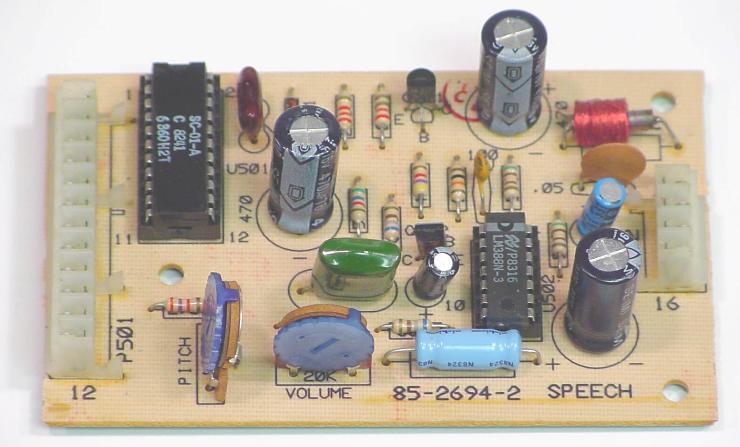
Image gallery
Find HERO speech hardware for your collection
Explore eBay listings for HERO 1 speech boards, voice kits, and related documentation.
Search eBay for HERO speech hardwareA voice for Heathkit’s educational robot
The ET-18-2 speech option gave Heathkit’s HERO 1 a programmable voice. Heathkit marketed the robot as a platform for learning about microprocessors, sensors, motion, and control. Speech let a program report what the robot was doing and added personality to demonstrations. It was an option for the basic robot kit; the complete assembled configuration included voice and the arm.
The board in this collection
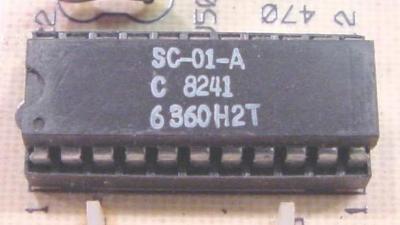
The photographed board is marked 85-2694-2 SPEECH. Its socketed speech IC is clearly labeled Votrax SC-01-A, and an LM386 audio amplifier sits alongside it. PITCH and VOLUME adjustments are visible at the bottom edge. The two photographs show the complete board and a close view of the speech processor.
Words assembled from phonemes
The SC-01-A generates selected speech sounds rather than reading English text or retrieving a prerecorded word for every command. Its six phoneme inputs select one of 64 codes, including silence and stop functions. A host program sequences these codes to build an utterance. The speech inventory is small, but the possible combinations are much larger than a fixed list of complete words.
How the Votrax voice works
The SC-01 family uses a vocal-tract model implemented with analog circuitry controlled by digital sound codes. Excitation and filtering produce voiced and unvoiced sounds, while changing control parameters shape the resonances needed for each phoneme. The circuitry also manages transitions between sounds. This differs from the SP0256’s digital LPC filter, although both approaches aim to reproduce the acoustics of a human vocal tract.
The speech card and the robot computer
HERO’s computer supplies the ordered phoneme and inflection data. The speech IC produces the acoustic signal, and the board’s amplifier drives the robot’s speaker. The card contains no keyboard, English parser, or independent conversational intelligence. What the robot says depends on its program, even when the speech appears to respond to a sensor or movement.
The voice dictionary
Heathkit’s Robot Voice Dictionary helped programmers turn words into sound sequences. John Fulcher’s University of Wollongong report describes a 750-word reference and recommends adapting a similar-sounding entry before constructing a new pronunciation from scratch. It also notes standard phrases stored in robot ROM. The printed dictionary is a programming aid, not a 750-word storage limit inside the SC-01-A.
Four inflection levels
Two inflection bits accompany each phoneme code, selecting four pitch levels. Fulcher documents adding hexadecimal 40, 80, or C0 to the base phoneme byte to select the higher levels. This lets a sequence vary its intonation without changing the low six bits that identify the sound. The board’s PITCH adjustment sets the hardware operating point; it is distinct from the inflection information sent with individual phonemes.
Speech and motion together
HERO’s interpreter provides speech modes that either speak before movement continues or allow speech while the robot moves. The choice lets a demonstration announce a step first or narrate activity during motion. Fulcher’s report places the speaker at the front of the robot’s head and documents the speech output port at hexadecimal C240. Correct sequencing links speech and movement into one program.
Why readiness matters
A phoneme synthesizer needs correctly timed selections. The SC-01’s acknowledgment/request signal tells the host when another sound can be accepted. Firmware must coordinate that handshake with its stored speech sequence. Sending a stream of codes without observing the interface timing can alter or lose speech. The robot’s higher-level speech commands hide some of this work from the person entering a demonstration program.
A distinctive electronic accent
Phoneme choice, ordering, pauses, and inflection strongly affect intelligibility. English spelling does not directly specify these sounds, so unfamiliar words and names need pronunciation work. The result has the characteristic Votrax accent: recognizable language generated from a compact acoustic model, rather than a recording of a person reading each complete sentence.
Educational value
The voice card makes the division between software and hardware unusually clear. A stored sequence describes what to say; digital control lines select speech sounds; the synthesizer turns those selections into an analog voice; and the amplifier makes it audible. Paired with the robot’s sensors and motion programs, speech becomes a practical lesson in how a computer communicates with the physical world.
Specifications
- Manufacturer
- Heathkit
- Host
- HERO 1 / ET-18 robot
- Voice option
- ET-18-2
- Pictured PCB
- 85-2694-2
- Speech IC
- Votrax SC-01-A
- Speech input
- Phoneme codes and two inflection bits
- Audio amplifier
- LM386
- Visible adjustments
- Pitch and volume
Phoneme byte and inflection
| Byte field | Function |
|---|---|
| Low six bits | Select phoneme code |
| Upper two bits | Select one of four inflection levels |
| Base code + 0x40 | Next pitch level |
| Base code + 0x80 | Third pitch level |
| Base code + 0xC0 | Highest pitch level |