Mockingboard
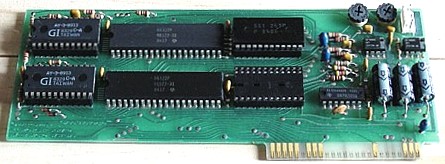
Image gallery
Find a Mockingboard for your collection
Search for Mockingboard hardware and related material. Check the model, fitted speech chip, and software when comparing listings.
Search eBay for MockingboardMusic, sound effects, and a voice for the Apple II
Sweet Micro Systems’ Mockingboard expanded the Apple II’s sound capabilities during the early 1980s. Depending on the model, it could provide musical tones, noise effects, synthesized speech, or a combination of all three. The name covers a family of products, rather than one fixed hardware configuration.
This distinction matters particularly in a speech museum. A Mockingboard that plays music is not necessarily equipped to talk: some boards were sold without a speech chip, while others combined sound generators and a phoneme synthesizer. The sound-only models and speech upgrades are therefore part of the same story.
Several sounds at once
The stereo models used two General Instrument AY-3-8913 sound generators, providing six tone channels divided between two audio outputs. Programmers could vary pitch and volume and combine tones with noise to make musical arrangements or effects.
Sweet Micro Systems’ sound-programming documentation describes registers for tone periods, a noise generator, channel mixing, amplitude, and envelope control. The Apple wrote settings to the sound hardware, which then generated the audio. This allowed musical activity to continue between software updates instead of requiring every waveform transition to be produced directly by the processor.
The sound generator and speech synthesizer had different jobs. One produced musical tones and noise; the other assembled a voice. Hearing a rich Mockingboard soundtrack therefore does not establish that a program also used its speech option.
Two generations of phoneme speech
Early Speech I and Sound/Speech I boards used the Votrax SC-01 family. Later speech-capable versions used the SSI 263 family, also known as the SC-02. These synthesizers build utterances from speech sounds rather than selecting only from a fixed list of complete words.
The sound hardware alone could not perform that job. A speech-enabled board required the appropriate synthesizer and software, and the early and later speech implementations should not be treated as interchangeable simply because both carried the Mockingboard name.
The model comparison below shows how sound-only boards, dedicated speech boards, and combined models fitted into the product family.
Teaching the computer how to speak
Sweet Micro Systems’ early speech manual describes software that converted written text into speech codes using pronunciation rules. Owners could experiment with a Rule Editor, correct troublesome names, and incorporate speech into their own programs. The manual used the name Robert as an example of a pronunciation that needed adjustment.
Punctuation helped direct the voice: a question mark could raise the ending pitch, while a period could lower it. Slash markers placed around parts of a word added stress. The manual presented the user as a director, shaping the performance rather than merely entering a sentence.
The resulting voice could be expressive by the standards of its time, but English spelling still posed problems. Editable rules gave an owner a practical way to improve an awkward pronunciation. These examples belong to the early speech software; later chip and driver combinations could behave differently.
Games used music and speech differently
The ReActiveMicro documentation lists Mockingboard support in Ultima III, IV, and V, noting that Ultima III gained support in an updated release and that Ultima V could use two boards. It separately identifies Rescue Raiders version 1.3 as using SSI263 speech.
Music support and speech support were separate features of an application. Software written for a sound-only board might never address a speech chip, while a speech-enabled title could depend on a specific synthesizer or driver. The game version, hardware model, and installed speech option all matter.
A card, speakers, and matching software
The slot-based Mockingboards connected to the Apple II expansion bus. Modern compatible boards are commonly installed in slot 4; software may expect a particular slot or offer a selection. The historical Mockingboard D was different: it was an external product for the Apple IIc, connected through a serial port.
Audio connections also varied across models and later recreations. ReActiveMicro’s designs offer a connection for the Apple’s own speaker signal and a means of routing speech to both output channels. Those conveniences should not be assumed to exist on every vintage board.
A design that continued to speak
ReActiveMicro began reproducing Mockingboard hardware in 2005. Its account describes tracing the original design, producing boards in assembled and kit forms, and making later revisions to the audio routing. These recreations helped keep compatible music and speech hardware available to Apple II enthusiasts.
Tom Charlesworth’s MB-Audit project tests real Mockingboard hardware as well as emulator implementations. It checks sound and speech components, including SC-01 and SSI263 devices, and uses recognizable phrases from Classic Adventure and The Spy Strikes Back in speech tests.
The combination of surviving boards, manuals, compatible recreations, and diagnostic software makes the Mockingboard more than a remembered accessory. It remains a way to hear how programmers gave an Apple II music and personality.
Specifications
- Manufacturer
- Sweet Micro Systems
- Platform
- Apple II family; D model designed for Apple IIc
- Format
- Internal expansion card; D model external
- Sound generation
- AY-3-8913 in later stereo models
- Tone channels
- Three or six, depending on model
- Early speech hardware
- Votrax SC-01 family
- Speech vocabulary
- Phoneme-based; pronunciation handled by software
- Speech availability
- Model-dependent; optional upgrade on several boards
The principal Mockingboard models
| Model | Sound | Speech / format |
|---|---|---|
| Sound I | Three tone channels | Sound only |
| Speech I | Speech output | SC-01 |
| Sound II | Six tone channels | Sound only |
| Sound/Speech I | Three tone channels | SC-01 |
| Mockingboard A | Six tone channels | Sockets for speech upgrades |
| Mockingboard B | Upgrade kit | SSI 263 speech chip, rather than a complete card |
| Mockingboard C | Six tone channels | A with an SSI 263 fitted |
| Mockingboard D | Six tone channels | External Apple IIc product with SSI 263 |
| Mockingboard M | Six tone channels | Bundled with Bank Street Music Writer; speech socket |