Voice Synthesizer IC Set
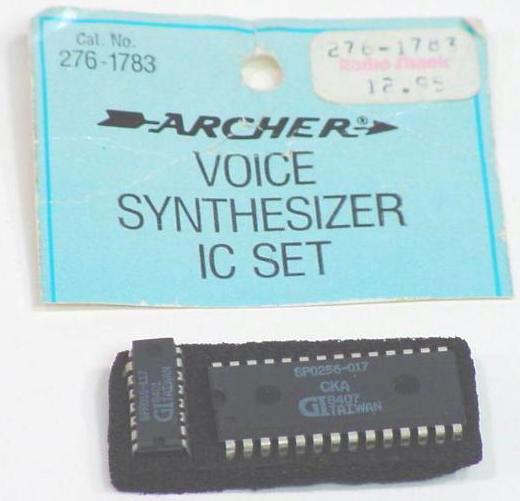
Image gallery
Find the Archer IC set for your collection
Search for the packaged set, its processor, or its companion speech ROM.
Search eBay for the Archer IC setSpeech synthesis from the parts counter
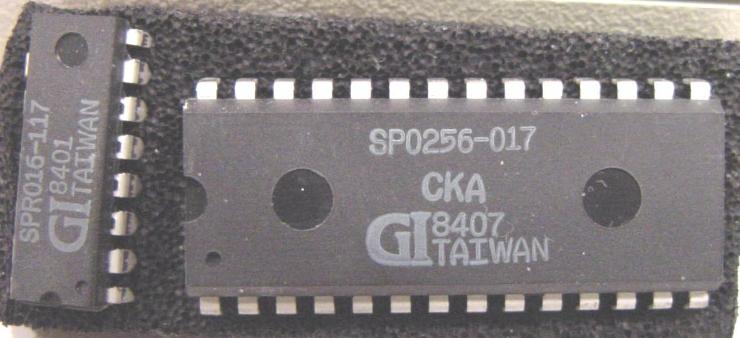
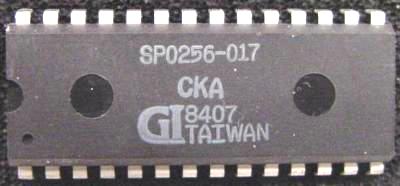
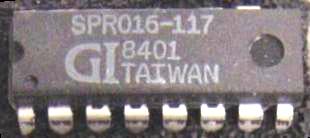
Radio Shack sold this set under its Archer component brand as the Voice Synthesizer IC Set. The photographed package carries catalog number 276-1783. Its two devices are visibly marked SP0256-017 and SPR016-117, both made by General Instrument. The retail name describes the packaged product; the markings identify the particular speech processor and ROM inside.
The custom 017 vocabulary
This set speaks prepared number words, clock phrases, and three melodies. The selection table contains 36 entries, numbered 0–35. Numbers above twenty are assembled from tens and units: thirty-five is a selection of “Thirty” followed by “Five,” rather than entry 35. Entry 35 actually selects Melody C.
The processor and the companion ROM
The SP0256-017 generates speech; the SPR016-117 stores encoded speech information. The processor also has 16 kilobits of internal ROM—2 KB—for instructions and data. The companion is another 16-kilobit speech ROM, not an audio amplifier or independent voice chip. The vocabulary table applies to the paired set and does not establish which memory holds each individual utterance.
How the electronic voice is made
General Instrument’s SP0256 documentation describes a programmable digital vocal-tract filter, an internal controller, stored instructions and data, and pulse-width-modulated output. Stored parameters govern excitation, pitch, amplitude, and the filter response. External low-pass filtering turns the digital output into an audio signal, which can then be amplified for a speaker. A melody and a spoken word are different programmed uses of that synthesis hardware.
Why the external ROM matters
The SPR016-117 uses the speech processor’s specialized serial interface. Serial address, clock, control, and data connections let the processor retrieve its program and sound information. It is not a standard parallel EPROM socket: memory capacity alone does not make another device compatible. The suffix 117 identifies custom contents, so another SPR016 part can have the same general interface yet contain a different vocabulary.
Choosing and joining the utterances
A controller supplies a selection on A1–A8 and pulses the active-low ALD input. LRQ indicates when the input latch can accept another selection; SBY indicates that speech is inactive. Observing readiness lets a project join separate entries into an announcement. The input latch is not a long text or sentence buffer.
An example time announcement
A controller announcing 7:35 P.M. can select “It Is,” “Seven,” “Thirty,” “Five,” and “P.M.” in order. Those entries are decimal 24, 7, 21, 5, and 26. The controller keeps time and chooses the sequence; the IC set supplies the voice. Additional circuitry provides power, the synthesis clock, selection logic, audio filtering, and amplification as required.
Different from the AL2 package
The SP0256-AL2 stores its allophone inventory in its internal ROM. A host sequences those sounds to construct words. The 017 set instead offers ready-made vocabulary suited to time announcements. Its external ROM is part of that custom arrangement; it does not imply that an AL2 needs an external ROM for its own allophones.
A misleading technical-sheet heading
The archived 276-1783 technical sheet labels its front page SP0256-AL2, although the table inside contains clock utterances and melodies. The photographed SP0256-017 marking and the supplied vocabulary identify the actual custom set. The AL2 heading should not be used to substitute the AL2 allophone table for this one.
Notes for building a working circuit
A documented breadboard reconstruction reports two mistakes in the supplied application drawing: ALD must be able to pulse low, and SE must be held high for normal strobed operation. Check the pin descriptions as well as the drawing. The reconstruction provides a tested alternative schematic; it is listed in the references below.
A hobbyist route to a talking project
The set demonstrates how a specialized speech vocabulary could become a component for another design. A builder could turn a clock, reminder, or demonstration into an audible device by choosing the available phrases. It is a speech subsystem, not a complete clock and not an English text-to-speech converter.
Specifications
- Retail brand
- Archer / Radio Shack
- Package name
- Voice Synthesizer IC Set
- Catalog number
- 276-1783
- Speech processor
- General Instrument SP0256-017
- Companion ROM
- General Instrument SPR016-117
- Sound selections
- 36 listed entries: number words, clock phrases, and three melodies
- Input
- Eight-bit selection with load/request handshake
Talking-clock selection table
| Decimal | Hexadecimal | Utterance |
|---|---|---|
| 0 | 00 | Oh |
| 1 | 01 | One |
| 2 | 02 | Two |
| 3 | 03 | Three |
| 4 | 04 | Four |
| 5 | 05 | Five |
| 6 | 06 | Six |
| 7 | 07 | Seven |
| 8 | 08 | Eight |
| 9 | 09 | Nine |
| 10 | 0A | Ten |
| 11 | 0B | Eleven |
| 12 | 0C | Twelve |
| 13 | 0D | Thirteen |
| 14 | 0E | Fourteen |
| 15 | 0F | Fifteen |
| 16 | 10 | Sixteen |
| 17 | 11 | Seventeen |
| 18 | 12 | Eighteen |
| 19 | 13 | Nineteen |
| 20 | 14 | Twenty |
| 21 | 15 | Thirty |
| 22 | 16 | Forty |
| 23 | 17 | Fifty |
| 24 | 18 | It Is |
| 25 | 19 | A.M. |
| 26 | 1A | P.M. |
| 27 | 1B | Hour |
| 28 | 1C | Minute |
| 29 | 1D | Hundred Hour |
| 30 | 1E | Good Morning |
| 31 | 1F | Attention Please |
| 32 | 20 | Please Hurry |
| 33 | 21 | Melody A |
| 34 | 22 | Melody B |
| 35 | 23 | Melody C |
Documentation and downloads
- SP0256B PDF Datasheet
Technical reference for the indicated processor.
- SPR016 serial speech ROM datasheet