SPEECH CHIP COLLECTION
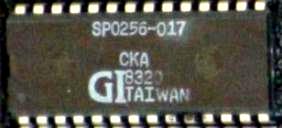
SP0256-017
Custom talking-clock speech processor, sold with the SPR016-117 serial speech ROM as Radio Shack’s Archer voice-synthesizer set.
Overview
The SP0256-017 gives the SP0256 speech engine a vocabulary tailored to announcing time. Radio Shack sold it with the SPR016-117 companion ROM under the Archer brand, catalog number 276-1783. Unlike the SP0256-AL2, this set selects prepared words, phrases, and melodies rather than isolated English allophones.
Explore the SP0256 family, gallery, and samples →
Image gallery
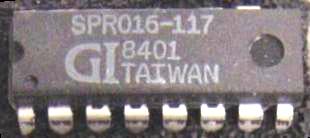
Two chips, two jobs
The SP0256-017 performs speech synthesis; the SPR016-117 supplies external encoded speech storage. The SP0256 also contains its own 16-kilobit internal program ROM. These memories belong to the speech system, not to the timekeeping mechanism. The 017 and 117 suffixes identify the paired custom contents; they do not mean that either device can be reprogrammed by the clock owner.
A voice set is not a complete clock
A controller must keep time and choose the utterances needed to announce it. The speech processor does not count seconds, maintain a calendar, or automatically decide what to say. Its selection inputs let a circuit or computer call up the desired entries. A project also needs the clock oscillator, suitable power, audio filtering, amplification, and the control circuitry appropriate to its design.
Building time announcements from words
The vocabulary includes separate number words and tens, allowing a controller to assemble minute values rather than store a complete recording for every possible time. For example, thirty-five can be formed by selecting “thirty” and “five.” Clock-related entries provide the surrounding phrasing. The table below lists selection codes for the paired set; it does not assign each utterance to a specific internal or external memory location.
How the serial ROM participates
The SPR016-117 is a specialized speech ROM with 16 kilobits of storage—2 KB—not a second synthesizer. Serial transfer and control logic deliver encoded instructions and parameters to the SP0256. The external ROM must be connected according to the matching speech-system circuit. A generic parallel EPROM or a different SPR016 vocabulary cannot be assumed to be an interchangeable replacement.
The same vocal-tract engine, different contents
Like other SP0256 variants, the 017 uses a digital vocal-tract model. Pulse or noise excitation passes through a 12-pole filter, with the stored program controlling pitch, amplitude, filter coefficients, and timing. A pulse-width-modulated output becomes audio after filtering. Numbers, phrases, and simple musical sequences can therefore share the same hardware; the sound set resides in the speech program.
Sending a selection
In the usual strobed mode, the controller places the selection code on A1–A8 and pulses the active-low ALD input. LRQ reports whether another selection can be loaded, while SBY indicates inactivity. Waiting for readiness is important when joining words into an announcement. A controller can prepare the next selection while the current sound plays, but the chip has only one pending-selection latch, not a long sentence buffer.
Notes for recreating the circuit
A published breadboard reconstruction identifies two errors in the supplied application drawing: ALD must be able to pulse low rather than being tied directly to +5 V, and SE needs the correct high state for strobed selection. Consult the pin-function descriptions alongside the drawing. Crystal frequency influences speech speed and pitch, so a clock change affects both rather than independently adjusting pronunciation.
A useful contrast with AL2
AL2 lets a host build many words from allophones. The 017 set trades that broad sound inventory for ready-made vocabulary suited to a particular job. A talking clock needs reliable time words much more than arbitrary text-to-speech. Neither suffix changes the basic SP0256 synthesis engine; the speech contents and supporting circuit determine the application.
Reading the Archer sheet carefully
The archived 276-1783 sheet labels its front page “SP0256-AL2,” but its vocabulary table lists the clock words and melodies rather than the AL2 allophones. Use the actual chip markings and the clock vocabulary to identify this set; that heading should not be taken as evidence that the two ROM patterns are the same.
Talking-clock selection table
| Decimal | Hexadecimal | Utterance |
|---|---|---|
| 0 | 00 | Oh |
| 1 | 01 | One |
| 2 | 02 | Two |
| 3 | 03 | Three |
| 4 | 04 | Four |
| 5 | 05 | Five |
| 6 | 06 | Six |
| 7 | 07 | Seven |
| 8 | 08 | Eight |
| 9 | 09 | Nine |
| 10 | 0A | Ten |
| 11 | 0B | Eleven |
| 12 | 0C | Twelve |
| 13 | 0D | Thirteen |
| 14 | 0E | Fourteen |
| 15 | 0F | Fifteen |
| 16 | 10 | Sixteen |
| 17 | 11 | Seventeen |
| 18 | 12 | Eighteen |
| 19 | 13 | Nineteen |
| 20 | 14 | Twenty |
| 21 | 15 | Thirty |
| 22 | 16 | Forty |
| 23 | 17 | Fifty |
| 24 | 18 | It Is |
| 25 | 19 | A.M. |
| 26 | 1A | P.M. |
| 27 | 1B | Hour |
| 28 | 1C | Minute |
| 29 | 1D | Hundred Hour |
| 30 | 1E | Good Morning |
| 31 | 1F | Attention Please |
| 32 | 20 | Please Hurry |
| 33 | 21 | Melody A |
| 34 | 22 | Melody B |
| 35 | 23 | Melody C |
Documentation and downloads
Machines using this chip
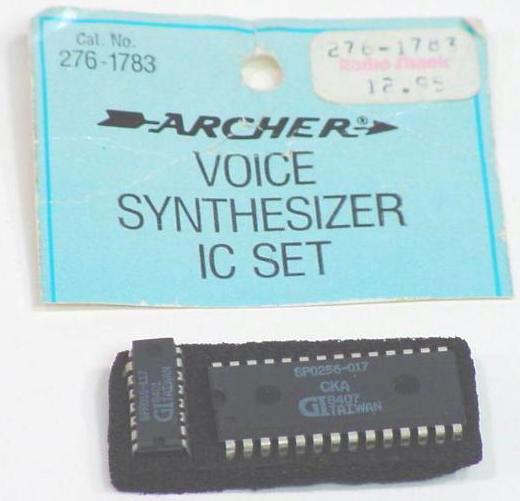
General Instrument
Voice Synthesizer IC Set
Archer catalog 276-1783 paired the SP0256-017 talking-clock processor with the SPR016-117 speech ROM.
Explore Voice Synthesizer IC Set