The Alien Group Voice Box
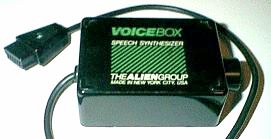
Image gallery
Find a Voice Box for your collection
Explore eBay listings for Atari Voice Box hardware and related material. Check the platform and version when comparing listings.
Search eBay for Atari Voice BoxGiving the Atari a voice
The Alien Group’s Voice Box brought synthesized speech to Atari 400 and 800 owners in 1982. The small external unit plugged into the computer’s serial input/output connector and sent its voice through the television speaker. Power came from the Atari, so there was no separate power supply to find room for on the desk.
Its black case measured approximately 3 × 4 × 1½ inches, with a permanently attached cable and a prominent control knob. The knob changed speech speed and pitch together, letting the same words move from a low, slow voice toward a higher, faster one. Contemporary Atari reviews listed the package at $169.
The Votrax voice inside
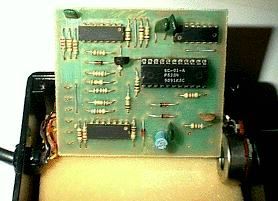
The photographed board contains a Votrax SC-01-A speech synthesizer. The SC-01 family builds speech from phoneme codes rather than playing back a fixed collection of complete words. Its 64 phoneme selections and digital pitch controls provided the raw materials for a wide vocabulary—but turning those sounds into convincing language was the job of the computer’s software.
The circuit-board photograph also shows several other integrated circuits with their markings removed. That makes the remaining SC-01-A identification especially useful when examining this unit. The pictures show both the compact finished box and the electronics that gave it a voice.
Teaching it how to pronounce words
The early software used editable pronunciation dictionaries. Owners could associate a written word with a sequence of phonetic symbols, save the dictionary, and reuse the pronunciation later. This offered control over troublesome spellings and names, rather than guaranteeing that any ordinary sentence would be pronounced correctly on the first attempt.
COMPUTE!’s November 1982 review described hyphens separating the phonetic components and slash symbols altering inflection. The software package also supplied a program framework for adding speech to BASIC applications. In its standard form, the speech routine waited while an utterance played; advanced machine-language programming offered more control. The display did not have to disappear during speech.
A talking face on the screen
The Voice Box was sold with more than a hardware interface. ANTIC’s October 1982 review described 16 KB and 32 KB software versions, dictionaries, and programs that helped owners add spoken output to their own applications. The larger version included an animated head with lips synchronized to the voice.
Its demonstration software could also assemble random sentences. A machine that delivered unexpected combinations of familiar words, accompanied by a moving face, felt more like a character than a conventional peripheral. Reviewers suggested practical uses too: spoken disk menus, audible error messages, spelling exercises, and talking games.
The last device in the chain
The Atari’s SIO connection normally allowed peripherals to be connected in a daisy chain, but Voice Box had to occupy the end of it. This was also where the cassette recorder ordinarily connected. For cassette-based software, programs therefore had to be loaded before the recorder was replaced by the speech unit.
That detail is important when understanding how owners actually used the product. Voice Box was an external speech peripheral, not a ROM cartridge that simply added a new BASIC command at power-up. Its voice depended on the accompanying driver and application software.
Voice Box II: talking became singing
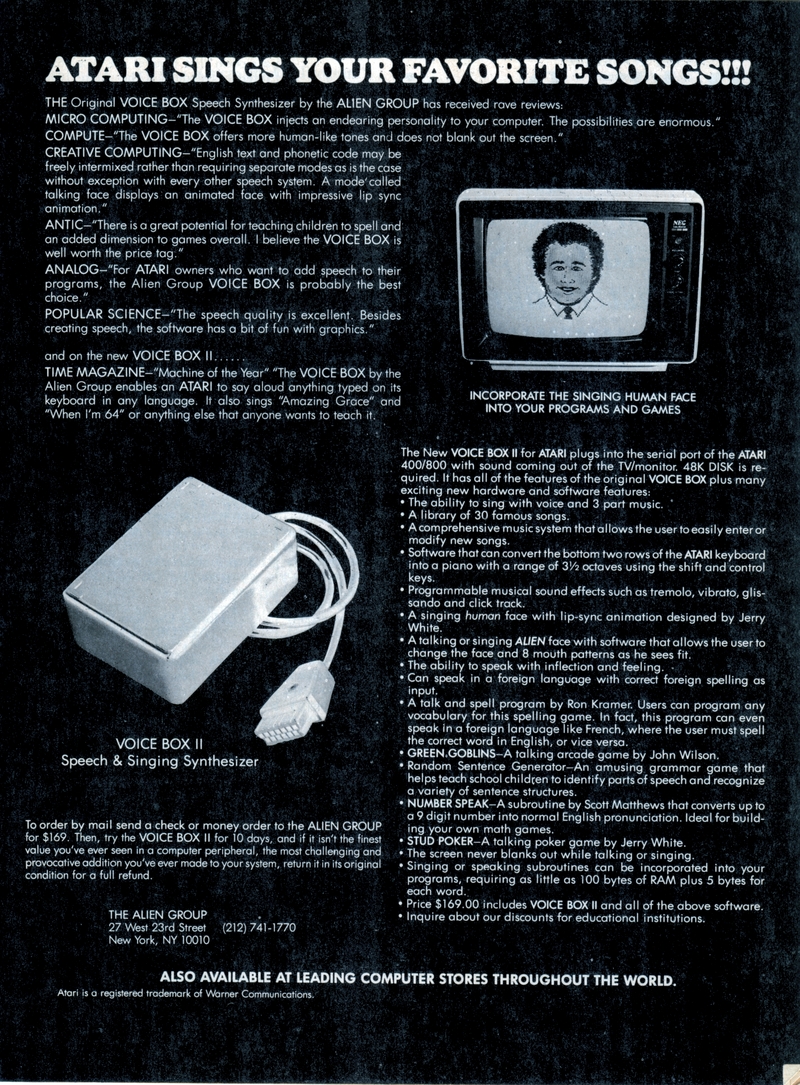
By May 1983, The Alien Group was advertising Voice Box II for a 32 KB Atari disk system. The announcement emphasized singing, inflection, and a music editor, along with a collection of 30 songs. A keyboard-piano program spanned 3½ octaves, and the software offered effects such as vibrato, tremolo, and glissando.
ANTIC’s November 1983 review described a customizable, symmetrical face editor and a disk of five games: Concentration, Stud Poker, Spelling, Acey Deucey, and Green Goblins. Ron Kramer’s spelling program asked players to type a spoken word and congratulated correct answers. These were features of the later Voice Box II package, rather than a description of everything supplied with the first Voice Box.
The 1983 advertisement in the gallery belongs to this later singing product. It illustrates how quickly the idea expanded from making a computer talk to giving it a voice, a musical repertoire, and an on-screen personality.
One name, several different products
The Alien Group used the Voice Box name across more than one computer platform and hardware generation. A 1984 Creative Computing review described Voice Box III for the Apple II and IIe using an SSI 263 speech chip, a controller card, and an external speaker. It was a different design from the Atari SC-01-A unit shown here.
That distinction matters when identifying surviving hardware, finding software, or searching for a unit to collect. A similar product name does not guarantee the same connector, speech chip, or compatible driver. The two recordings below capture examples of this Atari unit’s electronic voice.
Hear the Voice Box
Defender
Voice Box speech recording labeled “Defender.”
Robots
Voice Box speech recording labeled “Robots.”
Specifications
- Manufacturer
- The Alien Group, New York
- Model
- Voice Box — Atari version
- Period
- Reviewed in 1982; Voice Box II documented in 1983
- Computers
- Atari 400 and 800
- Type
- External speech-synthesis peripheral
- Connection
- Atari SIO; last device in the daisy chain
- Speech processor
- Votrax SC-01-A
- Vocabulary
- Phoneme-based speech; software pronunciation dictionaries
- Physical control
- Knob varies speech pitch and speed together
- Audio output
- Routed to the television speaker
- Power
- Supplied by the Atari
- Approximate dimensions
- 3 × 4 × 1½ inches
- Contemporary price
- $169 for the Atari package
- Software requirements
- 16 KB or 32 KB packages described in 1982; later Voice Box II required a 32 KB disk system
Documentation and downloads
- Votrax SC-01 datasheet
Technical reference for the SC-01 speech synthesizer family.