Ciarcia’s Circuit Cellar, Volume III
Steve Ciarcia
1982 · 237 pages
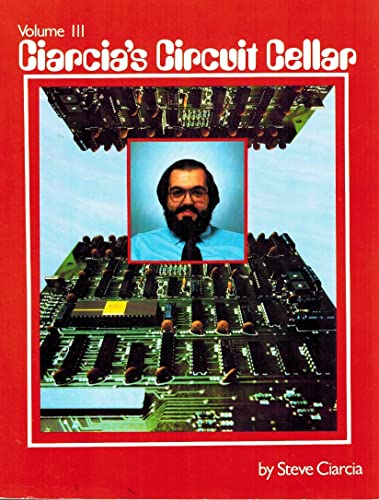
Two ways to give a computer a voice
For a speech-chip enthusiast, the attraction of Volume III is its pair of practical speech-synthesizer projects. Collected from Steve Ciarcia’s BYTE columns of July 1980 through December 1981, they capture a moment when a talking computer was something an electronics hobbyist could build—and make distinctly their own.
MicroMouth: a vocabulary ready to speak
“Build a Low-Cost Speech-Synthesizer Interface,” originally published in June 1981, introduces MicroMouth. Its voice comes from National Semiconductor’s DT1050 Digitalker chip set, combining the MM54104 speech processor with two vocabulary ROMs.
Here, the experimenter selects stored expressions and puts them to work. Ciarcia presents speech as a useful computer output: a way to announce information that would otherwise require watching a display. The project brings the processor, vocabulary memory, and computer interface together in a working board, with connections for the Apple II and TRS-80 Model I.
Sweet Talker: building words from sounds
September 1981’s “Build an Unlimited-Vocabulary Speech Synthesizer” takes a different approach. The Sweet Talker uses the Votrax SC-01 to assemble speech from phonemes, freeing the programmer to experiment beyond a supplied vocabulary.
That freedom comes with a hands-on challenge: deciding which sounds to send, and in what sequence. The SC-01 does not interpret ordinary English text by itself; the controlling software must provide the phoneme codes. Ciarcia’s design supplies the supporting circuitry—including buffering, an oscillator, filtering, and amplification—with parallel-interface and Apple II versions.
For today’s enthusiast, this is part of the appeal. You can explore how a familiar robotic voice is constructed, one sound at a time.
The other projects are a bonus
Volume III also covers subjects such as remote control, computer testing, a logic analyzer, a Z8-based control computer, and EPROM programming. Those projects give the speech experiments a wider setting: computers connected to circuits that sense, control, and respond to the world.
Why it belongs in the museum
This volume preserves more than descriptions of two speech systems. It preserves the invitation to build them.
MicroMouth and Sweet Talker offer two different pleasures: making a stored vocabulary useful, and shaping new words from individual sounds. Together, they make Volume III a fitting companion to the museum’s chips and recordings—a book about taking those distinctive electronic voices off the page and hearing them speak.
Further reading
Featured exhibit: MicroMouth
Find one for your collection
Looking for a copy of Ciarcia’s Circuit Cellar, Volume III? Explore listings on eBay or Amazon to add this book to your collection.