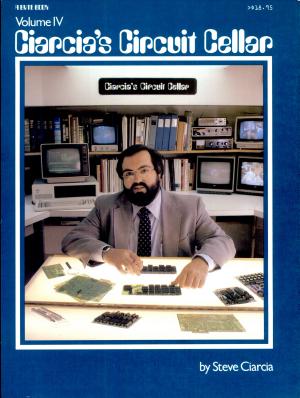
Ciarcia’s Circuit Cellar, Volume IV
Steve Ciarcia
Collects January 1982–June 1983 · 222 pages
From phonemes to plain English
For a speech-chip enthusiast, Volume IV is the next step after the talking projects in Volume III: making a synthesizer useful without asking its owner to spell everything in sounds. Its centerpiece is Microvox, Steve Ciarcia’s two-part text-to-speech project, with hardware in September 1982 and software in October.
Microvox pairs a dedicated 6502 processor with the Votrax SC-01A. The processor interprets incoming text and chooses phonemes; the speech chip turns those instructions into its unmistakable electronic voice. The pronunciation rules belong to the software, rather than to the SC-01A itself. This distinction is central to understanding the project—and many of the talking peripherals of its time.
A voice that can stand on its own
The design accepts text through serial or parallel connections, allowing a host computer to send words to it much as it would send characters to a printer. Instead of tying pronunciation software to one particular home computer, Ciarcia gives the speech hardware its own processor and memory. The Microvox articles acknowledge Dianna Visek’s work on the text-to-speech algorithm; the project’s commercial counterpart appeared as the Intex Talker.
For a builder, the attraction is seeing the whole chain together: computer connection, text conversion, phoneme selection, and audible output. Read alongside the earlier Sweet Talker and MicroMouth projects, it shows how a voice circuit becomes a more complete talking system.
Listening to speech, and synthesizing it differently
Two other articles widen the speech story. “Use Voiceprints to Analyze Speech” examines the sound itself, while “Use ADPCM for Highly Intelligible Speech Synthesis” explores another route to electronic speech. The latter appears near the end of the volume, in the June 1983 installment.
ADPCM—adaptive differential pulse-code modulation—encodes changes in a sampled waveform. That makes it a different approach from instructing a phoneme synthesizer to generate individual sounds. For the collector, these projects help explain why speech hardware developed along several paths: some designs emphasized freely assembled phonemes, while others emphasized reproducing an encoded voice.
More tools for the workbench
The surrounding projects include a computerized weather station, infrared control, programmable sound effects, the MPX-16 computer, and RS-232 interface tools. They give the volume a wider electronics life, but the speech projects are the reason to pull it off the shelf here.
Volume IV belongs in the museum because it captures the work between a speech chip and a useful voice: not just making a circuit speak, but teaching it what to say when someone types ordinary words.
Further reading
Featured exhibit: Microvox
Find one for your collection
Looking for a copy of Ciarcia’s Circuit Cellar, Volume IV? Explore listings on eBay or Amazon to add this book to your collection.