GENERAL INSTRUMENT · ORATOR · LPC SPEECH SYNTHESIZER
SP0250
General Instrument’s SP0250 Orator rebuilds speech from LPC parameter frames supplied by a host, using a programmable vocal-tract filter rather than a built-in word list.
Overview
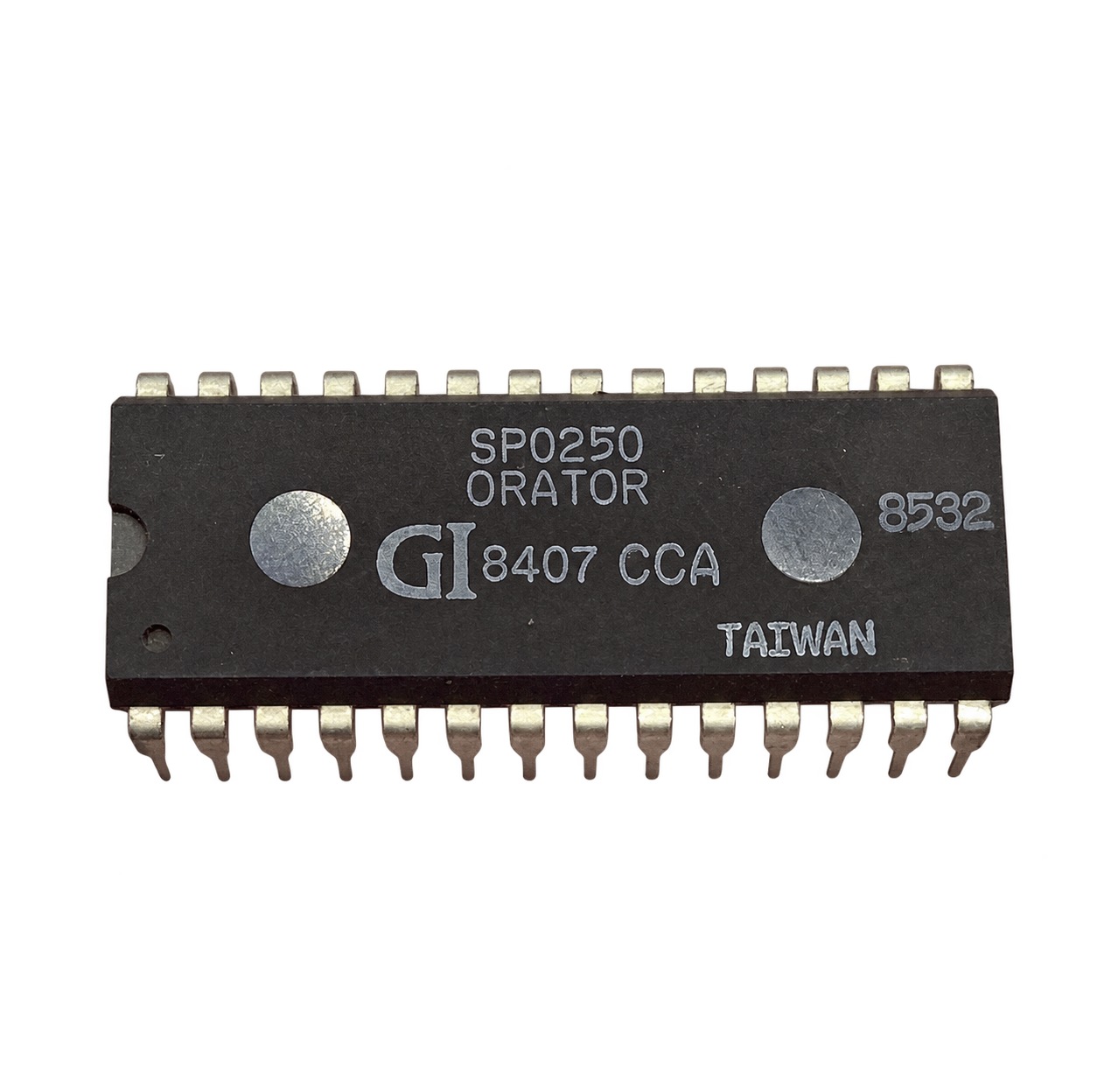
The General Instrument SP0250 Orator rebuilds speech from changing numerical descriptions of a voice. A host supplies frames of filter and excitation parameters; the chip shapes voiced pulses or noise through a programmable vocal-tract model and produces a speech waveform. It does not contain a fixed word list or understand text on its own.
Explore the SP0256 family, gallery, and samples →
Orator: a vocal tract described by numbers
The SP0250 is a single-chip speech synthesizer built around a programmable digital filter. Twelve coefficient registers describe the changing shape of the vocal tract. Instead of dedicating a large cascade of separate hardware to every filter stage, the SP0250 time-shares a two-stage filter section to simulate a twelve-stage cascade. This compact design brought a sophisticated speech model into one 28-pin integrated circuit.
The source changes with the sound
The filter needs an excitation signal to turn its vocal-tract model into speech. For voiced sounds, pitch and amplitude parameters control a repeating pulse source; for unvoiced sounds, the synthesizer uses random noise. The filter coefficients change from frame to frame to reproduce the changing resonances of the recorded voice. The SP0250 therefore synthesizes speech from a compact model rather than playing a stored digital waveform.
Speech arrives in parameter frames
A speech frame contains fifteen eight-bit values: twelve filter coefficients, plus amplitude, pitch, and repeat information. These values are loaded into a 15-by-8-bit FIFO. The double-buffered input lets a host prepare the next frame while the current frame is controlling speech generation. DATA REQUEST tells the host when the chip can accept data, and a DATA PRESENT strobe clocks each byte into the input buffer.
The host provides the words
The SP0250 has no built-in vocabulary ROM, phoneme list, or spelling-to-speech converter. A microcomputer or dedicated controller must supply the parameter stream and any speech storage or decoding needed to create it. General Instrument’s VSM2032 reference speech module illustrates the complete system: it pairs an SP0250 with a PIC1650A microcomputer and a 32-kilobyte ROM. A programmer could also generate or prepare parameter frames with suitable speech-analysis software.
From a recording to a synthesized voice
General Instrument’s applications manual describes a route from recorded speech to SP0250 data. The recording is band-pass filtered, sampled, and analyzed with linear predictive coding (LPC). That analysis calculates filter coefficients that approximate the spectral shape of each speech frame. Software then encodes the parameters for storage; during playback, a controller expands them into the fifteen-byte frames the SP0250 consumes. This separates the recorded speaker’s voice data from the silicon that reconstructs it.
A chip inside a larger audio path
The SP0250 includes its oscillator and a seven-bit pulse-width-modulation digital-to-analog converter. Its DIGITAL OUT pin carries the synthesized signal as a high-speed digital waveform, so the surrounding circuit must smooth and amplify it for a speaker. The preliminary datasheet specifies a single five-volt supply and an externally controlled crystal oscillator; the applications manual uses a 3.12 MHz crystal in its standard interface description.
How it relates to the SP0256
The SP0250 and SP0256 belong to General Instrument’s speech-synthesis family and use a related LPC vocal-tract approach. Their system roles differ: the SP0250 expects its host to feed parameter frames, while SP0256 versions add sequencing and, depending on the part, speech data in internal or external ROM. The SP0256-AL2, for example, contains its own allophone program. That makes the SP0250 a flexible speech engine, but one that depends much more heavily on its host system.
SP0250 at a glance
| Feature | Specification |
|---|---|
| Package | 28-pin dual in-line package |
| Supply | Single +5 V supply |
| Speech model | Programmable LPC vocal-tract filter; twelve coefficients |
| Input frame | 15 eight-bit speech parameters |
| Input buffering | 15 × 8-bit double-buffered FIFO |
| Speech storage | External ROM or host-generated parameter data |
| Audio output | On-chip seven-bit PWM DAC at DIGITAL OUT |
| Clock | On-chip oscillator with external crystal control; 3.12 MHz in the applications-manual interface |