SPEECH CHIP COLLECTION
T6721A
Toshiba’s PARCOR speech synthesizer, best known for giving Commodore’s Magic Voice its distinctive spoken vocabulary.
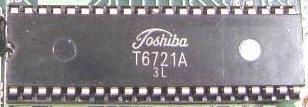
Overview
The Toshiba T6721A reconstructs speech from externally stored acoustic parameters. It is the speech engine inside Commodore’s Magic Voice; the words and software belong to the surrounding system, rather than a fixed vocabulary built into the chip.
Image gallery
Find a T6721A
Search for this Toshiba speech synthesizer and Magic Voice hardware. Check the part marking and listing details.
Search eBayPARCOR: a compact description of a voice
PARCOR, short for partial correlation, is a form of linear predictive coding. Instead of storing every point of an audio waveform, a speech stream describes how a voice changes: its excitation, strength, pitch, and vocal-tract resonances. An excitation source passes through a digital filter to reconstruct speech. This is synthesis from encoded voice data, not ordinary waveform playback, and it differs from selecting phoneme codes on an SC-01. The vocabulary can preserve the character of the speaker whose voice supplied the analysis data.
Toshiba’s speech system
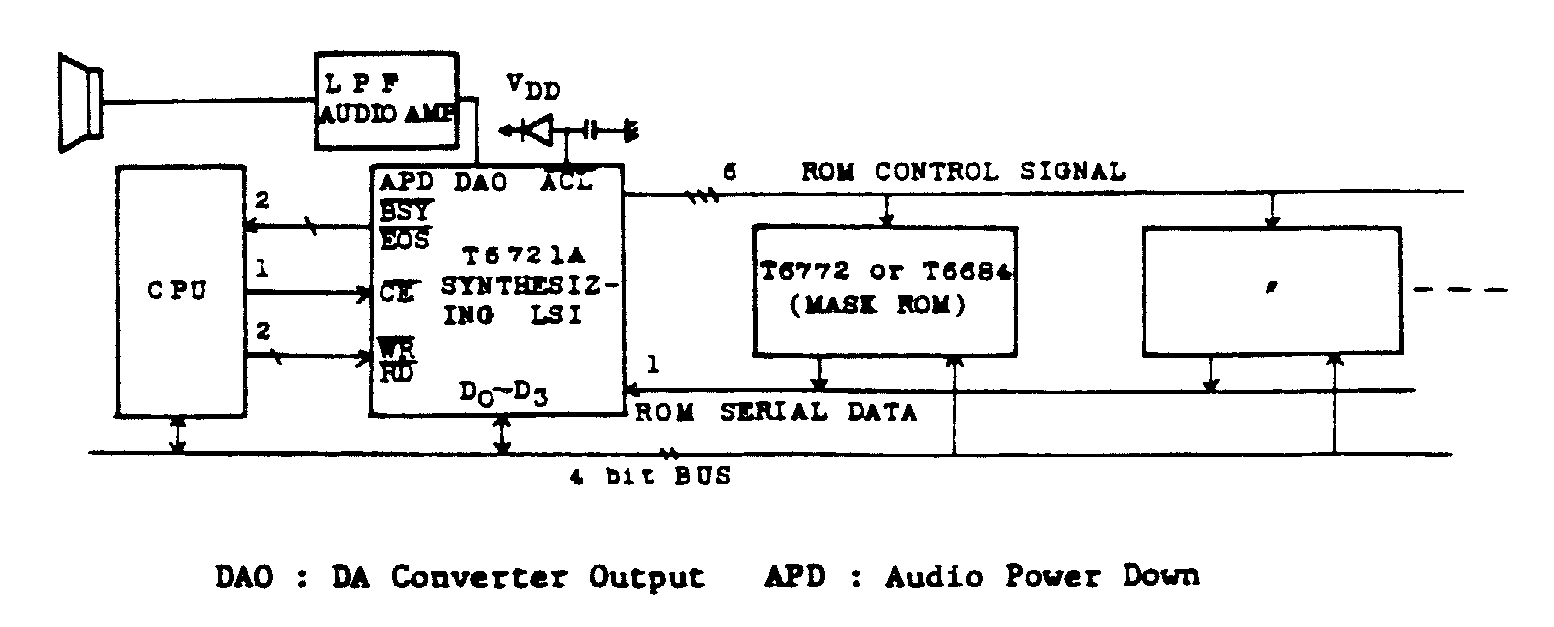
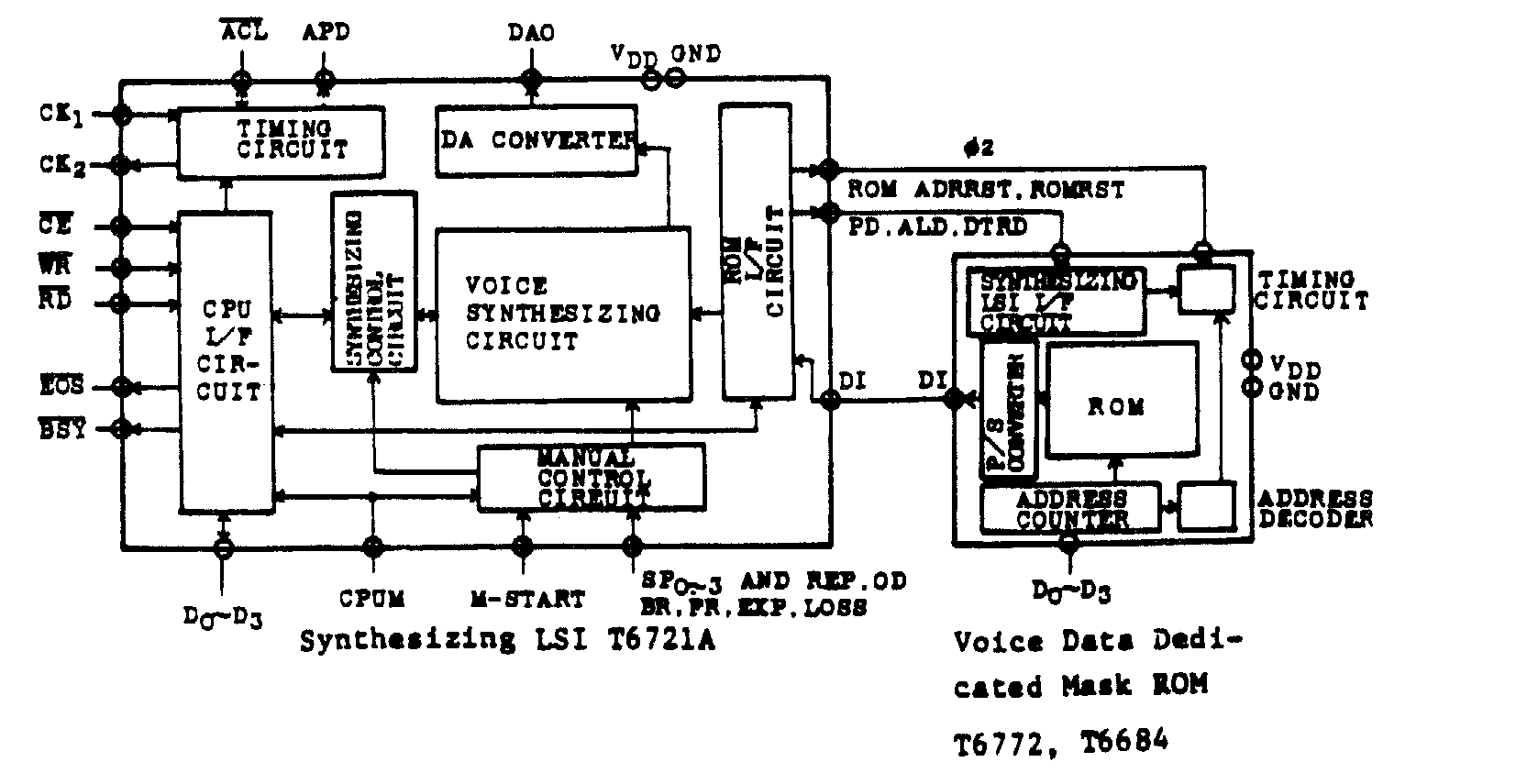
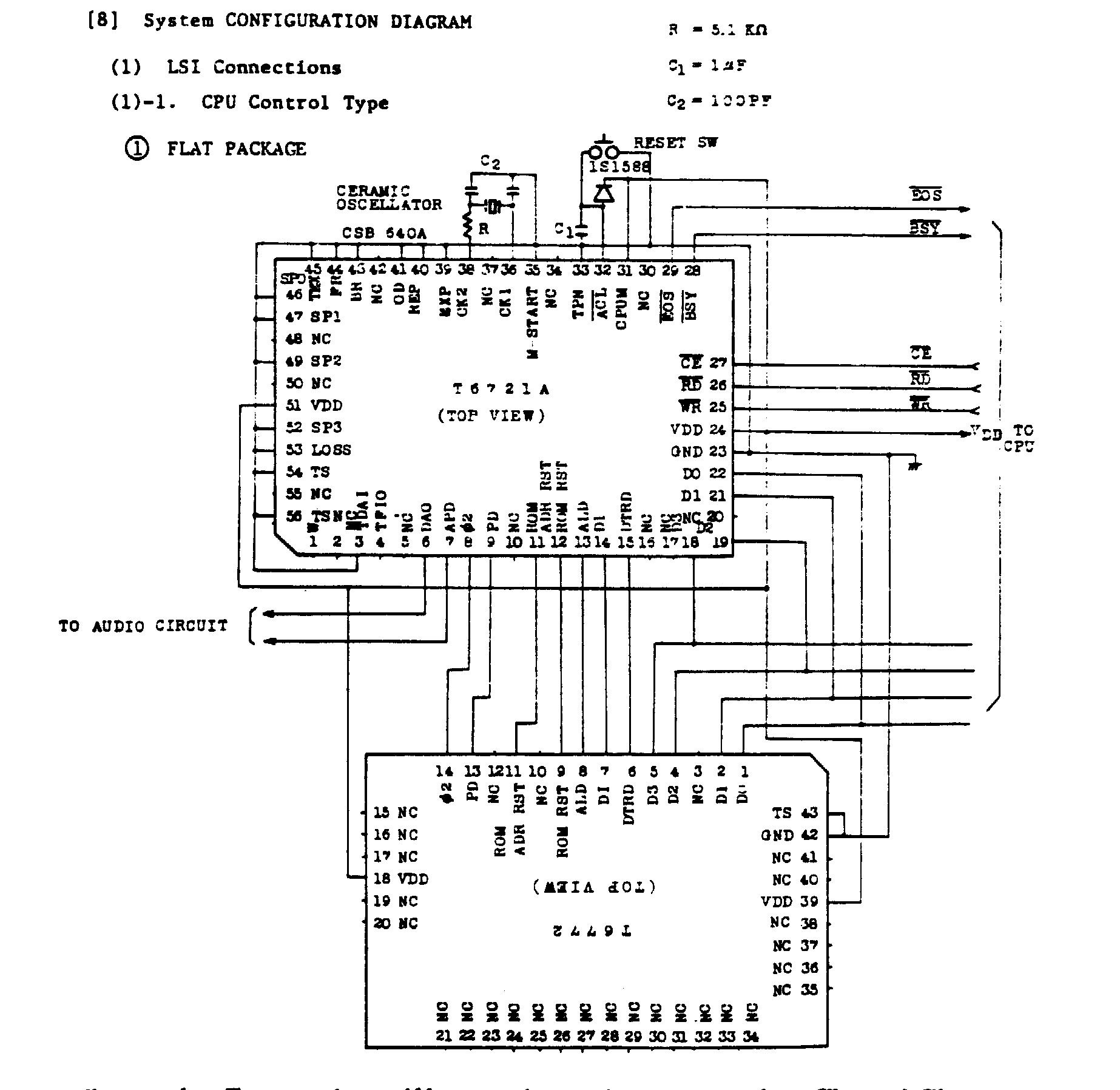
Toshiba specifies selectable eight- or ten-stage filtering, interpolation, two voiced sources, and white noise for unvoiced sounds. Speech data rates are 2.4, 4.8, or 9.6 kbit/s. A four-bit CPU bus provides commands and status; dedicated ROM-control signals handle speech memory. The alternative manual mode starts phrases without a CPU and supports repeating speech. A built-in DAC still needs external low-pass filtering and amplification.
The words live outside the chip
The companion T6772 and T6684 are 64- and 128-kilobit speech ROMs. More memory can be connected for longer vocabularies. At the lowest data rate, Toshiba gives roughly 53 seconds for one T6684. The T6721A does not translate English spelling into speech: it synthesizes the supplied encoded data.
What you hear in Magic Voice
Commodore’s Magic Voice supplies 235 utterances in its standard female vocabulary. Some entries are complete words; others are pieces such as number endings or the sound used to make plurals. BASIC programs select them with SAY, set delivery speed with RATE, choose a vocabulary with VOC, and check readiness with RDY. Speech-compatible software can supply additional vocabulary and character voices. The synthesizer is separate from the C64’s SID, allowing speech alongside music and graphics. A familiar voice therefore comes from the combination of speech data, synthesis hardware, and software—not from the Toshiba part number alone.
The Speak & Spell connection
Commodore engineer Bil Herd recalled that Richard Wiggins and Tom Brightman joined Commodore after their work at Texas Instruments on Speak & Spell. His account places their work in the Magic Voice vocabulary and command hardware, including the 8706 gate array. That supports a connection between the two products’ development teams, rather than identifying them as the designers of Toshiba’s T6721A silicon. Herd also remembered an office full of prototype 364 computers repeating a mispronounced “purple”: a small, wonderfully human detail behind an electronic voice.
A general-purpose chip with a famous Commodore application
Toshiba documented generic microcomputer and standalone applications. Magic Voice is its best-established museum application; the T6721A was not documented as a Commodore-only design.
Technical snapshot
| Feature | Specification |
|---|---|
| Manufacturer | Toshiba |
| Supply | Single +5 V |
| Sampling rate | 8 kHz |
| Arithmetic | 15-bit |
| Output converter | 9-bit DAC |
| Host connection | Four-bit bus |
| Speech memory | External encoded speech data |
Magic Voice vocabulary demonstration
The T6721A speaking the Magic Voice vocabulary.
Documentation and downloads
Machines using this chip
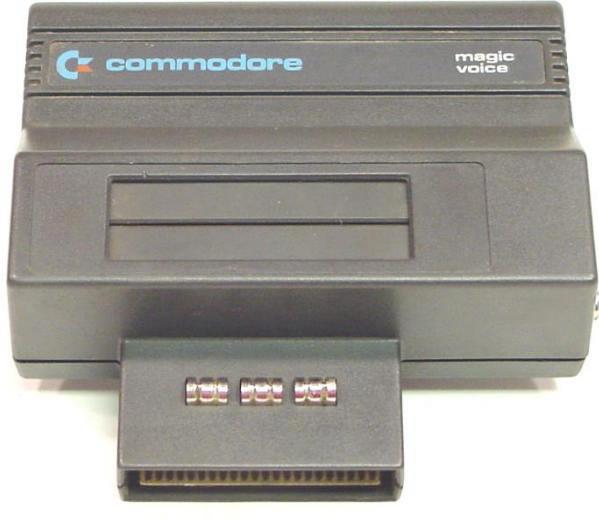
Commodore
Magic Voice
Commodore’s speech cartridge for the C64 and SX-64, with a built-in female voice, 235 utterances, BASIC commands, and talking game support.
Explore Magic Voice