Black Hole
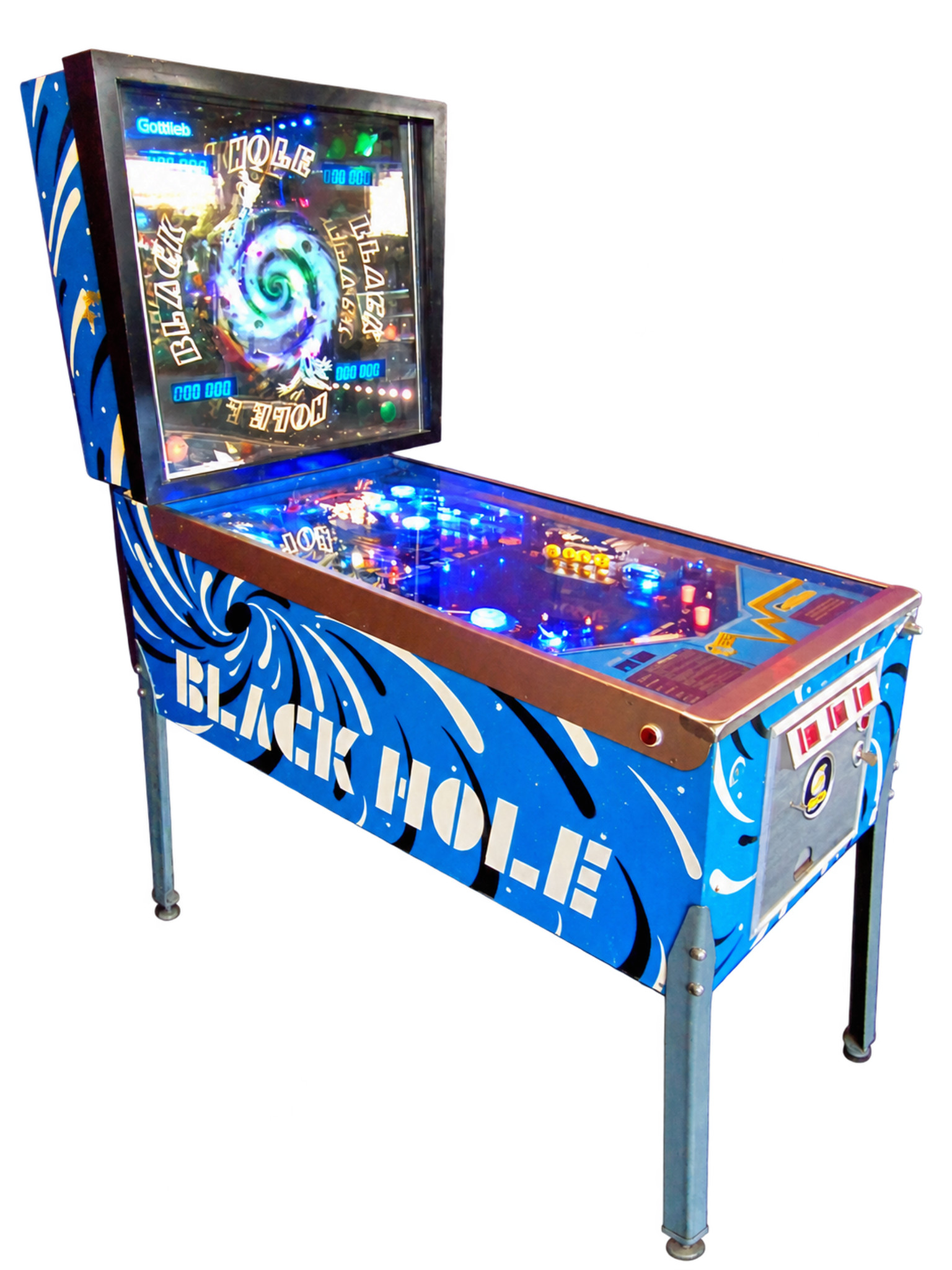
Image gallery

Watch it talk
Black Hole pinball video
Watch Black Hole in action. Jump to 4:58 in the video to hear it talk.
Watch on YouTube ↗Find a Black Hole for your collection
Search for Gottlieb Black Hole machines, original boards, manuals, and parts. Check whether a machine is the speaking or non-speaking export version.
Search eBay for Black HoleShopping through this link helps preserve and grow the SpeechChips Museum. If you make a purchase, we may earn a commission that supports the collection.A voice from the darkness
Black Hole gives its space theme an unmistakable electronic personality. Released by D. Gottlieb & Co. in October 1981, the widebody System 80 machine combines a conventional upper playfield with a smaller, reversed playfield beneath it. The voice-equipped version challenges passing players with “Do you dare to enter the black hole?”—a phrase that makes the synthesizer as memorable as the machine’s unusual geometry.
For the speech-chip enthusiast, this is a complete performance: programmable phonemes, changing electronic effects, moving lights, and a ball disappearing beneath the surface. The robotic voice belongs to the world of the game.
The Votrax behind the voice
The speaking version uses the Votrax SC-01 family on Gottlieb’s MA-216 sound/speech board. SC-01A documentation is also associated with this board family. These chips construct speech from phonemes; the voice is not a recording of an actor stored as ordinary sampled audio.
Game-specific ROM software supplies the sequences and controls that make the chip pronounce its messages. The same family of Gottlieb sound hardware also appeared in arcade machines, including Q*bert, where phoneme synthesis became a very different kind of character voice. Black Hole demonstrates how expressive a limited sound alphabet could become when matched to a strong theme.
A small computer devoted to sound
The MA-216 is an autonomous sound system with a 6502 processor and 6532 RAM, I/O, and timer device. It receives sound commands from the pinball electronics, then uses its own program to generate the response. The SC-01 speech path and other sound-generation circuitry ultimately feed the amplifier.
Gottlieb’s technical documentation separates the audio DAC from the SC-01 clock DAC. Adjusting the speech clock affects the electronic voice’s character, and the contemporary calibration procedure checks those circuits independently. This helps explain why different surviving machines can sound noticeably different even when playing the same programmed message.
The speech chip also makes the vortex
The SC-01 is used for more than spoken words. Firsthand repair documentation identifies Black Hole’s lower-playfield vortex effect as a sound generated using the speech chip. The synthesizer is helping portray the environment, not merely announcing events.
The sound program waits for the SC-01 to acknowledge phonemes. If a voice-equipped board is missing that chip, ordinary upper-playfield effects may initially work, but calling the vortex effect can leave the sound processor waiting indefinitely. This is why a missing voice chip can cause more than missing speech. A factory non-speaking export configuration is a separate case, with different hardware and software.
Entering is easier than escaping
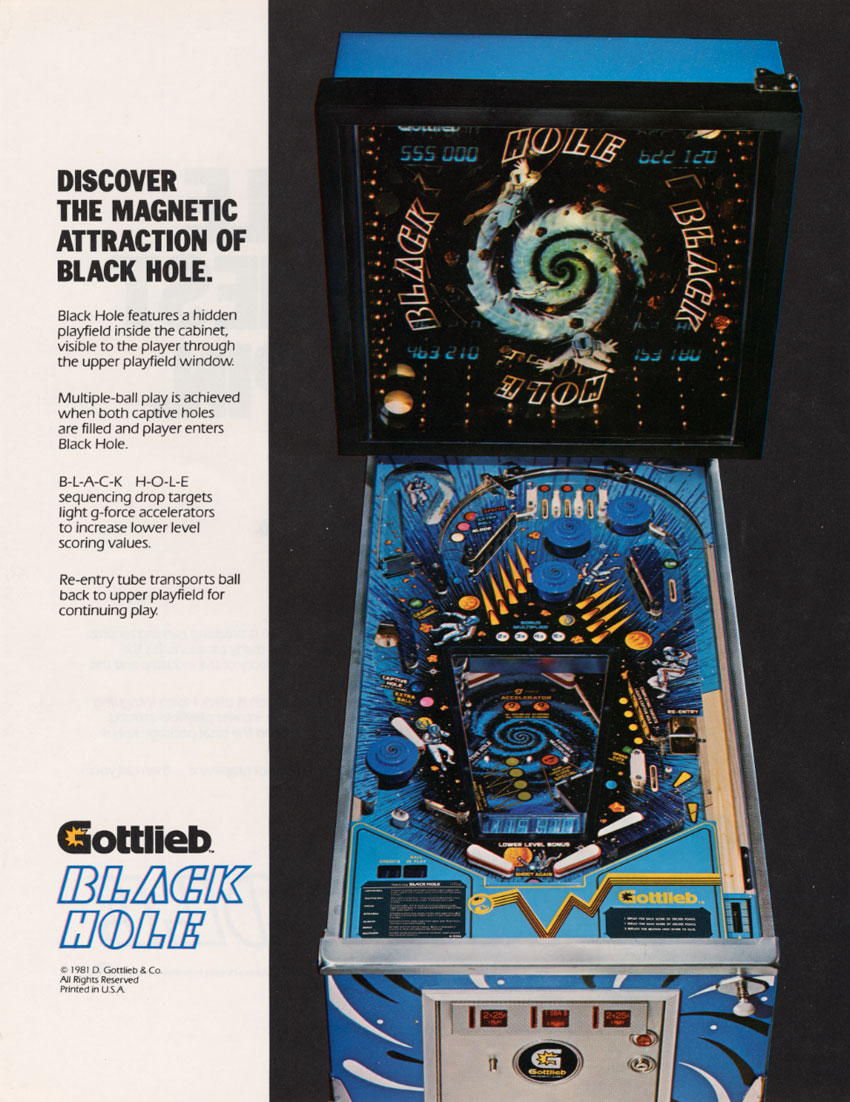
The upper playfield’s window reveals a second playfield sloping away from the player. Its flippers launch the ball back toward the viewer, reversing the familiar visual relationship between gravity and the controls. A transfer mechanism delivers the ball below; a kicker and return tube bring it back up.
Opening the re-entry gate is crucial. Completing either lower drop-target bank permits a returning ball to continue on the upper playfield; without the necessary condition, the return can become a drain. The lower field builds bonus, while upper-field achievements affect multipliers.
Locking balls on both levels sets up the machine’s three-ball multiball sequence. Play can then involve balls on the two oppositely sloped fields, combining physical disorientation with the electronic soundtrack. It is a much more theatrical use of speech hardware than a simple talking score display.
An idea from outside the factory
At Pinball Expo 2006, originator Joe Cicak described noticing the unused space beneath the playfield of a solid-state machine being repaired in a restaurant. Later, a conversation while watching Carl Sagan’s Cosmos helped turn that observation into a black-hole-themed game idea.
Cicak and collaborators constructed a playable prototype before taking it to Gottlieb. The manufacturer developed the concept into the production game, with John Buras and Adolf Seitz Jr. credited for the final design and Terry Doerzaph for the artwork. In a later interview, Buras recalled the engineering challenge of cutting a viewing window, moving the ball between levels, and getting it back upstairs.
A machine that drew a crowd
The original sales flyer emphasizes two-level play, three-ball action, synthesized speech, and the animated backglass effect. Its spinning spiral and lighting made the cabinet an attraction even before a ball was launched. The promise was a whole experience of descending into another space.
Buras recalled receiving reports that coin mechanisms were jamming because cashboxes had filled. That recollection captures the excitement around the game without making the voice alone responsible for its success: layout, presentation, and sound worked together.
Not every Black Hole speaks
Export versions were produced with a simpler backglass and without the original speech feature. Technical repair documentation identifies the non-talking MA-55 sound board in that configuration. A silent export machine is therefore not automatically a broken speaking machine.
When examining a surviving example, distinguish its original market configuration, installed sound board, and any later replacement hardware. Modern System 80 replacement boards may emulate the SC-01, but that is different from preserving an original Votrax chip. The separate Gottlieb System 80 sound/speech board exhibit explores the hardware shared by these machines.
Hear Black Hole talk
Do you dare to enter the black hole?
The machine’s distinctive synthesized invitation.
Specifications
- Manufacturer
- D. Gottlieb & Co.
- Model
- 668
- Release
- October 1981
- Platform
- Gottlieb System 80
- Players
- 1–4
- Layout
- Two playfields; lower field slopes away from the player
- Production design
- John Buras and Adolf Seitz Jr.
- Artwork
- Terry Doerzaph
- Export variation
- Non-speaking configuration with simpler backglass
Sources and further reading
- Gottlieb Black Hole instruction manual
- Original Gottlieb sales flyer, 1981 — Arcade Flyer Archive
- John Buras interview — PA Pinball, March 2007
- Joe Cicak’s account at Pinball Expo 2006 — Pinball News
- MA-216 sound-board technical documentation
- SC-01 sound effects, handshaking, and export-board differences — Flipprojets
- Gottlieb sound-board calibration and On Target bulletin reference
- Black Hole game rules
- Replacement System 80 sound/speech boards — Flippp!
Speech hardware
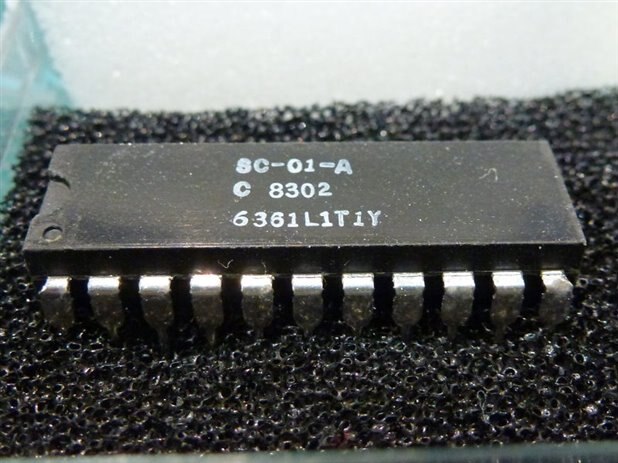
SC-01 / SC-01A
The phoneme voice behind talking robots, home-computer accessories, and some of the most memorable machines of the early 1980s.
Hear the SC-01 / SC-01A →Gottlieb System 80 Sound & Speech Board
Gottlieb’s MA-216 / B-20887 board combined game sound with Votrax SC-01 phoneme speech.
Explore the Gottlieb System 80 Sound & Speech Board →