Q*bert
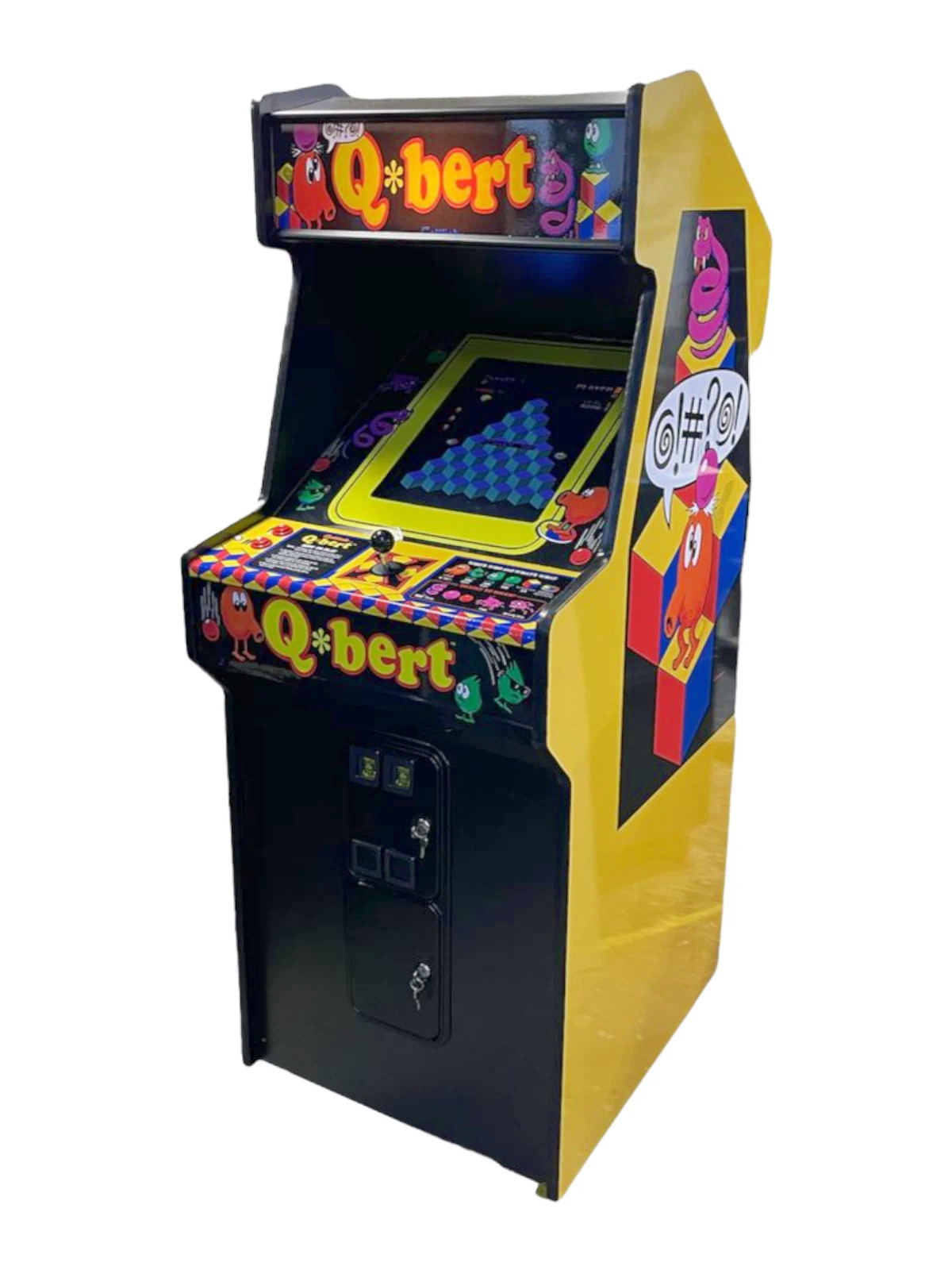
Image gallery
Watch it talk
Q*bert arcade video
Watch Q*bert in action.
Watch on YouTube ↗Find a Q*bert for your collection
Search for Gottlieb Q*bert cabinets, original sound boards, manuals, and parts. Check the installed electronics when comparing original machines and conversions.
Search eBay for Q*bertShopping through this link helps preserve and grow the SpeechChips Museum. If you make a purchase, we may earn a commission that supports the collection.The voice that became a character
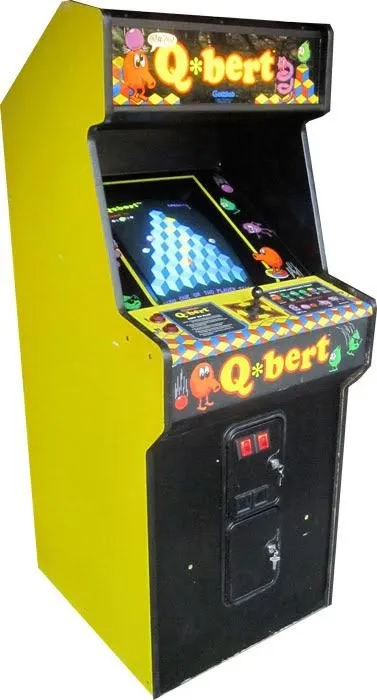
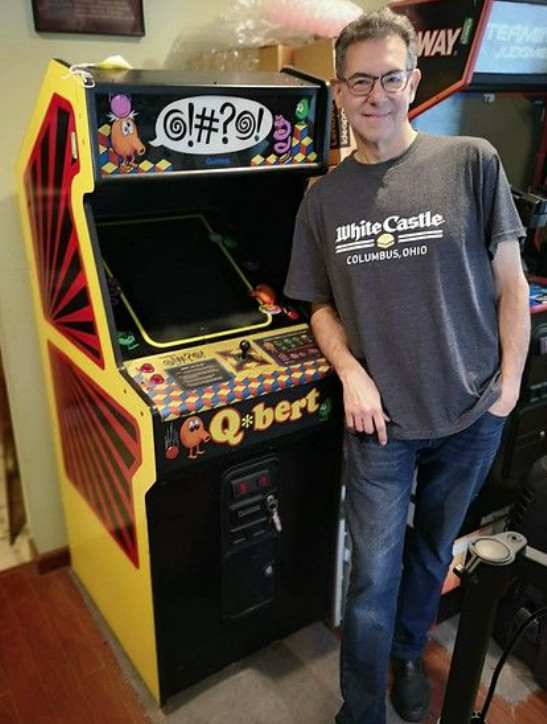
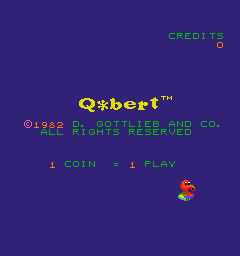
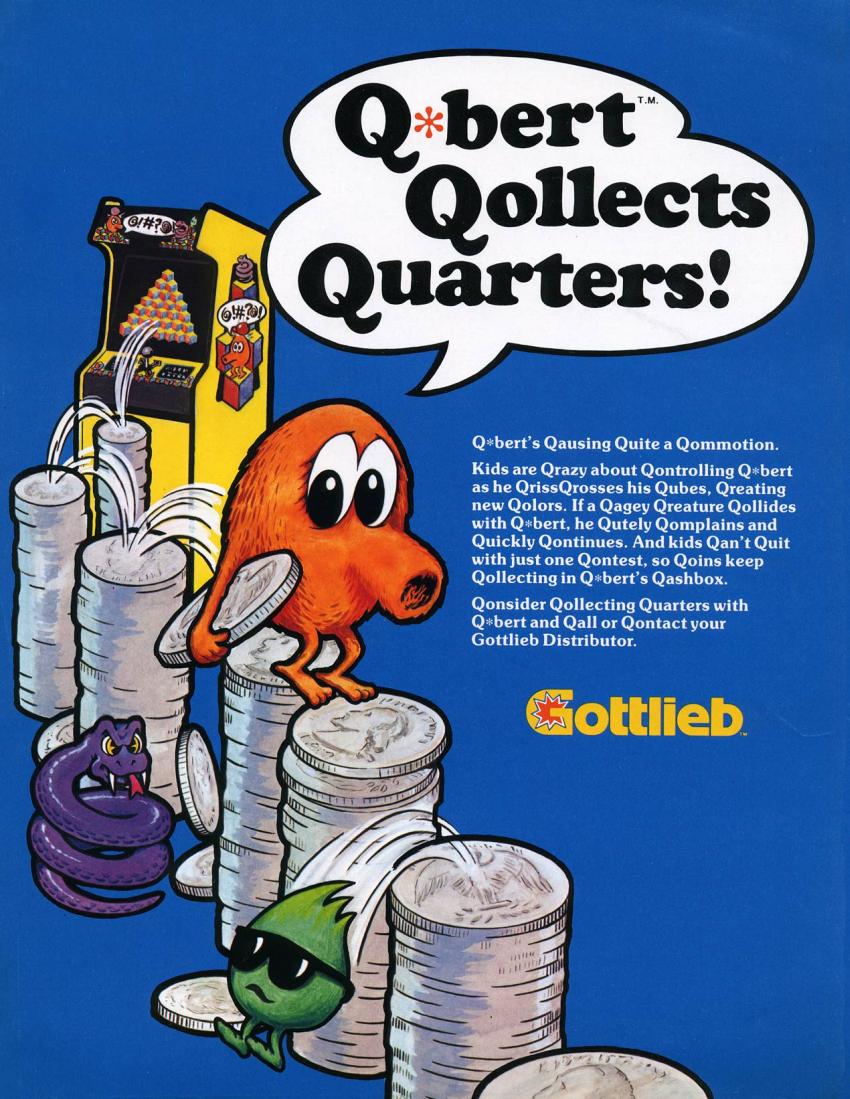
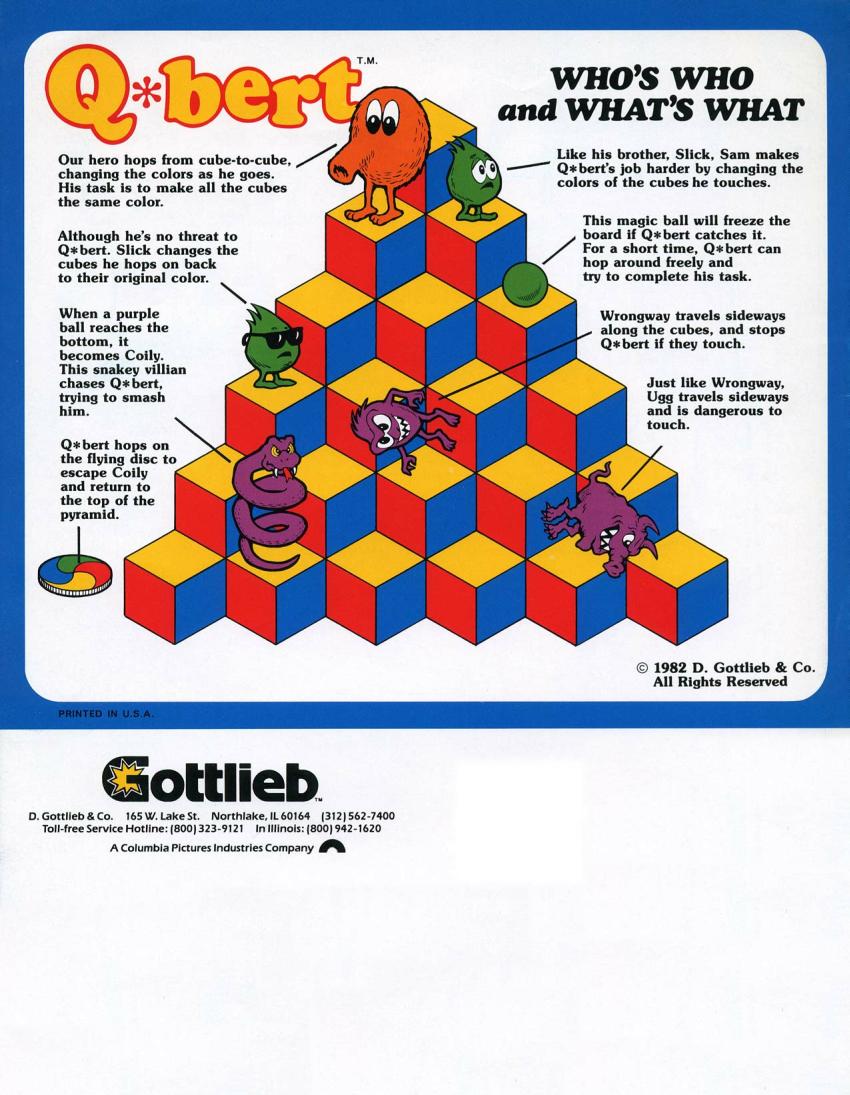
Q*bert’s electronic babble is one of the most recognizable uses of a vintage speech chip. Gottlieb’s 1982 arcade game places an orange, long-nosed character on a pyramid of cubes, hopping between their tops while avoiding enemies. A collision brings a burst of nonsense speech and a cartoon balloon full of punctuation. Sound and graphics turn frustration into personality.
The voice comes from a Votrax SC-01-family phoneme synthesizer on Gottlieb’s MA-216 sound/speech board. It is neither a recording of an actor nor the computer reading the punctuation marks aloud. The game supplies sound codes, and the chip constructs the resulting vocal sounds electronically.
From misunderstood words to wonderful nonsense
Sound designer David Thiel traced the idea to his earlier work on Reactor. He had tried to construct an announcement for a ten-thousand-point bonus, but listeners misunderstood it. Technician Chris Brewer suggested feeding the Votrax random phonemes. Thiel tried it and liked the strange result.
When he saw Warren Davis’s developing Q*bert character, Thiel recognized a perfect home for that experiment. Instead of forcing the hardware to imitate clear human speech, the game made its peculiar pronunciation the character’s own language. The limitations became part of the joke.
Does Q*bert really swear?
According to Thiel, no profanity was programmed into Q*bert’s phoneme stream. The familiar impression of swearing comes from the babble, the timing, and the comic-strip balloon. A listener may occasionally hear something resembling a word, but that does not mean the game deliberately said it.
The game is not entirely random vocal noise. Thiel identifies deliberate greetings and farewells, including the power-up line “Hello, I’m turned on” and the game-ending “Bye-bye,” as well as the falling cry. Those exceptions are worth preserving when explaining how the sound program works.
A pinball voice inside an arcade cabinet
Q*bert’s instruction manual identifies the Sound/Speech Assembly as MA-216. This is the pinball-derived board family explored in the Gottlieb System 80 Sound & Speech Board exhibit. Early Gottlieb arcade games reused that dedicated audio design; Q*bert itself is an arcade video platform, not a System 80 pinball machine.
The board has its own 6502 processor, 6532 RAM/I/O/timer device, program ROMs, DAC circuitry, SC-01 voice synthesizer, and amplifier. The video-game computer sends commands, while the audio processor runs the sound program and controls the synthesizer. Board-specific ROMs and wiring are therefore as important as the speech chip.
The hardware’s programmed speech-clock path helps vary the character of the voice. A phoneme stream is something the sound software can shape, rather than a fixed recording that always plays identically. The same chip family that announces events in Black Hole becomes an expressive cartoon voice here.
The cabinet delivers the landing
Q*bert’s most physical sound does not come from the speech chip. Technician Rick Tighe suggested installing a pinball-style knocker in the cabinet so a fall from the pyramid could end with a real impact. Warren Davis’s account describes triggering the coil when the character disappeared below the screen.
Davis wanted a softer thud and experimented with foam, but that extra production step was omitted. The resulting knock still strengthened the illusion that the character had dropped into the bottom of the cabinet. An operator setting could disable it. The combination of synthesized voice and an actual mechanical impact is a particularly fitting crossover from Gottlieb’s pinball heritage.
Cubes, characters, and a diagonal joystick
Warren Davis describes the game beginning as an exercise in randomness and gravity, inspired by a cube pattern created by fellow programmer Kan Yabumoto. Jeff Lee supplied the characters; Ron Waxman suggested having the cube tops change color when the player landed on them. That gave the hopping experiment a goal.
The control directions follow the pyramid’s diagonals. What looks like a simple movement game therefore asks the player to learn an unfamiliar relationship between joystick and screen. The voice reacts to mistakes in a way that makes the little character seem exasperated rather than merely resetting a game state.
The art of making an electronic creature
Jeff Lee credits M. C. Escher’s work as an influence on the unusual orientations of Ugg and Wrongway. He also describes the punctuation balloon as implying random cussing. The joke crosses two media: the screen suggests a comic-strip outburst while the synthesizer supplies the invented language.
Lee emphasized the collaboration among artists, programmers, engineers, and sound designer. For this museum, Q*bert is a compelling example of why preserving a speech chip also means preserving the software and the surrounding machine. Its voice makes the most sense alongside the animation, controls, speaker, and cabinet knocker.
Hearing the original hardware
The recordings below preserve examples of Q*bert’s babble and Ugg’s voice. They are vocal examples, not a complete recording of every sound in the game. The instruction manual is available locally for studying the original electronics and connections.
When examining a cabinet, check whether it retains the original sound board and speech chip or uses replacement hardware. A modern multigame conversion can resemble Q*bert externally while producing audio in an entirely different way. The two hardware cards below lead to the SC-01 and the Gottlieb board family behind the original voice.
Hear Q*bert talk
Q*bert’s comic gibberish
Phoneme-generated babble associated with the cartoon outburst.
Ugg’s voice
Another character voice from the game.
Specifications
- Manufacturer
- D. Gottlieb & Co.
- Year
- 1982
- Game number
- GV-103
- Design and programming
- Warren Davis
- Character graphics
- Jeff Lee
- Sound programming
- David Thiel
- Audio board
- MA-216 sound/speech assembly
- Physical sound effect
- Pinball-style cabinet knocker
Documentation and downloads
Sources and further reading
- David Thiel interview — the origin of the random-phoneme voice
- Warren Davis — The Creation of Q*bert
- Jeff Lee interview — characters, Escher influences, and the speech balloon
- Gottlieb Q*bert instruction manual — November 1982
- Gottlieb technical service bulletin — MA-216 arcade applications
- MA-216 pinball-derived sound/speech board technical reference
- Gottlieb archive — game details, cabinet photographs, and flyers
Speech hardware
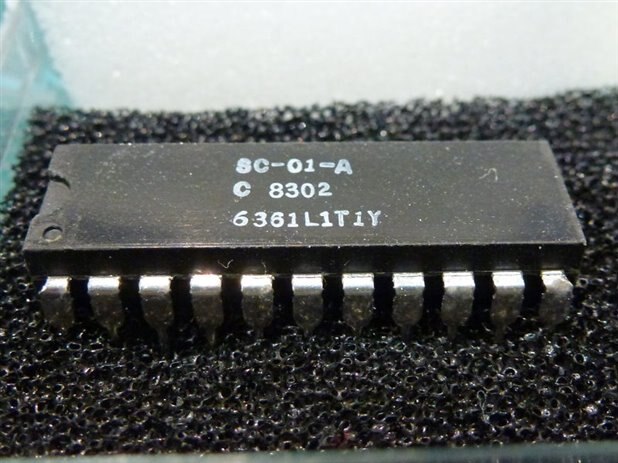
SC-01 / SC-01A
The phoneme voice behind talking robots, home-computer accessories, and some of the most memorable machines of the early 1980s.
Hear the SC-01 / SC-01A →Gottlieb System 80 Sound & Speech Board
Gottlieb’s MA-216 / B-20887 board combined game sound with Votrax SC-01 phoneme speech.
Explore the Gottlieb System 80 Sound & Speech Board →