Heathkit HERO 1
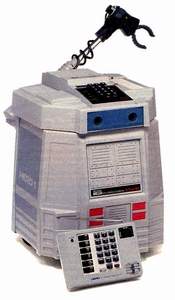
Image gallery
Watch it talk
HERO 1 robot video
See and hear Heathkit’s HERO 1 robot.
Watch on YouTube ↗Find a Heathkit HERO 1 for your collection
Browse listings for this robot, parts, and documentation.
Search eBay for Heathkit HERO 1A robot you could build and understand
Introduced in 1982, Heathkit’s HERO 1 brought the promise of a personal robot into the workshop and classroom. Its name stood for Heath Educational Robot. Learning how the machine worked was central to its purpose: assembly, programming, sensors and motion were all part of the experience.
Speech and the arm were separate options for the basic ET-18 kit. One period Heathkit catalog listed the basic robot at $999.95, the ET-18-2 voice at $149.95, and an assembled robot with arm and voice at $2,499.95. These are historical prices for those configurations, not present-day values.
The SC-01 gave it a personality
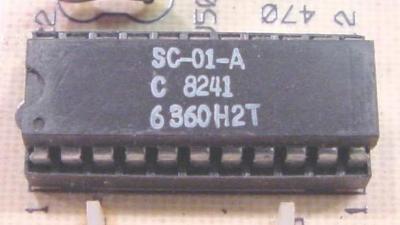
The optional HERO 1 Speech Card used a Votrax SC-01-family phoneme synthesizer; the museum’s photographed board carries an SC-01-A. Speech is created by a vocal-tract model, rather than replaying recordings of complete words. Programs arrange speech sounds into words and phrases.
Heathkit advertised an unrestricted vocabulary because the programmer could construct new pronunciations. That did not mean effortless text-to-speech: the chip itself understands phoneme codes, not English spelling. Getting a phrase to sound right was part of the experiment.
A byte becomes a voice
Six bits select one of the SC-01’s 64 codes, and two bits select one of four inflection levels. The host sends these selections to the speech hardware, which turns them into the robot’s distinctive electronic accent.
The board’s pitch adjustment and volume control offer further ways to shape its sound. The SC-01 provides its own phoneme timing and transitions; it should not be confused with the later SSI-263, whose separate controls give programmers more freedom over the voice.
Speaking was part of the performance
A January 1983 BYTE review describes a speech-equipped HERO 1 announcing “ready” at startup. Its programmable phrases and effects could accompany actions, making a sequence of motor movements feel more like a performance.
The same review describes a teaching pendant that let an operator demonstrate movements, store them, and replay them. Programmed motion and speech could be coordinated by rapidly alternating tasks. The impression of a lively robot came from deliberately written routines, rather than conversational intelligence.
Senses behind the show
HERO 1 carried light and sound sensors, ultrasonic ranging and motion detection, plus a clock. These inputs gave programs something to respond to: a change in light, a nearby object or a scheduled event could become a reason to move or speak.
Sound detection was not general speech recognition. Hearing that a noise occurred is a different capability from understanding words. The head-mounted experimenter board invited owners to connect additional circuits and explore that difference for themselves.
Programming close to the hardware
A Motorola 6808 controlled the robot. Its hexadecimal keypad and numeric display provided direct access to program entry, while cassette storage preserved work between sessions. The robot-language interpreter made motion and sensing more approachable than writing every operation in machine code.
In 1984, John Fulcher at the University of Wollongong documented an expansion for developing programs on a Unix system and downloading them to HERO 1. His report includes hardware, EPROM software and program listings. It is a concrete example of the robot becoming a platform for university engineering work.
Preserving a working voice
For a speech-chip enthusiast, HERO 1 brings the circuitry and its purpose together. A phoneme code is no longer just a sound from a bench speaker: it becomes the voice of a machine that can turn its head and respond to its surroundings.
Its modular construction also helps collectors distinguish the complete robot from individual boards. The speech-board exhibit provides close photographs and technical documentation; this exhibit places that board back in the robot it was designed to animate.
Specifications
- Manufacturer
- Heathkit / Heath Company
- Introduced
- 1982
- Model
- ET-18; assembled package ETW-18
- Processor
- Motorola 6808
- Speech option
- ET-18-2; Votrax SC-01 family
- Speech codes
- 64 codes; four inflection levels
- Program interface
- Hexadecimal keypad, robot interpreter and machine code
- Program storage
- Cassette interface
- Sensors
- Light, sound, ultrasonic ranging and motion detection
- Arm
- Optional ET-18-1 arm and gripper
Phoneme byte and inflection
| Byte field | Function |
|---|---|
| Low six bits | Select phoneme code |
| Upper two bits | Select one of four inflection levels |
| Base code + 0x40 | Next pitch level |
| Base code + 0x80 | Third pitch level |
| Base code + 0xC0 | Highest pitch level |
Documentation and downloads
Sources and further reading
Speech hardware
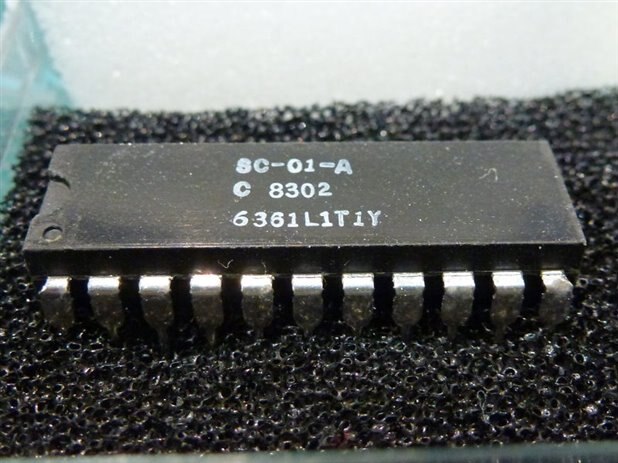
SC-01 / SC-01A
The phoneme voice behind talking robots, home-computer accessories, and some of the most memorable machines of the early 1980s.
Hear the SC-01 / SC-01A →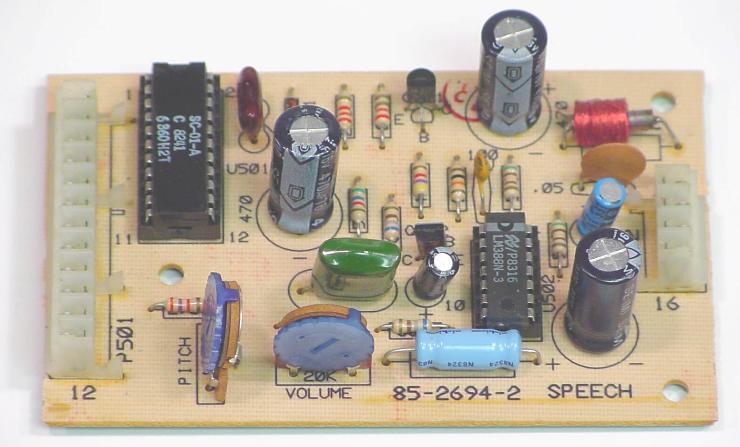
HERO 1 Speech Card
Heathkit’s ET-18-2 voice option gave HERO 1 phoneme-based speech through a Votrax SC-01-A synthesizer.
Explore the HERO 1 Speech Card →