Heathkit HERO 2000
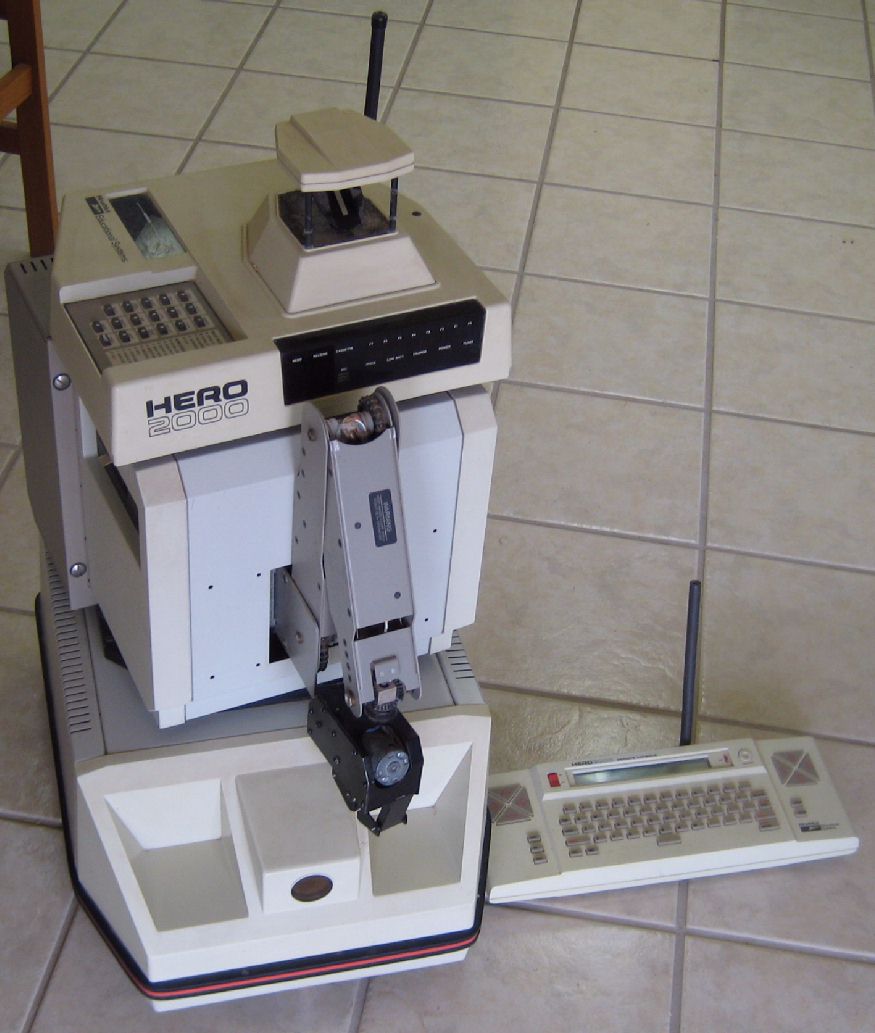
Image gallery
Watch it talk
HERO 2000 robot video
See and hear Heathkit’s HERO 2000 robot.
Watch on YouTube ↗Find a Heathkit HERO 2000 for your collection
Browse listings for this robot, parts, and documentation.
Search eBay for Heathkit HERO 2000A bigger ambition for the talking robot
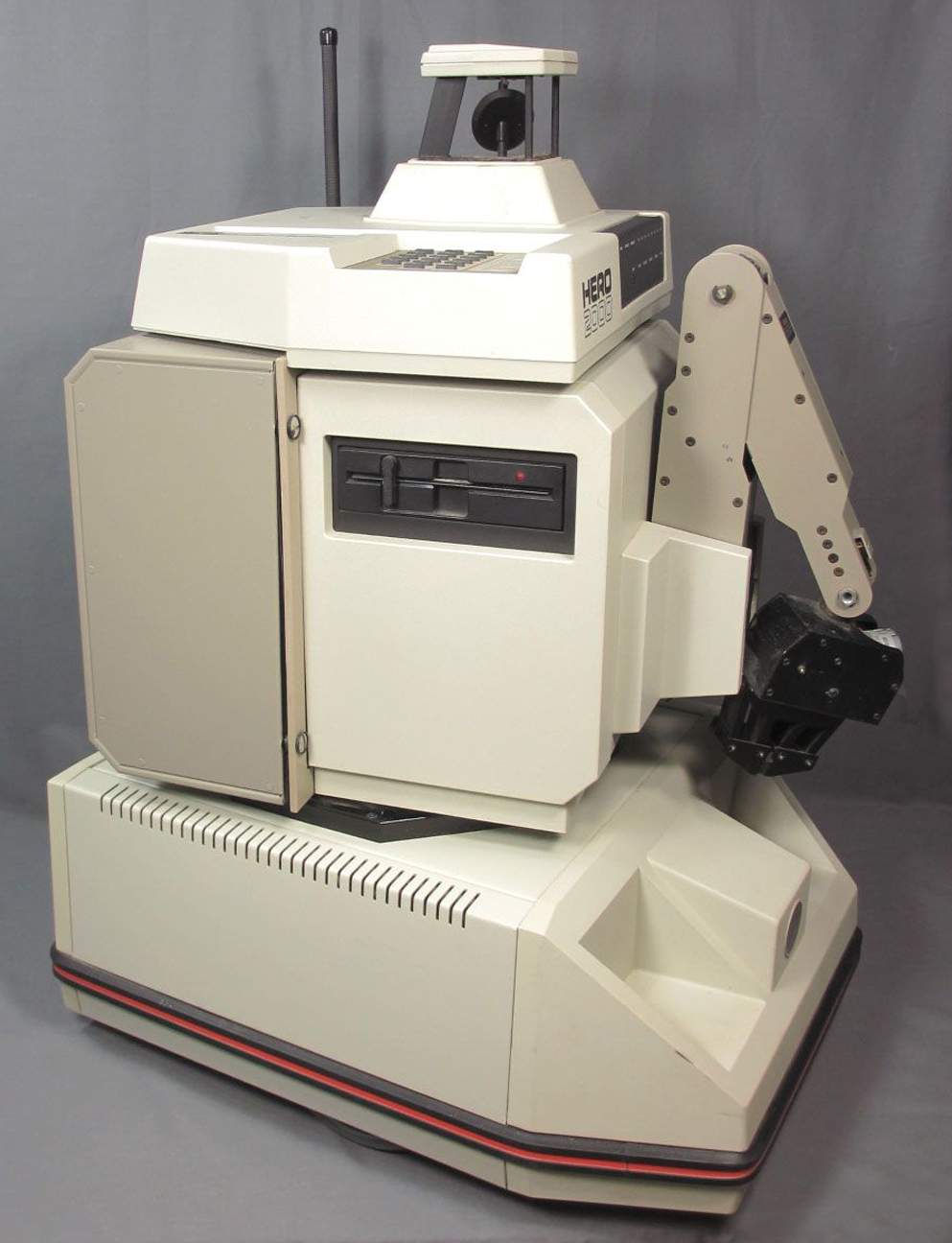
Heathkit’s HERO 2000, model ET-19, was the ambitious successor to HERO 1. Available in the mid-1980s and documented in 1986, it combined an expandable computer, sensors, servo-controlled motion and a built-in voice in a substantial educational robot.
It was a platform for learning automation rather than a ready-made household servant. An optional articulated arm, remote console, memory boards and disk system let owners build a more capable configuration around the basic machine.
A new generation of electronic voice
HERO 2000 used the Silicon Systems SSI-263 speech synthesizer, also known in the museum as the Votrax SC-02 family. Like HERO 1’s SC-01, it constructs speech from phonemes rather than playing recordings of whole words. The important change is the freedom to shape that synthesized voice.
The SSI-263 separates phoneme selection from controls for inflection, duration, speech rate, articulation and amplitude. Those parameters allow a program to vary the character and delivery of speech more extensively than the SC-01’s phoneme selection and four inflection levels. The downloadable chip documentation explains the register interface.
Type a sentence, hear a robot
HERO 2000 supplied text-to-speech conversion in its software. Instead of requiring every message to be entered as phoneme codes, a programmer could give its BASIC interpreter text to pronounce. The SAY command provided that approachable route to spoken output.
The distinction matters: the SSI-263 itself does not read spelling. The robot’s software translates text into the sequences and control values needed by the synthesizer. Speech hardware supplies the sound; the interpreter and pronunciation routines make it convenient to use.
More than a spoken message
Heathkit promoted synthesized music and sound effects alongside speech. A contemporary Radio-Electronics report described a demonstration that made HERO 2000 appear to breathe—an especially fitting trick for a machine whose electronic voice already suggested a personality.
For a speech enthusiast, that is a compelling use of phoneme synthesis. A vocal sound can be stretched, repeated or shaped into something other than a word. The robot’s expressive possibilities include the noises between sentences as well as the sentences themselves.
Many controllers, one performance
An Intel 8088 runs the main program, supported by dedicated Intel 8042 controllers handling lower-level tasks. The documented configuration has six peripheral controllers in the basic robot, rising to eleven with the optional arm. Local controllers handle motion and sensing so the main program can coordinate the overall activity.
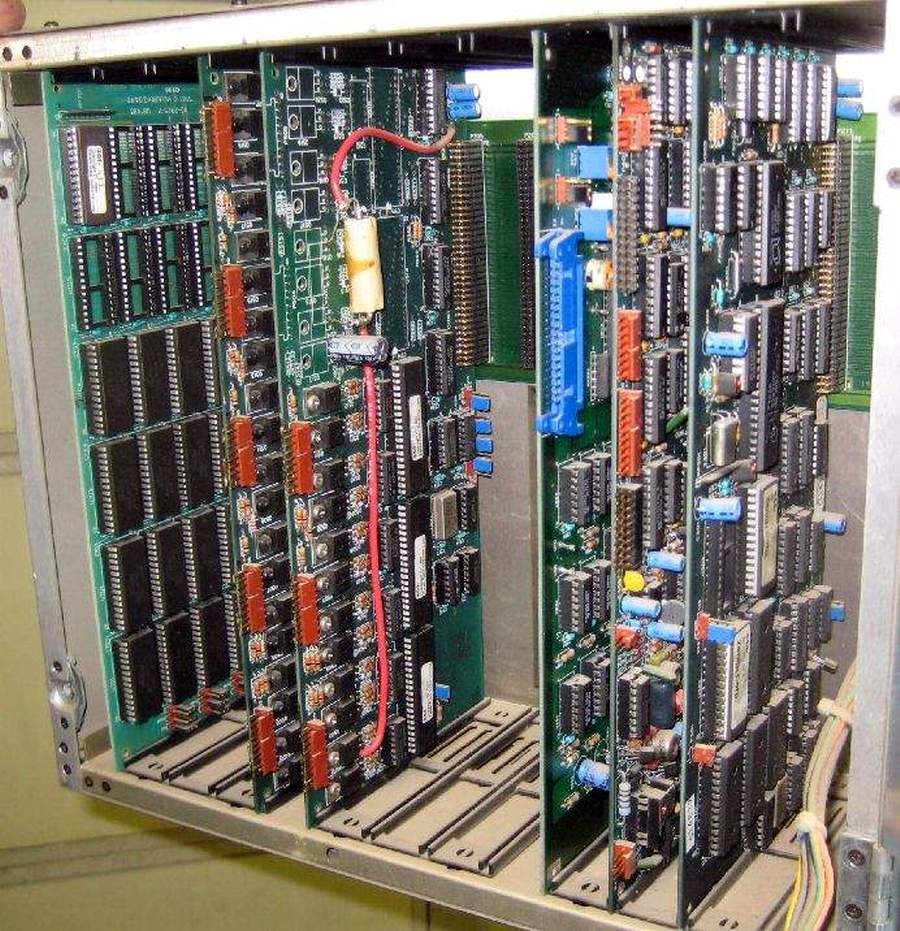
Its passive backplane provides twelve card positions. Memory, interface and controller boards make the computer expandable and its architecture visible to an experimenter. The 8088 connection to early personal computing is real, but having that processor alone does not make the robot an ordinary IBM-compatible desktop.
A voice with something to respond to
A rotating sensor assembly surveys the surroundings with ultrasonic ranging and light measurements. A separate rangefinder in the base, sound-level sensing and temperature sensing provide further inputs for programs. Detecting sound is not the same as understanding conversation.
Two driven wheels use feedback for controlled motion. With the optional arm, the robot can manipulate objects using a force-sensitive gripper. Spoken status messages can make a routine’s decisions audible: what the program measured, what it intends to do, and when a task has finished.
Programming from across the room
The optional remote console combines a keyboard, an 80-character display and teaching controls with a two-way radio link. A serial terminal offers another way to program the robot. Its BASIC includes robot-control facilities, and machine-language routines provide an alternative when a task needs lower-level access.
The system starts with 24 KB RAM and 64 KB ROM containing BASIC, with expansion options for additional memory and floppy storage. Automatic docking was an accessory capability, not a feature to assume on every surviving unit.
Keeping the whole system alive
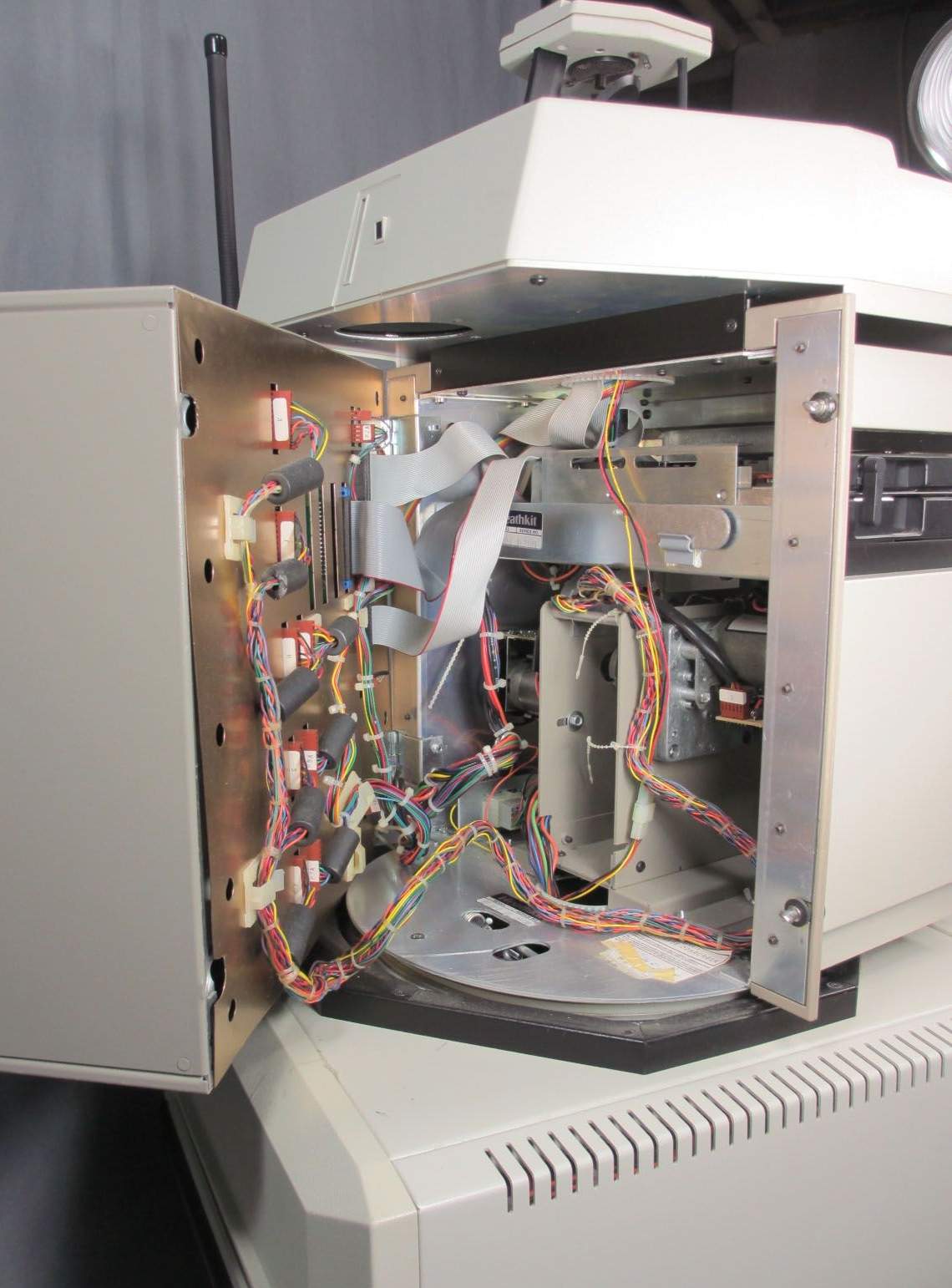
A preserved HERO 2000 is a collection of cooperating systems. Its voice chip, firmware, controller boards, power system and mechanics all contribute to the performance. A working synthesizer is only one part of restoring a robot that speaks while it acts.
The Selectric Typewriter Museum’s restoration photographs show that relationship clearly: an arm and torso mechanism needing attention sit above a card-based computer. HERO 2000 belongs in this museum because it gives the SSI-263 a body—and makes the expressive possibilities of phoneme speech tangible.
Specifications
- Manufacturer
- Heathkit / Heath Company
- Model
- ET-19 / HERO 2000
- Main processor
- Intel 8088
- Peripheral controllers
- Intel 8042; six basic, eleven with optional arm
- Standard memory
- 24 KB RAM; 64 KB ROM with BASIC
- Expansion
- Twelve-position passive backplane; optional memory and disk hardware
- Voice
- SSI-263 phoneme synthesis; software text-to-speech
- Drive
- Two driven wheels with feedback
- Sensors
- Ultrasonic ranging, light, sound level and temperature
- Programming
- BASIC; machine-language routines; serial terminal or optional remote console
Documentation and downloads
Sources and further reading
- Radio-Electronics, 1986 — contemporary HERO 2000 hardware report
- Heathkit 1986 Spring/Summer catalog — HERO 2000
- Richard Irons — HERO 2000 programming presentation
- Selectric Typewriter Museum — HERO 2000 restoration and photographs
- Patrick H. Stakem, Personal Robots — HERO 2000 architecture
- HERO robot family — speech-chip identification