Votalker C-64
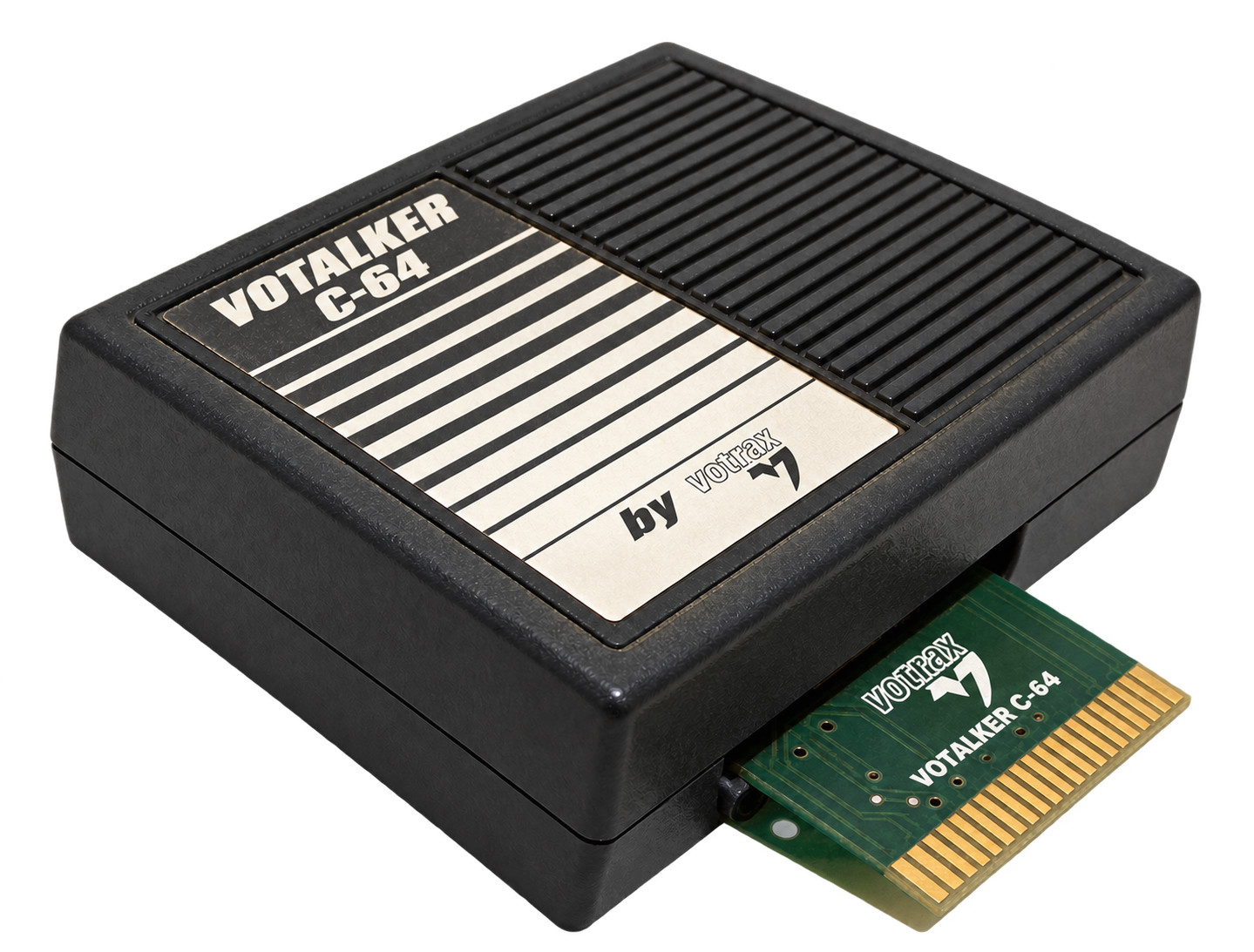
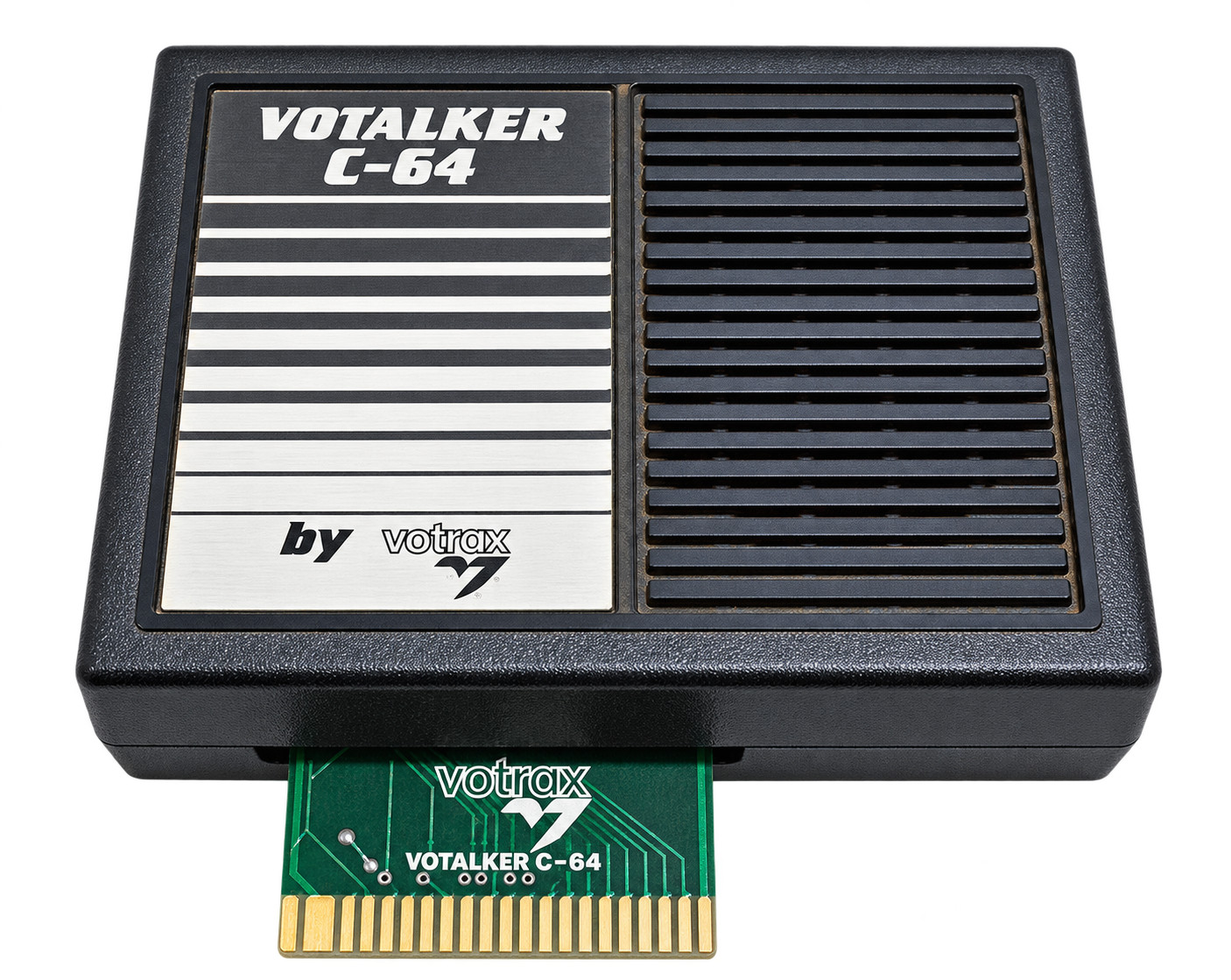
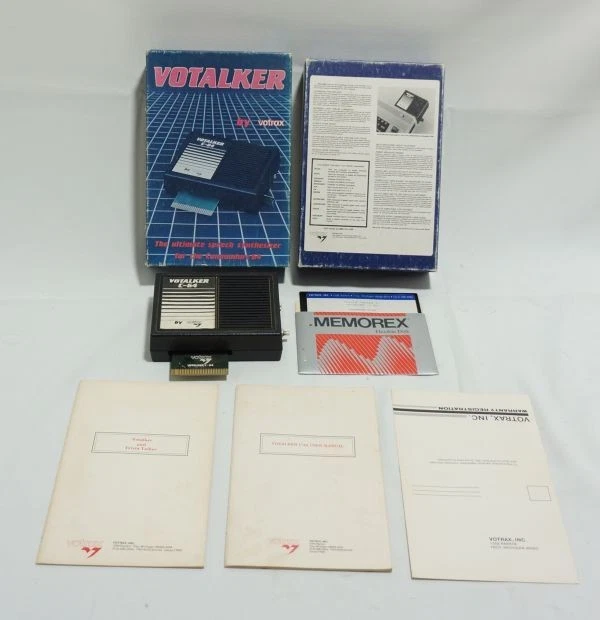
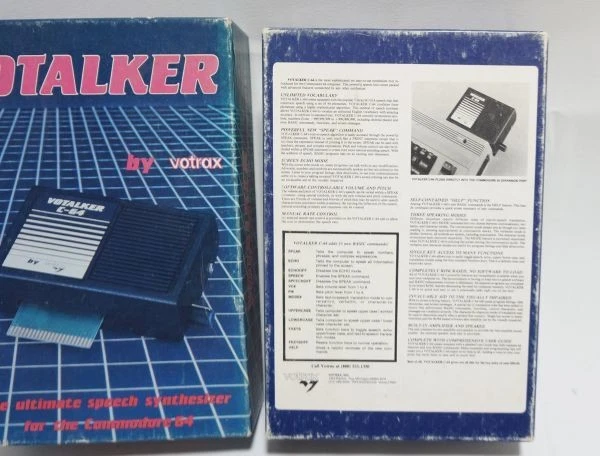
Image gallery
Watch it talk
Votalker C-64 speech demonstration
Hear the Votalker give a Commodore 64 its electronic voice.
Watch on YouTube ↗Find a Votalker C-64 for your collection
Explore eBay listings for Votrax Votalker C-64 cartridges, manuals, and companion software.
Search eBay for Votalker C-64Shopping through this link helps preserve and grow the SpeechChips Museum. If you make a purchase, we may earn a commission that supports the collection.The chip maker’s own voice
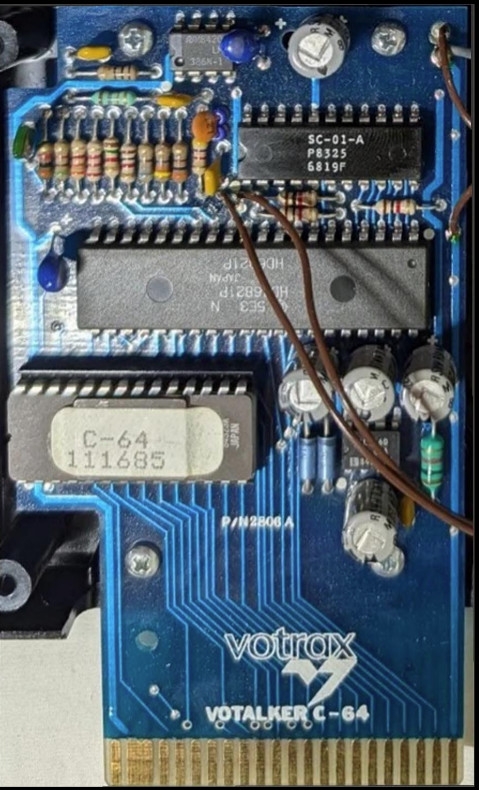
The Votalker C-64 comes directly from Votrax, the company behind the SC-01 and SC-01A speech synthesizer chips. Here, the chip maker brought its own distinctive voice to the Commodore 64 as a complete product, combining the synthesizer with text-to-speech software, BASIC commands, and a built-in speaker.
A voice ready when the computer starts
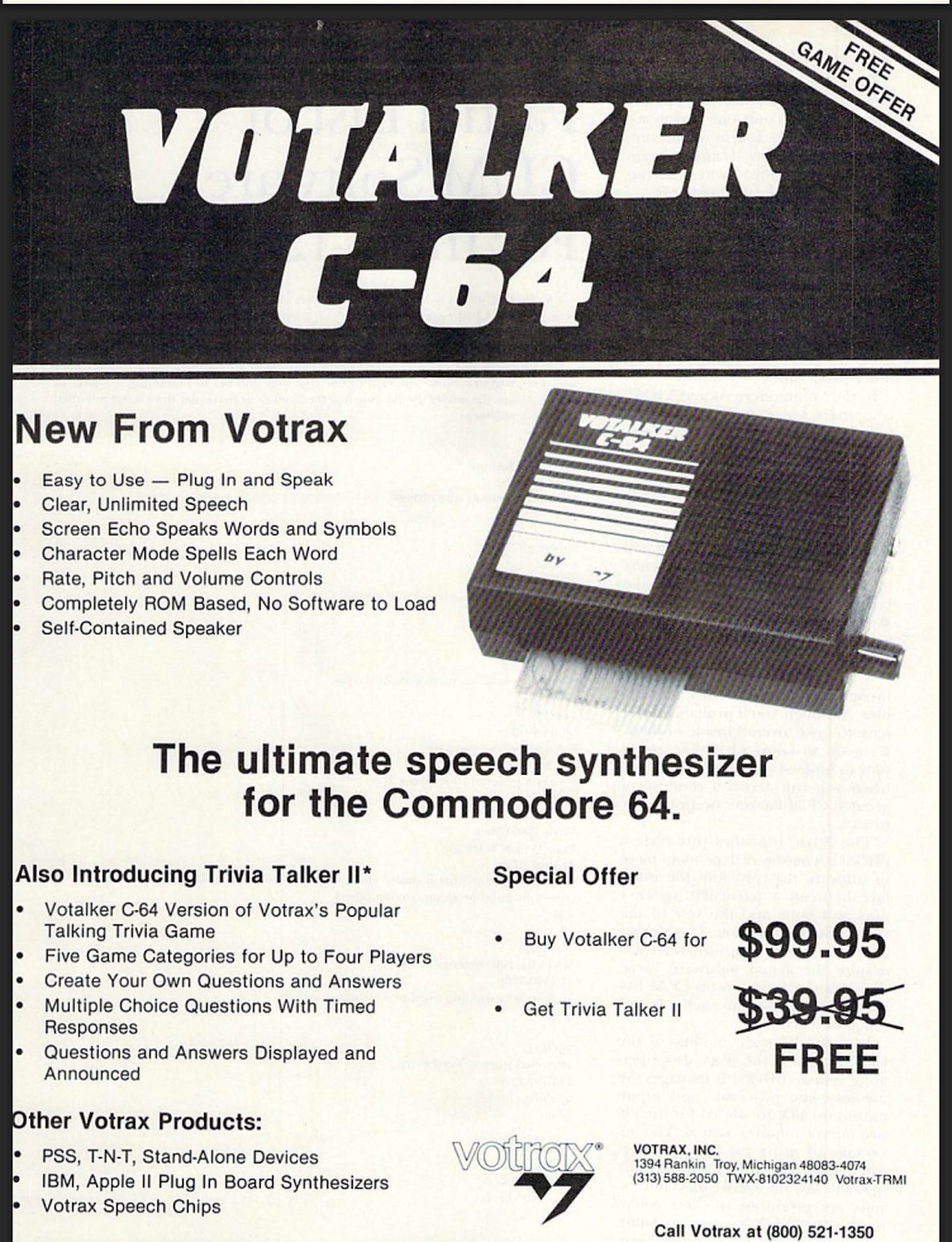
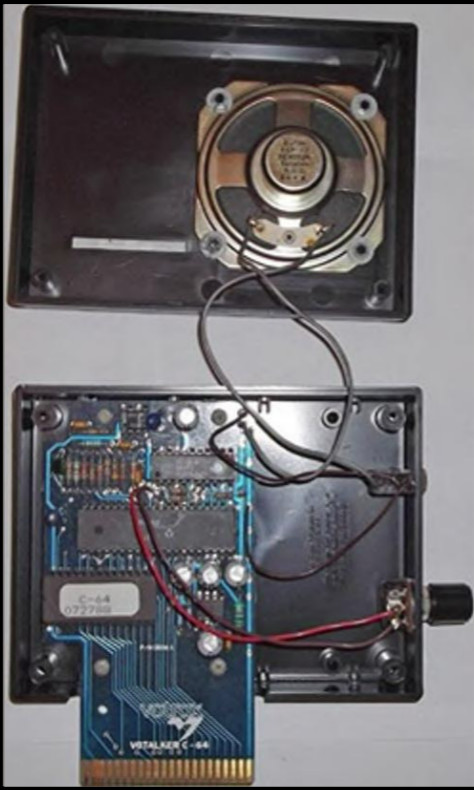
The Votalker C-64 brings Votrax speech to the Commodore 64 in a plug-in module with its own amplifier and speaker. Its speech software is held in ROM, so the basic talking functions are available without loading a program from disk or tape. Votrax was advertising the unit by November 1985, presenting it as a ready-to-use way to give an ordinary home computer a voice.
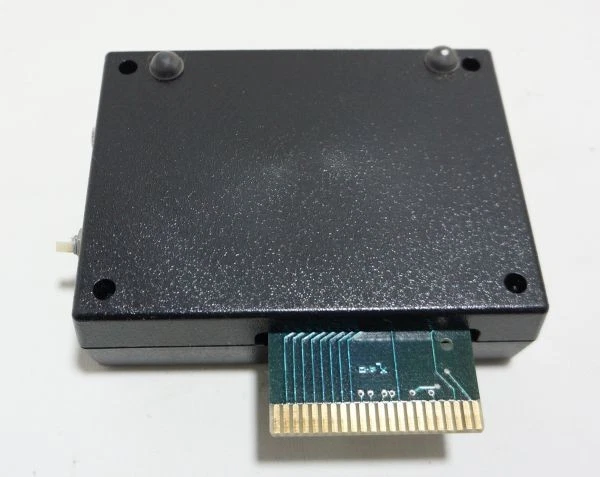
The cartridge combines speech hardware, text conversion, and BASIC extensions in one enclosure. Its external speaker jack provides another way to listen, while the adjustment knob gives the user direct control over the speaking rate.
From written words to electronic speech
Contemporary product descriptions in TPUG Magazine and Modern Electronics identify the speech chip as the Votrax SC-01A. This phoneme synthesizer creates speech from a set of 64 sound codes; it does not contain a collection of recorded words. The cartridge’s text-to-speech software supplies the sound sequences needed to pronounce English text.
The advertised unlimited vocabulary refers to constructing words from those sounds instead of choosing from a fixed word list. It does not guarantee perfect pronunciation: spelling-to-sound rules still have to navigate the irregularities of English. For the experimenter, the attraction is a dedicated electronic voice that can say new things without recording them first.
Three ways to listen
The MODE command selects how text is interpreted. Conversation mode reads words and uses punctuation to shape pauses. Verbatim mode also speaks punctuation and symbols, making the structure of the text audible. Character mode pronounces each character individually.
Those choices make the same hardware useful for different tasks: listening to prose, inspecting a program listing, or checking the exact characters in a name or command. The cartridge turns reading and spelling into distinct listening experiences.
BASIC that speaks
Votrax’s period advertising describes 13 additional BASIC commands. SPEAK works much like PRINT, but sends the result to the voice rather than displaying it. The advertised inputs include phrases, numbers, and expressions, with pitch and volume adjustments available within a SPEAK statement.
HELP displays a summary of the added commands. Function-key shortcuts toggle speech, screen echo, character case, and translation modes, reducing the amount of typing needed to control the voice. These are cartridge-resident facilities; the presence of application disks in a surviving set does not mean a disk is required to activate the basic speech system.
A talking screen and an accessibility tool
With screen echo enabled, text sent to the screen can also be spoken. Period advertising suggested listening to BASIC listings and disk directories, or using communications software as a talking terminal. This can let suitable programs speak without adding speech instructions to every line.
The feature also gave the cartridge a purpose beyond novelty. Contemporary descriptions promoted it for reading and spelling practice and as a talking proofreader for people with visual impairments. Verbatim and character modes could reveal details that ordinary spoken prose leaves out. Compatibility with every program should not be assumed, particularly where software bypasses the normal text-output routines.
Trivia Talker II and the original offer
A November 1985 Votrax advertisement offered the Votalker C-64 for US $99.95 with Trivia Talker II supplied free. The game supported up to four players, five categories, user-created questions and answers, and timed multiple-choice responses, with questions both displayed and announced.
Trivia Talker II was the cartridge-oriented version of Votrax’s talking trivia game. The same advertisement distinguishes it from Trivia Talker I, which used the Commodore 64’s SID chip. That distinction matters when matching surviving software to the speech hardware.
A place among the Commodore voices
The Votalker C-64 belongs alongside Currah Speech 64 and Commodore’s Magic Voice as a different approach to a talking Commodore. Its emphasis is English text conversion and screen echo through a self-contained phoneme-synthesis module. The Votrax family also includes the Votalker IB and Votalker AP for other computer platforms, but their software and interfaces should not be treated as interchangeable with this cartridge.
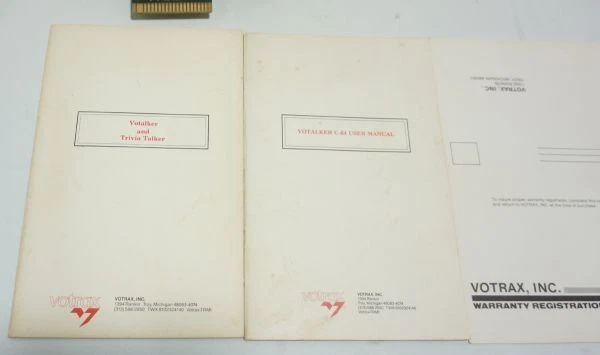
For a collector, the enclosure, original packaging, command documentation, and companion software tell different parts of the story. For a speech-chip enthusiast, the real reward is hearing a programmable Votrax voice respond to the computer’s words.
Hear the Votalker C-64
Votalker C-64 speech demonstration
A sample of the Votalker C-64’s voice.
Specifications
- Manufacturer
- Votrax, Inc., Troy, Michigan
- Computer interface
- Commodore 64 expansion port
- Speech hardware
- SC-01A, as identified in contemporary product descriptions
- Speech method
- Phoneme synthesis with ROM-resident English text-to-speech software
- Speaking modes
- Conversation, verbatim, and character
- Audio
- Built-in amplifier and speaker; external speaker jack
- User controls
- Speech rate, pitch, volume, and screen echo
- Documented availability
- November 1985 advertisement; continuing promotion in 1986
- Original US offer
- $99.95, including a promotional copy of Trivia Talker II
Selected BASIC facilities
| Command | Purpose |
|---|---|
| SPEAK | Vocalizes text, numbers, and expressions. |
| MODE | Selects conversation, verbatim, or character translation. |
| HELP | Displays a summary of the added commands. |
Sources and further reading
- Votrax advertisement and Trivia Talker II offer — RUN, November 1985
- Votalker C-64 announcement, page 42 — TPUG Magazine, November 1985
- Speech Synthesizer for C-64 — Modern Electronics, April 1986
- Votalker features and BASIC controls — Australian Electronics Monthly, August 1986
- Watch a Votalker C-64 demonstration — DTM Music Box Sound Source, 2021
- Boxed Votalker C-64 photographs and included materials — eBay listingShopping through this link helps preserve and grow the SpeechChips Museum. If you make a purchase, we may earn a commission that supports the collection.