GENERAL INSTRUMENT SPEECH PROCESSOR
SP1000
General Instrument’s SP1000 combined real-time LPC speech analysis and synthesis in a 5 V, 28-pin processor peripheral. It produced compact speech features for a host computer to recognize and could synthesize from prepared LPC data.
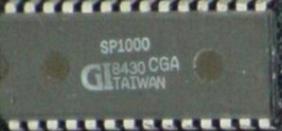
Overview
General Instrument’s SP1000 combined real-time LPC speech analysis and synthesis in a 5 V, 28-pin processor peripheral. It produced compact speech features for a host computer to recognize and could synthesize from prepared LPC data.
Hear an SP1000-based system
Hearsay 1000 voice synthesis and recognition for the C64
At 9:55, the video demonstrates the Hearsay 1000 for Commodore 64. This related system also used the General Instrument SP1000, so its speech output is a listenable example of SP1000-based LPC synthesis. It is not a recording of a LIS’NER 1000.
Video by RetroCombs; linked to the original YouTube upload.
Watch the full Hearsay 1000 video ↗How the analysis works
The LIS’NER 1000 manual gives an audio sampling rate of approximately 6.2–6.5 kHz. The chip calculated eight Linear Predictive Coding (LPC) coefficients plus an energy value for each frame. LIS’NER collected frames every 20 milliseconds—about 50 frames per second—so the host received a compact description of the voice rather than a full waveform recording. The SP1000 used a modified Correlation Cancellation Loop (CCL) in a reconfigurable lattice instead of large matrix calculations. According to the manual, the approach required about 300 bits of working storage, compared with roughly 3,000 bits for conventional covariance or autocorrelation analysis.
Reversible synthesis architecture
The lattice could be reconfigured to run backwards: analysis estimated LPC coefficients from speech, while synthesis used LPC parameters to recreate speech. This made the SP1000 both a speech-analysis front end and an LPC speech engine. Synthesis depended on prepared LPC data; Micromint’s documentation describes a limited demonstration vocabulary and notes that preparing new speech data required specialized processing. The chip did not turn arbitrary text into speech on its own.
Host interface and division of work
The manual identifies a 5 V, 28-pin N-MOS device with an 8-bit bidirectional bus and control lines. It was memory-mapped and occupied four address locations, implemented as three read/write registers and one write-only register. In the LIS’NER 1000, the chip analyzed the microphone signal; Apple II software detected speech and silence, managed templates, and compared the feature frames with words trained for that speaker. The recognition decision therefore belonged to the host software, not to the SP1000 alone.
SP1000 and SP0256 are different tools
The SP1000’s reversible LPC analysis/synthesis peripheral is distinct from the SP0256 family of speech synthesizers, whose chips played encoded speech for specific variants. The SP1000 needed an external processor for control and recognition software, while the SP0256 family is associated chiefly with speech playback.
A documented SP1000 system
Micromint’s LIS’NER 1000 used the SP1000 to analyze speech; the Apple II performed training and word matching.
Further references
- Micromint, LIS’NER 1000 User & Assembly Manual, Apple Version, Rev. 2.0 (1984), SP1000 description and interface
- Steve Ciarcia, “The Lis’ner 1000,” BYTE, November 1984
- TU Eindhoven thesis bibliography listing General Instrument SP1000 datasheets, speaker-dependent recognition document, and AN-0504 application note
- Smithsonian, LIS’NER 1000 board record and photograph (image reuse terms apply)